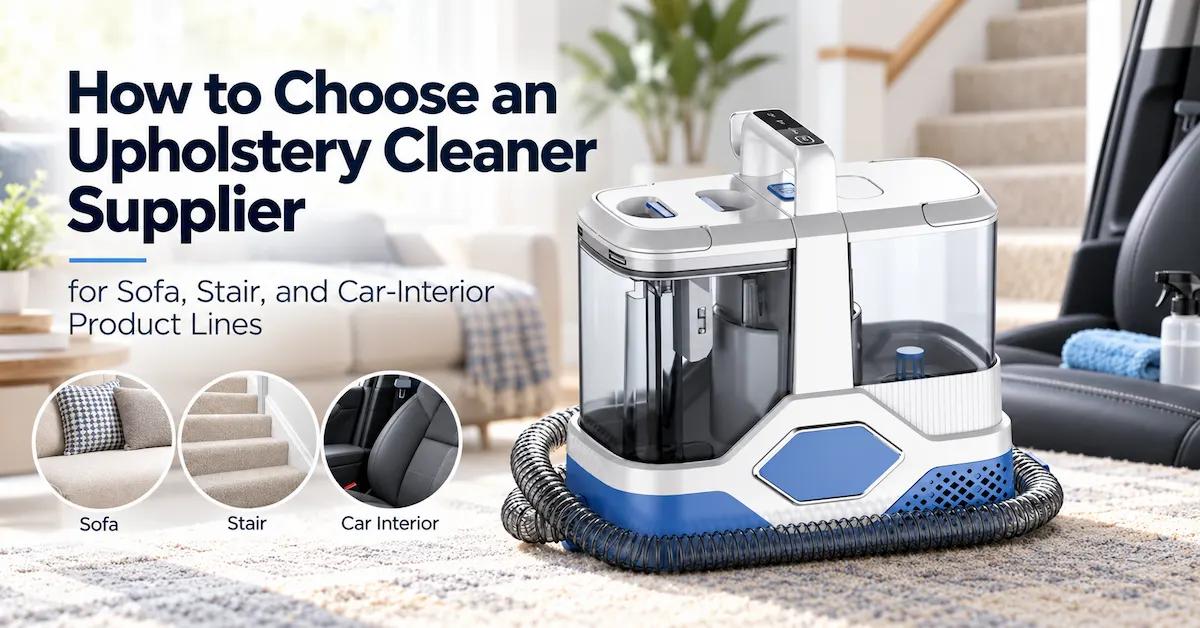
What Should Buyers Confirm First With an Upholstery Cleaner Supplier?
Before comparing prices, an upholstery cleaner supplier should establish how the selected machine cleans. Does it vacuum dry dust and loose debris? Does it dispense cleaning liquid and recover dirty water? Does it support both methods? Those are different product promises, and they require different components, sample tests, maintenance instructions, and customer-facing claims.
This distinction is especially important for the Anbolife Portable Upholstery Cleaner with up to 18kPa suction. Its product title positions it for sofas and carpets, while the published description discusses vacuuming dust, dirt, and loose debris. The page does not clearly confirm liquid dispensing, separate clean- and dirty-water tanks, or wet stain extraction for the exact listed configuration.
That does not mean the machine lacks those functions. It means a buyer should request a model-specific specification and working demonstration before claiming them. A retailer that markets a dry-use vacuum as a wet spot extractor risks returns and dissatisfied customers. A distributor that rejects a suitable wet-cleaning configuration because of incomplete online copy could miss a product opportunity. The solution is the same in both cases: define the intended job and verify the actual model.
For professional buyers, supplier selection should cover five connected decisions:
- The target fabrics, soils, and cleaning tasks.
- The precise cleaning method and included tools.
- Measured performance under repeatable sample conditions.
- Electrical, safety, packaging, and after-sales requirements.
- Whether the supplier can reproduce the approved configuration across orders.
A useful quotation should answer these questions rather than provide only a unit price and an attractive suction figure.
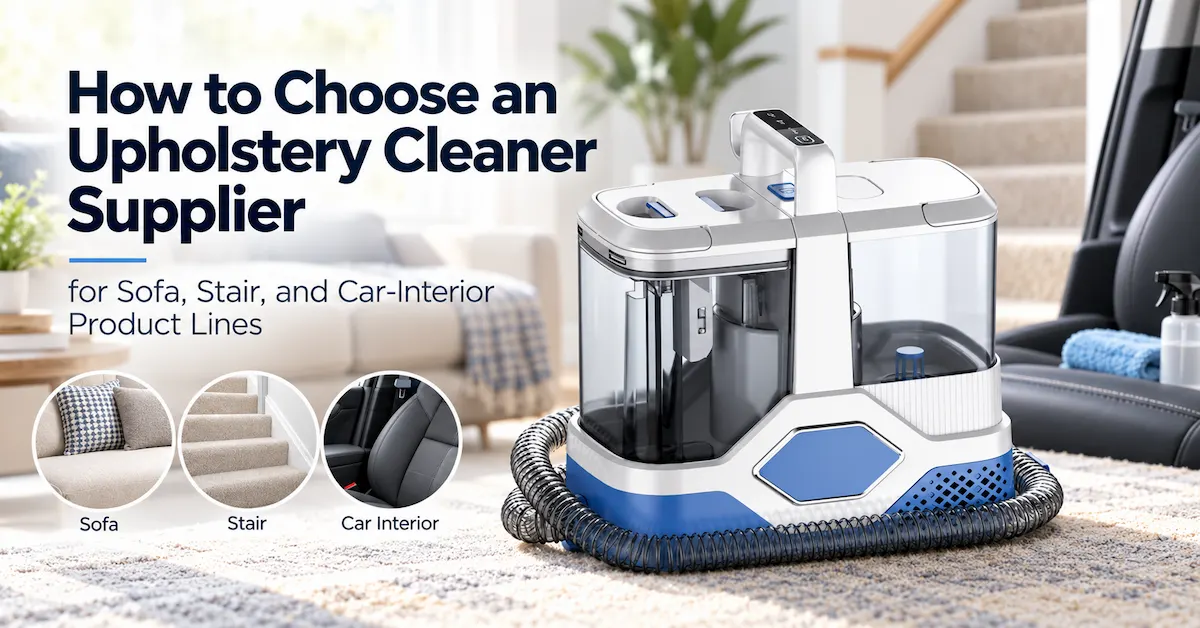
Dry Vacuuming and Wet Spot Extraction Are Different Product Categories
The term “upholstery cleaner” can describe several types of appliances. A dry vacuum attachment removes loose material from a fabric surface. A wet spot extractor applies liquid, agitates or works the area according to its design, and recovers moisture and suspended soil. Some machines may combine functions, but that capability must be confirmed for the selected configuration.
The Anbolife carpet-cleaner category guide tells sourcing teams to distinguish portable spot extraction from full-area carpet cleaning. It also advises buyers to confirm the selected model’s cleaning method, tools, hose reach, tanks, instructions, and sample results.
| Intended product | What the buyer should verify | Suitable evaluation |
|---|---|---|
| Dry upholstery vacuum | Pickup of loose dust, crumbs, hair, and debris; tool access; filtration | Controlled debris pickup on compatible fabric |
| Portable wet spot extractor | Liquid application, dirty-water recovery, tank design, hose cleaning | Controlled stain and moisture-recovery tests |
| Full-area carpet cleaner | Floor coverage, movement, tank capacity, repeated passes | Larger-area carpet tests |
| Multi-purpose cleaner | Each advertised mode and the parts required for it | Separate tests for every claimed function |
These categories can serve different customers. A furniture-care retailer may want a compact sofa and stair spot cleaner. A home-appliance distributor may need a dry vacuum with upholstery accessories. A vehicle-detailing supplier may focus on access to narrow seating areas and manageable hose length. The buyer’s specification should reflect that difference.
Do Not Infer Wet Cleaning From a Product Name
A product title, image, or category placement is not enough to prove water spraying, heated cleaning, steam generation, or dirty-water recovery. Ask the supplier for a current technical sheet identifying the fluid path, tank arrangement, compatible solutions, and cleaning procedure if wet extraction is required.
Likewise, do not assume that a product described as an upholstery cleaner is safe for every fabric. Care instructions vary by material, dye, backing, and finish. The appliance manual and the furniture manufacturer’s care guidance should both be considered.
What Is Confirmed About the Anbolife Reference Product?
The Anbolife product page describes a portable cleaner positioned for upholstery, sofas, and carpets. It states up to 18kPa of suction power and describes a powerful motor for routine cleaning. Its detailed body copy emphasizes pickup of dust, dirt, and loose debris on suitable surfaces. It also positions the product for household use and selected professional cleaning applications, subject to the final configuration.
The listing does not publish a complete specification for the exact model. It does not clearly establish the rated power, voltage, airflow, noise level, tank arrangement, hose length, accessory set, cleaning-fluid compatibility, dimensions, weight, or wet-extraction method. Multiple variant identifiers appear on the page, but their functional differences are not explained in the public copy.
A buyer should therefore treat the page as a product lead, not an approved sales specification.
| Specification area | Publicly described | What the buyer must confirm |
|---|---|---|
| Product positioning | Portable upholstery and carpet cleaner | Exact model and intended cleaning tasks |
| Suction | Up to 18kPa | Measurement point, method, operating condition, and variant |
| Motor | Described as powerful | Rated input, duty expectations, and test method |
| Debris pickup | Dust, dirt, and loose debris | Suitable surfaces and tool configuration |
| Wet extraction | Not clearly established in the product description | Spray, tanks, recovery path, and approved solutions |
| Accessories | Dependent on configuration | Included tools, brush type, and hose |
| Electrical version | Not specified on the page | Voltage, frequency, plug, cord, and labels |
| Size and weight | Not specified on the page | Product and carton dimensions |
| OEM/ODM | Potential cooperation discussed | Actual scope, MOQ, samples, and cost |
The confirmed 18kPa figure is worth evaluating, but it should not replace a real cleaning test.
Why Suction Alone Does Not Prove Cleaning Performance
Suction pressure is one part of a cleaning system. It does not by itself establish how well a tool removes debris from textured upholstery or how much liquid a wet extractor can recover from a cushion. Nozzle design, airflow, contact with the surface, hose restrictions, seals, filters, and user technique also influence the result.
The phrase “up to 18kPa” should prompt precise questions:
- Where was the pressure measured?
- Was the measurement taken at the motor, hose end, or working tool?
- Was the nozzle sealed during measurement?
- Were the filter and collection system installed?
- Was the machine new and clean?
- Which electrical version and variant were tested?
- Is the result a peak value or a sustained operating value?
- How does performance change as the collection container fills or the filter loads?
Do not compare two suppliers solely by their advertised kPa values if their test methods are unknown. A lower advertised number measured at a working tool and a higher number measured near a motor are not automatically comparable.
For Dry Pickup, Test the Surface and Tool
Use representative upholstery materials and defined debris types. The buyer might evaluate fine dust, crumbs, and loose fibers where the product instructions permit. Apply the same amount of debris to comparable fabric samples, use the approved tool, and document the number of passes and visible residue.
The test should also assess whether the tool pulls excessively on a delicate material, snags loops, pushes debris into seams, or loses pickup when used at a realistic angle.
For Wet Extraction, Measure More Than Visible Stain Removal
If the chosen variant supports wet spot extraction, evaluate liquid delivery, agitation where applicable, dirty-water recovery, remaining moisture, and the final appearance after drying. A fabric can look clean while retaining too much moisture. Conversely, a stain may persist because the chemistry or fabric is unsuitable, even if the recovery system operates as designed.
Do not publish a universal “removes all stains” claim. The result depends on fabric, stain age, treatment, solution, application method, and drying conditions. Use approved recipes and care instructions in every test.
Map the Product to the Right Customers
Home-Appliance Importers
Importers need clear product identity, destination-market electrical configuration, packaging protection, documentation, a service plan, and predictable repeat production. A portable cleaner can serve home-care product lines, but the importer should decide whether it is selling a dry upholstery vacuum, a wet spot cleaner, or a verified combination.
That decision determines the retail title, shelf comparison, warranty support, and likely customer questions. It also determines which competing products are commercially relevant. A wet extractor should not be priced or compared as though it were only a dry handheld vacuum.
Private-Label Cleaning Brands
A private-label brand may want a distinctive housing color, logo, accessory set, packaging, and user manual. The brand should also specify its central promise: pet-related debris pickup, sofa maintenance, stair cleaning, vehicle interiors, or verified spot extraction.
The product promise must match the machine. A claim about removing pet stains is not supported merely by a suction rating. If stain removal is essential to the brand, verify wet-cleaning capability, approved solutions, stain tests, and fabric precautions first.
Retail Chains and E-Commerce Sellers
Retail buyers need a product that customers can understand quickly. A listing should answer what the appliance cleans, whether it uses water, what accessories are included, how heavy it is, how far the hose reaches, and how it is cleaned after use.
Online returns frequently arise from a gap between customer expectations and delivered functionality. A clear comparison graphic distinguishing “dry pickup” from “wet spot extraction” can be more valuable than a broad claim such as “deep clean every surface.”
Vehicle-Care Distributors
Vehicle seats, carpets, mats, and narrow cabin spaces create a specific ergonomic test. A buyer should evaluate hose flexibility, tool width, carrying method, cord reach, and access around seat edges. If the product uses liquid, the buyer must also examine water containment, drying time, and compatibility with the relevant vehicle fabrics.
These are evaluation criteria, not confirmed features of the Anbolife model. Request the actual accessory list and test the exact variant intended for sale.
Cleaning-Service and Hospitality Suppliers
Professional operators may need repeated use, faster setup, and readily available replacement parts. Before recommending the unit for this channel, confirm its intended operating environment and duty expectations. “Selected professional applications” on a product page does not establish continuous commercial-duty performance.
A service buyer should test transport between rooms, hose handling, emptying, maintenance, and operation across several representative jobs. The cost of staff time may matter as much as the appliance price.
Application and Fabric Suitability
An upholstery product is often considered for sofas, armchairs, dining chairs, stairs, area rugs, mattresses, vehicle seats, and other soft furnishings. These applications are not interchangeable. Each has different access, fabric construction, soil type, and drying requirements.
Sofas and Armchairs
The tool must reach cushions, arms, seams, and edges without making the user hold the base unit awkwardly. If wet cleaning is part of the product configuration, assess whether moisture penetrates cushion layers and whether the manual explains appropriate use and drying.
Stairs and Carpeted Edges
A portable body may make stairs easier to approach than a full-size floor cleaner, but actual ease of use depends on weight, handle design, hose reach, cord length, and stability on a step. None of those values should be assumed from the word “portable.”
Car Interiors
Narrow upholstery tools can help reach seat contours, but tool shape and hose flexibility must be tested. Check how easily debris or recovered water is emptied without spilling inside a vehicle.
Delicate and Restricted Fabrics
A cleaning machine should not be promoted as safe for all textiles. Buyers should require instructions telling users to check the fabric manufacturer’s care guidance and test an inconspicuous area where appropriate. If liquid cleaning is involved, fabric backing, dyes, adhesives, and drying conditions can affect the result.
For a private-label brand, this guidance belongs in the manual and customer-support scripts, not only in a small disclaimer on the website.
A Practical Sample-Test Plan for Upholstery Cleaners
A production-representative sample should be tested against written acceptance criteria. The plan should separate confirmed functions from proposed ones and use the target market’s real cleaning tasks.
Stage 1: Identify the Variant
Record the exact model and variant identifier, voltage, plug, accessories, motor rating, hose and cord specifications, filtration arrangement, tank configuration if present, and packaging contents. Photograph every component.
If the supplier provides multiple variants, do not assume they all share the same 18kPa claim, tools, or cleaning method. Request a variant comparison sheet.
Stage 2: Inspect Build and Ergonomics
Check the handle, housing fit, switches, cable entry, hose connections, tool attachment, collection-bin or tank closure, wheels or feet where applicable, and carrying balance. Evaluate whether a user can set the machine down safely while working on a sofa or stair.
Record the actual weight and dimensions of the approved sample. A product may be compact in photographs yet inconvenient to carry during a full cleaning session.
Stage 3: Test Dry Pickup
Use consistent fabric swatches and measured debris where the instructions allow. Keep the same tool, pass count, angle, and preparation method across samples. Record visible residue and any material snagging or damage.
A useful test includes seams and corners, not just a flat open surface. Customers often purchase an upholstery cleaner because ordinary floor tools do not reach those areas well.
Stage 4: Test Wet Cleaning Only If Confirmed
If the selected variant is documented as a wet spot extractor, follow the manual to fill, apply, and recover liquid. Use controlled stain samples and approved cleaning solution. Record the amount applied and recovered, visible staining before and after drying, remaining moisture, leaks, and cleaning of the hose and tool.
If the variant is not approved for liquid use, do not perform a water test. Applying liquid to a dry-only appliance can damage it and create an electrical hazard.
Stage 5: Assess Repeated Use
Test realistic sessions rather than a brief power-on demonstration. Observe suction at the working tool, motor sound, heat, hose attachment, filter loading, and ease of emptying. For a wet-capable model, include multiple fill and recovery cycles if the intended user would perform them.
The supplier and buyer should agree on the test duration and conditions. This avoids converting a single peak suction number into an unsupported continuous-performance claim.
Stage 6: Clean and Store the Machine
Ask a new user to complete the maintenance procedure using only the supplied manual. Record the time, tools, access to filters or tanks, drying steps, and whether residue remains in a hose or brush.
A machine can clean a sofa effectively yet still create negative reviews if customers find it unpleasant or confusing to clean the appliance afterward.
Stage 7: Test the Customer Package
Unpack a retail-ready sample. Confirm all accessories, labels, manuals, and protective parts. Check whether vulnerable hose connections, transparent tanks, and finished housing surfaces are protected from shipping damage.
Save the approved physical sample or a controlled record with specification, photographs, test results, artwork revision, and packaging files.
Cleaning and Maintenance Questions That Affect Returns
Maintenance is part of the product’s value proposition. A buyer should understand how the user empties collected debris, cleans filters, clears the tool, washes any tank, and stores the hose and cord.
Ask the supplier:
- Which components are removable?
- Which parts may be washed?
- Must filters be fully dry before reinstallation?
- Are replacement filters available?
- How are blockages identified and cleared?
- If wet extraction is supported, how is the dirty-water path cleaned?
- Which cleaning solutions are approved?
- What should users do after accidental overfill or a leak?
- Which parts wear out during normal use?
- Are parts interchangeable across variants?
The answers should appear consistently in the user manual, support materials, and spare-parts list. Do not describe parts as washable, dishwasher-safe, or replaceable until the exact configuration confirms it.
Quality Control and Model-Specific Documentation
Anbolife describes its general quality path as incoming review, production-stage inspection, applicable safety checks, and document verification on its Quality and Certifications page. For a specific upholstery-cleaner project, buyers should request an inspection plan tied to the approved variant.
Relevant checks may include:
- Motor and electrical-component identification.
- Housing and hose assembly.
- Tool fit and attachment retention.
- Collection-system seals.
- Suction or functional testing under the agreed method.
- Leakage checks if the model handles liquid.
- Appearance and printing inspection.
- Accessory count and packing verification.
- Product label and electrical-version checks.
A certificate or report should be checked for the exact model, electrical version, relevant scope, issuing organization, and validity. A document for an unrelated appliance does not demonstrate compliance for this cleaner.
Clarify the Scope of the 18kPa Claim
If “up to 18kPa” will appear on packaging, agree on how the claim is verified during development and production. It may not be practical to measure every unit using the same laboratory setup, but the supplier should explain the approved type test and the production checks used to maintain consistency.
A brand should also decide whether the claim needs a qualification in its market. Do not convert “up to 18kPa suction” into “18kPa at the upholstery tool throughout use” without evidence.
OEM and ODM Development for a Cleaning-Appliance Brand
The Anbolife OEM/ODM page describes two starting routes. OEM projects begin with buyer-defined drawings, specifications, or quality requirements. ODM projects begin with an existing product direction and review suitable changes for the target market.
ODM From an Existing Cleaner Platform
An ODM discussion may cover logo placement, housing color, packaging, manuals, labels, electrical configuration, and selected accessories. Each change should be confirmed for the exact model and order plan.
Accessory selection can materially change the product’s usefulness. A wide surface tool, narrow crevice tool, or upholstery brush serves a different task. The buyer should specify which tools are included in the standard carton and which are optional, then test the quoted set.
OEM for a Defined Cleaning Workflow
A buyer with its own technical brief may define the cleaning method, user journey, accessory geometry, hose management, tank arrangement, control location, appearance, and inspection standard. Engineering review should take place before the supplier promises a sample or launch date.
For a wet-extraction project, the brief should specify liquid delivery, recovery, sealing, tank emptying, and cleaning. For a dry vacuum project, it should focus on pickup, filtration, tool access, and debris disposal. Combining both sets of requirements without a clear product architecture can create scope and cost problems.
Protect the Approved Configuration
The purchasing specification should identify the model, variant, motor and electrical version, tools, hose, filters, tanks if any, materials, logo, packaging, manual, testing method, and change-control process.
If a component changes between orders, the supplier should notify the buyer and evaluate whether performance, documents, packaging claims, or spare-parts compatibility are affected.
Total Cost of Ownership for Wholesale Buyers
The factory price is only one part of the purchasing decision. An importer or private-label brand should calculate the cost of putting a reliable product into customers’ hands and supporting it after sale.
| Cost area | What to include |
|---|---|
| 产品 | Exact variant, electrical version, tools, and accessories |
| Development | Samples, molds, artwork, and configuration changes |
| Documentation | Testing, manuals, labels, and market requirements |
| Packaging | Retail box, export protection, and parcel handling |
| Freight | Final carton dimensions, weight, and shipment plan |
| Inspection | Factory and third-party checks |
| After-sales | Filters, hoses, tools, tanks, warranty labor, and returns |
| Customer education | Product content, cleaning instructions, and support materials |
A lower-priced cleaner can become expensive if it arrives with weak hose fittings, unclear instructions, missing accessories, or poorly protected packaging. A more expensive configuration may be commercially justified if its tools solve the target cleaning task and its maintenance process is easier for users.
Compare quotations only after normalizing the configuration. One offer may include several tools and a retail carton; another may quote the base unit alone.
MOQ, Lead Time, and Logistics
The public Anbolife product page does not establish a universal MOQ, sample lead time, mass-production lead time, carton size, or loading quantity for this cleaner. These values should be requested for the specific variant and customization scope.
A project timeline should show separate milestones for technical confirmation, sample preparation, cleaning tests, artwork, market documentation, pre-production approval, mass production, inspection, and shipment readiness.
Ask whether a custom hose, tool, color, or packaging format changes the MOQ or schedule. A buyer should not assume that a logo-only order and a redesigned wet-extraction system follow the same development path.
For e-commerce, review individual parcel protection. For wholesale distribution, examine master-carton strength, pallet planning, barcode placement, and warehouse handling. A long hose or multiple accessories can affect the box dimensions more than the main unit does.
Common Mistakes When Sourcing an Upholstery Cleaner
Mistake 1: Confusing Dry Pickup With Wet Stain Extraction
The product title may suggest broad upholstery cleaning, while the detailed text emphasizes dust and debris. Request a working demonstration and written cleaning-method specification before approving claims.
Mistake 2: Buying on Suction Pressure Alone
An “up to” kPa figure does not describe tool design, airflow, fabric contact, or moisture recovery. Test the actual task with the supplied accessories.
Mistake 3: Promising Universal Fabric Compatibility
Different fabrics and finishes have different care requirements. Provide fabric-care precautions and avoid “safe for all upholstery” language unless supported by a defined scope.
Mistake 4: Using a Stain Demonstration Without a Test Method
A fresh, easy-to-remove stain on a selected fabric does not predict every household result. Record stain type, age, fabric, solution, passes, drying, and final appearance.
Mistake 5: Ignoring After-Use Cleaning
Filters, tools, tanks, and hoses may need regular maintenance. Poor access can create odor, reduced performance, or customer complaints.
Mistake 6: Treating All Variants as Identical
The product page displays multiple variant identifiers. Ask for a comparison sheet before transferring specifications or photos from one variant to another.
Mistake 7: Publishing Unconfirmed Electrical or Compliance Claims
Confirm rated power, voltage, plug, labels, and applicable test documents for the destination market and exact production version.
A Buyer Scorecard for Supplier Selection
A purchasing team can use a weighted scorecard to compare suppliers without allowing a low price to hide a critical product mismatch.
| Decision area | Evidence to request | Approval question |
|---|---|---|
| Cleaning method | Specification and live demonstration | Does it perform the task being advertised? |
| Surface performance | Controlled fabric tests | Does it work on the target applications? |
| Suction claim | Test method and measurement point | Is the published figure supportable? |
| Maintenance | Manual and observed cleaning process | Can users keep it functioning correctly? |
| Electrical and compliance | Model-specific documents | Is the version suitable for the market? |
| OEM/ODM | Confirmed customization scope | Can the brand promise be reproduced? |
| Commercial terms | Itemized quotation and timeline | Does the total cost support the channel? |
| After-sales | Parts and defect process | Can failures be handled efficiently? |
Market compliance and core cleaning-method fit should be treated as approval gates. A supplier cannot compensate for the wrong product type with an attractive price.
What to Include in a High-Quality Inquiry
A focused inquiry helps an upholstery cleaner supplier recommend the right variant and issue a comparable quotation. Through the Anbolife contact page, provide:
- Destination country
- Sales channel and customer group
- Dry pickup, wet spot extraction, or both
- Target surfaces and fabrics
- Typical soils or stains
- Expected use frequency
- Reference product and desired variant
- Required voltage and plug
- Tool, hose, and accessory requirements
- Branding and packaging needs
- Expected first order and annual volume
- Required reports and manual languages
- Sample-test plan
- Spare-parts and warranty expectations
- Target launch schedule
A useful initial request might say: “We are evaluating a portable upholstery cleaner for sofas and vehicle interiors in our retail market. Please confirm whether the quoted variant is dry-only or supports liquid spray and recovery. Send the current specification, 18kPa test method, included tools, hose and tank details, electrical versions, sample terms, private-label MOQ, packaging options, model-specific documents, and lead-time milestones.”
That message is much more likely to produce a meaningful technical answer than “Please quote your best upholstery cleaner.”
Frequently Asked Questions
Does Anbolife list a portable upholstery cleaner?
Yes. Its product page lists a portable cleaner titled for sofas and carpets, with up to 18kPa suction. Buyers should confirm the exact variant, cleaning method, accessories, electrical specification, and intended applications before ordering.
Is the listed product a wet spot extractor?
The public product description does not clearly confirm liquid dispensing, separate clean- and dirty-water tanks, or wet recovery for the exact listed configuration. Request a model-specific specification and demonstration before making wet-extraction claims.
What does 18kPa suction mean?
It is a stated suction-pressure figure. Its commercial meaning depends on the measurement method, location, operating conditions, and product variant. It does not by itself establish stain removal or water-recovery performance.
Can the machine clean sofas and carpets?
The product title positions it for sofas and carpets, but the appropriate cleaning task and fabric depend on the actual configuration, supplied tools, and instructions. Test the target surfaces before publishing a detailed application claim.
Can it be used on vehicle interiors?
Vehicle interiors are a potential sourcing application for portable cleaners. Confirm tool access, hose reach, fabric suitability, cleaning method, and the exact variant’s intended use. Do not assume an accessory is included.
Does it have clean- and dirty-water tanks?
The product page does not clearly specify tank arrangements. The category guide advises buyers to compare them for wet-cleaning models, but that guidance does not confirm that every listed product has tanks.
Is it suitable for professional cleaning companies?
The page mentions selected professional applications, subject to product specifications. Confirm operating frequency, duty expectations, maintenance, parts, and warranty terms for the planned environment before describing it as commercial-duty equipment.
Can I add my brand logo and packaging?
Potential OEM/ODM cooperation is described on the site. Available logo, color, accessory, packaging, and manual options should be confirmed for the model and order quantity.
What documents should an importer request?
Request the exact model specification, electrical and safety documents applicable to the destination market, user manual, label artwork, inspection criteria, packaging specification, and claim-support information such as the suction test method.
How should I compare two suppliers?
Use the same cleaning-method brief, target fabrics, accessory list, electrical version, sample tests, packaging standard, and after-sales requirements. Then compare verified performance and total landed cost, not just advertised kPa and unit price.
What is the MOQ for a private-label order?
The public page does not state a universal MOQ. Ask for a written quotation covering the selected variant and the specific logo, color, packaging, and accessory changes requested.
What should be approved before mass production?
Approve the physical sample, cleaning-method specification, variant, performance tests, tools, hose, filters and tanks if applicable, electrical version, artwork, manual, packaging, inspection plan, price, and delivery milestones.
Conclusion
Selecting an upholstery cleaner supplier starts with a clear product definition. Buyers must establish whether the chosen variant is intended for dry debris pickup, wet spot extraction, or both. Only then can they evaluate the 18kPa suction claim, tools, fabric performance, maintenance, electrical configuration, documentation, and commercial terms against the right customer need.
The Anbolife Portable Upholstery Cleaner offers a relevant starting point for sofa- and carpet-cleaning product discussions, but its published copy does not resolve every functional detail. Request the exact variant’s specification and test a production-representative sample before making wet-cleaning, stain-removal, or professional-duty claims.
Importers, distributors, and private-label brands can review the carpet-cleaner product category, discuss the OEM/ODM process, and send a detailed brief through the contact page. Specify the cleaning method, target surfaces, accessories, market, order volume, and sample criteria to turn a general inquiry into a verifiable product proposal.