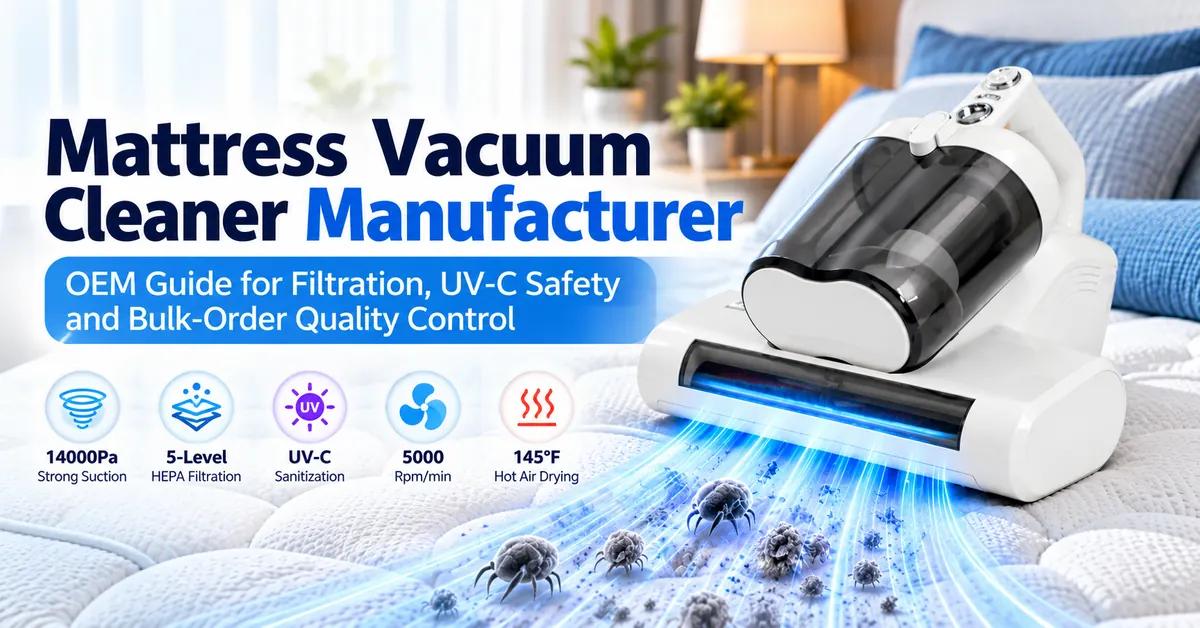
Selecting a reliable mattress vacuum cleaner manufacturer is not simply a matter of finding the lowest factory quotation or the highest advertised suction rating. For importers, private-label appliance brands, retailers, and distributors, the real challenge is sourcing a handheld cleaning appliance that delivers consistent fabric-surface cleaning, controlled dust collection, practical maintenance, verified safety, and dependable manufacturing quality.
Mattress vacuum cleaners are designed for cleaning mattresses, beds, sofas, pillows, and other compatible upholstered surfaces. Unlike conventional floor vacuums, they focus on fabric contact, compact handling, dust extraction, and, depending on the model, dedicated brush systems or additional cleaning technologies.
For a successful OEM or wholesale project, buyers should evaluate five essential factors: actual cleaning performance, filtration integrity, brush and housing construction, safety and regulatory documentation, and the manufacturer's ability to reproduce the approved sample consistently.
AMBOLIFE offers a portable handheld mattress vacuum cleaner within its household appliance portfolio. The product is positioned for mattress and upholstery cleaning, with OEM/ODM opportunities for international sourcing projects. Specific suction ratings, filtration configurations, UV-C functionality, and electrical specifications require confirmation for the selected production version.
This guide explains how B2B buyers can evaluate those requirements, identify common sourcing risks, and develop a private-label mattress cleaning appliance program with clearer technical and commercial expectations.
1. What Is a Mattress Vacuum Cleaner, and Why Does Manufacturer Selection Matter?
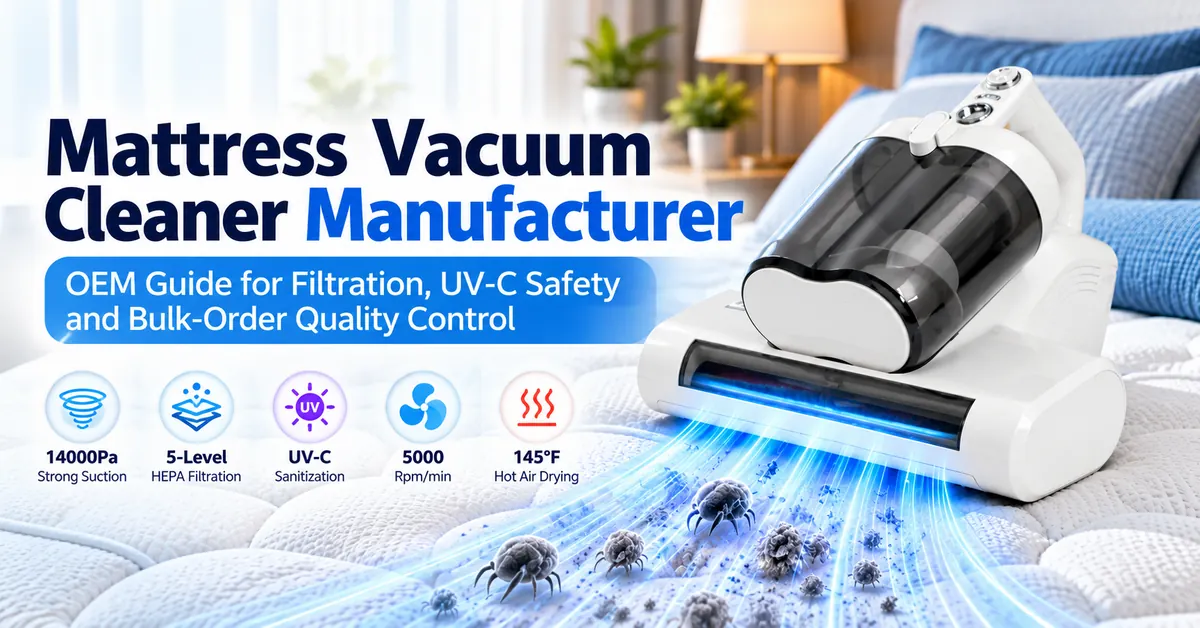
A mattress vacuum cleaner is a compact surface-cleaning appliance intended to remove loose dust, particles, fibers, and other removable debris from mattresses and compatible upholstered materials.
Its design is usually different from a general-purpose vacuum cleaner in several important ways.
First, the cleaning head must remain in effective contact with a soft, sometimes uneven fabric surface. Second, the appliance should be comfortable to move repeatedly over a mattress. Third, the filtration and dust-container system must prevent excessive particle release during operation and emptying.
Some product designs also incorporate motorized brush rollers, vibration or tapping mechanisms, ultraviolet-light components, or additional filtering stages. However, these functions should never be assumed to be present without a verified product specification.
For wholesale buyers, manufacturer selection directly affects the customer experience after the product reaches the market.
An appliance may appear attractive in promotional photographs but create problems when users discover that its suction decreases rapidly, its brush catches delicate fabric, or its dust cup is difficult to clean.
For private-label brands, these weaknesses can lead to negative reviews, higher warranty expenses, replacement requests, and additional customer-service costs.
A capable mattress vacuum cleaner supplier should therefore support more than product availability. The buyer should expect transparent specifications, sample testing, appropriate documentation, quality inspection, packaging coordination, and an agreed process for repeat orders.
2. Who Should Source Mattress Vacuum Cleaners from a Manufacturer?
Mattress cleaning appliances serve several distribution channels, but each customer segment has different product expectations.
| B2B customer segment | Primary purchasing needs | Important selection priorities |
|---|---|---|
| Private-label home-care brands | Branded products and differentiated retail positioning | Appearance, functions, packaging, verified product claims |
| Household appliance importers | Market-ready products for multiple retail channels | Compliance documents, pricing, electrical configuration |
| Cleaning appliance wholesalers | Repeat supply and broad distribution | Product consistency, cartons, spare parts, commercial terms |
| Online marketplace brands | Clear product benefits and manageable after-sales risk | Demonstrable performance, packaging protection, customer instructions |
| Department stores and retail chains | Reliable merchandise with strong consumer presentation | Quality inspection, product safety, packaging and warranties |
| Regional distributors | Stable product configurations and local-market suitability | Electrical requirements, documentation, replenishment |
| Sourcing agencies | Accurate comparison of multiple factories | Technical specifications, samples, factory processes |
| Hospitality equipment suppliers | Appropriate equipment for bedding and upholstery maintenance | Durability, ease of use and confirmed application suitability |
Private-Label Brands
Private-label brands usually need an appliance that can be differentiated from competing retail products.
This may involve an approved logo, housing color, packaging design, product instructions, or selected functional configurations.
However, the brand should prioritize features that can be demonstrated and supported by technical evidence rather than relying on aggressive or unverified cleaning claims.
Importers and Distributors
Importers focus on whether the product can be sold legally and supported reliably in their destination market.
They should pay particular attention to electrical ratings, plug types, product identification, applicable safety documentation, packaging information, and replacement-part arrangements.
E-Commerce Sellers
E-commerce customers often compare products using photographs, videos, feature tables, and product reviews.
A visible dust-collection system, manageable appliance weight, understandable controls, and clear maintenance instructions may create meaningful sales advantages.
However, marketplace listings should only describe features supported by the actual production model.
Best-fit applications: Household mattress cleaning, domestic upholstery maintenance, and compatible fabric-surface care.
Applications requiring additional verification: Intensive hotel housekeeping, specialist hygiene services, clinical environments, and other high-frequency or regulated uses. A household mattress vacuum should not automatically be described as commercial-duty or medical-grade equipment.
3. ANBOLIFE Mattress Vacuum Cleaner: Product Positioning and Available Specifications
ANBOLIFE's current Vacuum Cleaners product category includes a portable handheld mattress vacuum cleaner intended for domestic fabric-surface maintenance.
Its published product information identifies a compact handheld format and applications involving mattresses, beds, sofas, pillows, and other compatible upholstery.
For international buyers, this provides an initial product direction rather than a substitute for a complete technical datasheet.
ANBOLIFE Product Specification Reference
| Specification | Publicly available product information | B2B procurement action |
|---|---|---|
| Brand | AMBOLIFE | Confirm final branding and product identification |
| Product category | Handheld mattress vacuum cleaner | Confirm the exact production model |
| Main applications | Mattresses, beds, sofas, compatible upholstery | Validate against intended fabrics |
| Product format | Portable handheld | Review dimensions and handling |
| Suction rating | Not confirmed in current specifications | Request measured value and test conditions |
| Rated electrical power | To be confirmed | Request rated power and tolerance |
| Voltage and frequency | To be confirmed | Confirm destination-market version |
| Power source | To be confirmed | Verify corded or rechargeable configuration |
| Filtration system | To be confirmed | Request construction and filtration evidence |
| Motorized brush mechanism | To be confirmed | Verify type, performance and maintenance |
| UV-C functionality | Mentioned in product naming; technical status unconfirmed | Request applicable safety and performance documentation |
| Dust-container capacity | To be confirmed | Evaluate maintenance interval and usability |
| Dimensions and net weight | To be confirmed | Assess ergonomics and shipping requirements |
| OEM/ODM customization | Subject to model and project confirmation | Discuss branding, packaging and selected specifications |
| Certification documents | Model-specific verification required | Request reports applicable to the destination market |
| MOQ and production lead time | Confirmed during quotation | Obtain written commercial terms |
A critical distinction is that a product name or URL may reference a feature without establishing its verified performance.
For example, a legacy product address may contain a suction figure or filtration description, while the current technical specifications still identify these items as requiring confirmation.
Professional purchasing teams should use the approved datasheet and sample-test record—not historical promotional wording—as the basis for purchase orders and retail claims.
Buyers can begin their evaluation through the ANBOLIFE mattress vacuum cleaner product page and request the latest specification sheet before selecting a configuration.
4. How Much Suction Power Does a Good Mattress Vacuum Cleaner Need?
Suction performance is one of the most important technical criteria when evaluating a mattress vacuum cleaner manufacturer.
However, the relationship between suction pressure and actual dust removal is frequently misunderstood.
Suction Pressure Is Not the Same as Cleaning Performance
Vacuum pressure is commonly expressed in kilopascals (kPa). It describes a pressure difference generated by the vacuum system under specific operating conditions.
A higher suction-pressure figure does not automatically mean that the appliance will remove more debris from a mattress.
Real cleaning performance also depends on airflow, nozzle geometry, contact with fabric, brush action, filter resistance, and how much performance remains as the dust container fills.
For example, a cleaning head with strong static suction but poor airflow may be less effective at transporting loosened particles into the collection system.
Similarly, a high-performing motor may provide disappointing cleaning results if the nozzle opening is poorly matched to soft bedding materials.
What Should Buyers Request?
A professional mattress vacuum cleaner supplier should be able to explain:
-
Where suction pressure is measured.
-
Whether the result represents maximum sealed suction or an operating condition.
-
Which filter and dust-container configuration is used during testing.
-
How airflow changes during normal operation.
-
Whether performance is measured with a clean or partially loaded filter.
-
How the complete appliance performs on representative fabric surfaces.
These questions create a much stronger technical comparison than simply collecting advertised kPa figures.
Develop a Repeatable Suction Test
For meaningful supplier comparison, buyers should define a consistent test procedure.
Use comparable fabric samples, measured quantities of representative debris, the same cleaning duration, and similar operating conditions.
Record the amount of debris recovered, the condition of the collection container, any remaining surface particles, and changes in operating sound or motor behavior.
If the product includes a powered brush, distinguish the contribution of brush agitation from suction alone.
The result should be assessed as a complete cleaning system.
Procurement recommendation: Do not select a mattress vacuum cleaner exclusively because its brochure displays a higher suction number. Require comparable test conditions and evaluate actual debris recovery, sustained performance, and usability.
5. Filtration Systems: A Critical Factor for Mattress Vacuum Cleaner Manufacturers
Filtration is particularly important for appliances marketed for bedroom and upholstery cleaning.
A vacuum cleaner may successfully lift particles from a mattress while allowing some collected material to escape through gaps, poorly fitted filters, or its exhaust system.
Therefore, buyers should evaluate not only the filtering material but also the complete airflow path.
What Does a Mattress Vacuum Cleaner Filtration System Do?
The filtration system is intended to retain collected particles while allowing sufficient airflow for the motor to operate effectively.
A typical design may incorporate a primary screen, a finer filter element, sealing components, and a dust-container assembly.
The exact combination varies by model.
For ANBOLIFE's publicly listed handheld mattress vacuum cleaner, the final filtering configuration has not yet been confirmed in the technical specifications.
Buyers should request an exploded product diagram, filter material information, cleaning instructions, and applicable test results for the proposed version.
HEPA Filtration: Verify the Claim
Some cleaning appliance suppliers market products using terms such as "HEPA filter" or "high-efficiency filtration."
Those descriptions should be supported by relevant evidence.
ISO 29463-1:2024 addresses classification, testing, performance, and marking of high-efficiency air filters. It is a useful reference when assessing filter classification claims.
However, a tested filter element does not automatically prove that the complete vacuum cleaner has equivalent particle-retention performance.
Poor housing seals, air bypass, or filter installation errors can reduce the overall effectiveness of the assembly.
For professional purchasing, ask whether a filtration claim refers to the filter material, the individual filter component, or the complete vacuum cleaner.
Filtration Evaluation Checklist
| Filtration factor | What the buyer should verify | Commercial importance |
|---|---|---|
| Filter material | Construction and supporting specifications | Accurate marketing claims |
| Filter efficiency | Test method, particle range, result and test scope | Credible performance information |
| Housing sealing | Air leakage around the filter assembly | Consistent particle containment |
| Airflow resistance | Performance with clean and loaded filters | Stable cleaning performance |
| Filter replacement | Removal and installation method | Customer convenience |
| Washable | Whether cleaning is permitted and how | Maintenance and warranty risk |
| Spare filters | Replacement availability and compatibility | Repeat sales and after-sales support |
| Dust-cup interface | Whether emptying creates excessive dust escape | Practical user experience |
Why Filtration Matters to Retail Brands
Filtration influences more than technical performance.
It affects the user's perception of cleanliness, maintenance effort, replacement costs, and product reliability.
A filter that is difficult to remove or reinstall may result in incorrect assembly and reduced performance.
An easily damaged filter can create avoidable warranty issues.
Brands should therefore test the complete filter-maintenance process, including removal, cleaning, drying when permitted, and reinstallation.
The product manual must clearly describe the correct procedure.
A well-designed filtration system can be a meaningful product differentiator, but only when its benefits are supported by the exact model's specification and testing.
6. Brush Roller, Agitation and Cleaning-Head Design
The cleaning head is another important component that determines how effectively a mattress vacuum cleaner works.
Unlike hard-floor cleaning, mattress cleaning requires interaction with soft, flexible materials.
The cleaning surface may include stitching, seams, quilted sections, textured fabrics, and edges.
Why Brush Design Matters
A brush mechanism can help loosen some particles from fabric surfaces so the airflow system can collect them.
However, brush performance depends on factors such as bristle stiffness, rotational speed, contact geometry, motor torque, and surface compatibility.
More aggressive brushing is not always better.
A brush that is too stiff or poorly controlled may catch loose threads, create visible wear, or perform inconsistently on delicate materials.
Therefore, buyers should ask the manufacturer to test the brush with the fabrics commonly used in their destination market.
Important Cleaning-Head Evaluation Factors
Contact consistency: The head should remain stable on typical mattress surfaces without requiring excessive pressure.
Fabric compatibility: Brush and nozzle materials should not damage the approved range of upholstery fabrics during normal use.
Debris recovery: Loosened particles should enter the collection system rather than being redistributed.
Hair and fiber management: The brush assembly should be accessible for inspection and removal of entangled material where applicable.
Durability: Bearings, rollers, drive components, and housing connections should withstand the agreed operating-cycle tests.
Maintenance: Users should understand how to clean the brush without damaging the mechanism.
When reviewing samples, examine the cleaning head from multiple angles. Check the intake opening, structural supports, material finish, gaps, and any removable components.
A manufacturer that can explain these design choices gives buyers more useful information than a supplier that only lists "powerful brush" as a selling point.
7. UV-C Mattress Vacuum Cleaners: How to Evaluate Safety and Product Claims
UV-C functionality is an important sourcing topic because it can influence product positioning, regulatory obligations, and marketing risk.
Some mattress vacuum cleaner product names refer to ultraviolet sanitization or dust-mite control.
However, the existence of a UV-C component does not by itself establish a specific sanitization rate, microbial reduction result, or health benefit.
ANBOLIFE's product title references UV-C, but its current technical specification identifies UV-C functionality as requiring confirmation.
Any retail advertising claim should therefore wait for the exact production configuration and supporting documentation.
What Is UV-C?
UV-C is a portion of the ultraviolet spectrum. Under controlled conditions, appropriate UV-C exposure can inactivate certain microorganisms.
Its effectiveness depends on wavelength, irradiance, exposure time, distance, surface geometry, and the characteristics of the target organism.
A mattress is not a smooth, uniformly exposed laboratory surface.
Fabric folds, seams, surface textures, and particles can create areas that receive less irradiation.
Consequently, a laboratory result on a particular test surface cannot automatically be applied to an entire mattress.
Three Questions Buyers Must Ask
1. Does the actual model contain a UV-C source?
Confirm the physical component, electrical design, wavelength information, and approved model specification.
A product title is not sufficient technical evidence.
2. How is user exposure controlled?
Where a UV-C system is included, buyers should review the actual protection design and applicable safety testing.
Depending on the design, protective measures may include shielding, contact-dependent operation, or a mechanism that switches the source off when the appliance is lifted.
These are engineering evaluation points, not claims that a particular ANBOLIFE model already includes those features.
3. What performance claims are supported?
Claims such as "kills 99.9% of dust mites," "eliminates bacteria," or "prevents allergies" require appropriate evidence and may trigger additional legal scrutiny.
The U.S. Food and Drug Administration has warned that unsafe UV-C exposure from certain consumer devices can injure skin and eyes.
The U.S. Federal Trade Commission has also taken action against unsupported ultraviolet disinfection claims.
These concerns are especially relevant when products are sold through marketplaces where brands must substantiate advertising statements.
UV-C Claim Verification Matrix
| Potential marketing statement | Required verification |
|---|---|
| Contains UV-C technology | Confirmed hardware configuration and technical records |
| Provides UV-C surface exposure | Verified operating conditions and safety controls |
| Reduces a specified microorganism | Relevant laboratory testing under clearly stated conditions |
| Achieves a stated percentage reduction | Test report supporting that exact claim |
| Eliminates dust mites from mattresses | Specific evidence; do not infer from UV-C presence |
| Prevents allergy or illness | Appropriate scientific and regulatory substantiation; avoid unsupported medical claims |
A trustworthy mattress vacuum cleaner manufacturer should help the buyer identify the distinction between a hardware feature and a substantiated performance claim.
For private-label brands, conservative and accurate product language is often a better long-term strategy than unverified health-related promises.
8. Ergonomics, Materials and Everyday Product Design
Technical performance is important, but retail success also depends on whether customers find the appliance comfortable and convenient.
Mattress cleaning involves repeated movement across large fabric surfaces. Excessive weight, poor handle balance, a stiff cable, or awkward controls can reduce user satisfaction even when suction performance is acceptable.
Important Ergonomic Features
Weight distribution: The product should feel balanced during normal cleaning movements.
Handle geometry: Users should maintain a comfortable grip without excessive wrist movement.
Cleaning-head width: A wider head may reduce the number of passes, but it can also affect maneuverability and motor requirements.
Noise and vibration: These should be evaluated under realistic operation, not only during a short demonstration.
Dust-container access: The container should be easy to remove and reinstall according to the approved instructions.
Storage requirements: Dimensions and cable or accessory management should suit household storage environments.
Housing quality also contributes to the overall experience.
Buyers should inspect plastic part alignment, edges, surface finishes, fastening points, and assembly consistency.
Where particular engineering plastics or other materials are specified, request the approved material identification and relevant supporting documents.
Do not assume a specific housing material or premium component is present without confirmation.
9. Mattress Vacuum Cleaner vs. Regular Vacuum Cleaner vs. Upholstery Extractor
Choosing the right product platform is essential for retailers building a household cleaning appliance range.
Mattress vacuums, general-purpose vacuums, and portable upholstery extractors may all be used around upholstered furniture, but their operating principles and primary applications differ.
Product Type Comparison
| Product type | Primary application | Typical technical focus | Main buyer consideration |
|---|---|---|---|
| Dedicated mattress vacuum cleaner | Beds, mattresses and compatible upholstery | Fabric contact, targeted suction, optional brush or UV functions | Mattress cleaning experience |
| General-purpose household vacuum | Floors, carpets and multiple surfaces | Multi-surface tools, airflow, cleaning reach | Overall home-cleaning versatility |
| Portable upholstery extractor | Suitable soft surfaces requiring liquid extraction | Solution delivery and recovery, water management | Stain cleaning and wet extraction |
A dedicated dry mattress vacuum cleaner should not be marketed as a stain-extraction machine unless it includes a verified wet-cleaning system.
Similarly, a household floor vacuum equipped with an upholstery attachment is not automatically identical to a purpose-designed mattress cleaner.
For brands planning a broader home-care portfolio, these categories can complement each other rather than compete directly.
ANBOLIFE also lists a separate Carpet Cleaners category, allowing buyers to explore additional household cleaning product directions.
Which Product Is Better for Retail?
The answer depends on the customer's problem.
If the primary need is routine dry cleaning of bedding and compatible upholstery, a dedicated mattress vacuum may offer clearer product positioning.
If customers want one appliance for floors and household surfaces, a general-purpose vacuum may provide broader functionality.
If the objective is removing certain stains through liquid extraction, a suitable upholstery extraction appliance should be considered.
Retail brands should avoid describing one product as capable of all three cleaning methods unless its exact design and testing support those functions.
10. Manufacturing Workmanship: What Should Buyers Inspect?
A professional mattress vacuum cleaner manufacturer must control the relationship between product engineering, components, assembly, and quality testing.
Even small manufacturing differences can influence noise, vibration, electrical safety, filtration integrity, and product durability.
Motor and Airflow Assembly
The motor and airflow components should be selected according to the approved product requirements.
Important considerations include operating temperature, expected duty cycle, mounting stability, electrical protection, and performance after extended use.
A motor that performs well during a brief sample demonstration may behave differently after repeated operating cycles.
Housing and Plastic Components
For a handheld appliance, the outer housing contributes to appearance, stability, insulation, handling, and protection of internal components.
Buyers should review housing fit, fasteners, seams, ventilation openings, and access to user-serviceable parts.
The specific manufacturing process and material specification should be confirmed for the product selected.
Brush, Filter and Dust Cup Assembly
Where a powered brush is fitted, alignment and drive-component quality can affect vibration and durability.
Filter assemblies require proper positioning to avoid unintended airflow bypass.
Dust cups should fit securely and withstand normal removal and reinstallation.
Electrical Connections
Electrical components should be appropriately specified for the actual power configuration.
A corded appliance requires particular attention to the power cord, plug, strain relief, internal wiring, and electrical protection.
A rechargeable configuration introduces additional battery, charging, transport, and maintenance considerations.
Buyers should never assume that corded and cordless product variants share the same safety documentation.
ANBOLIFE describes an integrated product development, production, and inspection approach through its manufacturing capabilities. For a mattress vacuum project, the sourcing team should confirm which manufacturing operations, components, and inspections apply to the exact selected model.
11. Electrical Safety, Testing Standards and Market Compliance
Electrical safety is a fundamental requirement when sourcing powered household cleaning equipment.
Requirements vary depending on the product's design, electrical configuration, target market, and applicable regulatory framework.
Relevant International Technical References
IEC 60335-1 addresses general safety requirements for household and similar electrical appliances.
IEC 60335-2-2:2026 addresses particular safety requirements for vacuum cleaners and certain related appliances. The appropriate national or regional adoption, edition, deviations, and conformity route must be confirmed for the destination market.
IEC 62885-2:2026 describes performance measurement methods for certain household dry vacuum cleaners. Its scope generally excludes handheld dry vacuum cleaners except for specified provisions, so buyers must not assume that a handheld mattress vacuum is fully covered by every test method in that standard.
Where a standard does not apply directly to the selected handheld product, a competent laboratory and the supplier should define suitable, repeatable performance measurements.
For filtration claims, relevant component-level standards and test reports may provide additional evidence, but their scope must be checked carefully.
Market-Specific Documentation
| Destination market | Documentation review priorities |
|---|---|
| European Union | Applicable product safety, EMC, RoHS, market marking and other relevant obligations |
| United Kingdom | Applicable GB/NI rules, conformity assessment, labeling and electrical requirements |
| United States | Applicable electrical safety evaluation, regulatory obligations and substantiation of performance claims |
| Other international markets | Local electrical configuration, import requirements, conformity documentation and product labeling |
This table identifies review categories rather than declaring that any particular certificate is mandatory or already held.
For example, a CE-related document for another ANBOLIFE kitchen appliance cannot establish that the mattress vacuum cleaner has an equivalent assessment.
The buyer should request reports showing the exact model number, covered specifications, test standards, issuing body, and relevant dates.
ANBOLIFE provides product quality and certification information on its Quality & Certifications page. For international buyers, it is important to verify that the relevant test reports and compliance documents apply to the exact mattress vacuum cleaner model, electrical configuration, and destination market before placing a bulk order.
This is an important distinction for professional importers who need an accurate documentation trail.
12. OEM, ODM and Private-Label Mattress Vacuum Cleaner Manufacturing
OEM and ODM services can help brands create a differentiated mattress vacuum cleaner range while coordinating product specifications, brand identity, and production requirements.
However, buyers should understand the differences between these cooperation models.
OEM Mattress Vacuum Cleaner Manufacturing
An OEM project generally begins with the buyer's drawings, technical specifications, quality requirements, or product concept.
The manufacturer reviews feasibility and works with the buyer to establish an approved production specification.
Possible project requirements include:
-
Product structure and intended application.
-
Motor and airflow performance targets.
-
Filtration and cleaning-head requirements.
-
Electrical configuration for the destination market.
-
Safety and inspection criteria.
-
Branding, packaging and product identification.
The feasibility, development cost, tooling requirements, and validation schedule depend on the project.
ODM Mattress Vacuum Cleaner Development
An ODM project typically starts from an existing product direction and evaluates appropriate modifications.
For a private-label mattress vacuum, the discussion may cover housing color, brand markings, packaging, manuals, electrical configuration, and selected model-dependent specifications.
Not every proposed adjustment will be possible without engineering changes.
For example, changing a logo usually presents a different level of complexity from redesigning an airflow system or adding a UV-C component.
Buyers should distinguish between artwork-level customization and engineering-level development.
Private-Label Packaging
Packaging is particularly important for mattress vacuum cleaners sold through retail chains and online marketplaces.
A private-label package may require localized instructions, verified technical claims, barcode information, product labeling, importer details, and protective packaging.
Online sellers should also consider shipping durability and damage during parcel delivery.
The packaging must communicate the approved product's actual features, not features of a different configuration.
ANBOLIFE OEM/ODM Process
AMBOLIFE OEM/ODM service describes a project process connecting product requirements, sample confirmation, branding, production, inspection, and shipment coordination.
For a mattress vacuum cleaner program, the practical workflow can be organized as follows.
| Project stage | Buyer and manufacturer responsibilities | Required result |
|---|---|---|
| 1. Project brief | Confirm market, product use, quantity and customization needs | Defined purchasing requirements |
| 2. Technical review | Review product configuration, drawings and testing expectations | Agreed technical direction |
| 3. Sample confirmation | Evaluate appearance, functionality and safety requirements | Approved reference sample |
| 4. Branding and packaging | Finalize logo, artwork, labels and manuals | Approved packaging documents |
| 5. Production planning | Confirm order specifications and manufacturing arrangements | Approved production plan |
| 6. Quality verification | Apply agreed inspection and testing requirements | Documented inspection results |
| 7. Shipment preparation | Confirm cartons, quantities and delivery arrangements | Approved shipment information |
For buyers developing a private-label range, an approved sample and a complete technical specification should remain the main reference throughout production.
13. How to Test Mattress Vacuum Cleaner Samples Before a Bulk Order
Sample testing is one of the most valuable ways to reduce sourcing risk.
A professional buyer should not approve a product based only on visual appearance or a short factory demonstration.
Testing should simulate realistic customer use and produce records that can be used during mass-production inspection.
Step 1: Define the Intended Use
Identify which fabric surfaces the product is intended to clean.
Different mattresses and upholstered materials have different textures, seam structures, and surface properties.
The sample test should reflect the materials likely to be encountered by customers.
Step 2: Evaluate Debris Collection
Use a defined amount and type of representative test material.
Measure the recovered material where practical, record the cleaning duration, and observe whether debris remains on the surface.
Test results should be reproducible and comparable.
Step 3: Check Filtration and Dust Containment
Inspect the filter and container assembly.
Look for unintended leakage, incorrectly fitted components, and visible particle escape during operation or maintenance.
Where specific filtration performance claims are proposed, use an appropriate laboratory method and documented criteria.
Step 4: Assess Brush Performance
If the selected model includes a powered brush, observe its behavior on approved fabrics.
Inspect for thread snagging, abnormal noise, unstable rotation, and visible fabric damage.
Check how easily users can inspect and clean the brush assembly.
Step 5: Evaluate Electrical and UV Safety
Verify relevant electrical safety provisions according to the approved product configuration.
If a UV-C function is included, evaluate the applicable safeguards and any marketing claims through appropriate testing.
Do not attempt informal eye-exposure testing or use unprotected UV-C emissions as a product demonstration.
Step 6: Conduct Extended Operation and Maintenance Checks
Operate the appliance according to an agreed test cycle.
Review motor temperature, noise, vibration, filter loading, dust-cup removal, control behavior, and other relevant features.
Inspect the product again after repeated use.
Step 7: Review Packaging
Verify that the approved retail carton protects the housing, cleaning head, accessories, and electrical components.
For e-commerce distribution, assess the risks associated with parcel handling, compression, drops, and product movement inside the carton.
Recommended Sample Acceptance Record
| Test area | Evaluation method | Acceptance basis |
|---|---|---|
| Appearance | Visual inspection against approved sample | Agreed finish and defect limits |
| Cleaning performance | Defined fabric and debris test | Approved recovery criteria |
| Filtration | Component and complete-system checks | Agreed results and documentation |
| Brush operation | Repeated use on approved fabrics | No unacceptable snagging or failure |
| Electrical safety | Applicable laboratory or production tests | Agreed standard and market requirements |
| UV-C function, if equipped | Applicable safety and claim verification | Approved supporting evidence |
| Noise and vibration | Measurements under defined conditions | Agreed project limits |
| Maintenance | Filter, dust-cup and brush servicing | Approved usability requirements |
| Packaging | Defined handling and protection tests | No unacceptable transport damage |
The acceptance limits should be agreed before production. They should not be invented afterward to justify a result.
A sample that passes these checks gives both the buyer and manufacturer a clearer reference for the commercial order.
14. Quality Control Requirements for Bulk Mattress Vacuum Cleaner Orders
Consistent manufacturing quality is essential for private-label and wholesale projects.
Buyers should ask how the supplier controls component quality, assembly, functional performance, and final packaging.
Incoming Component Inspection
Incoming inspection should focus on the components that materially affect product performance and safety.
Depending on the design, these may include motors, electrical assemblies, housings, filters, brush components, switches, power cords, and packaging materials.
The purpose is to identify unacceptable materials or components before they enter final assembly.
In-Process Quality Control
During assembly, inspection should confirm that the product matches the approved technical configuration.
Relevant checkpoints may involve component alignment, wiring protection, fastener installation, sealing, dust-container fit, and cleaning-head assembly.
Functional and Safety Checks
Finished appliances should undergo the functional and safety checks specified for the actual model.
These may include power-on verification, operating controls, appropriate electrical tests, noise or vibration checks, and inspection of safety-related functions.
For a UV-equipped configuration, applicable safeguards require specific validation.
Pre-Shipment Inspection
Before shipment, buyers should confirm product identification, sample consistency, packaging artwork, carton marking, accessories, quantities, and inspection records.
ANBOLIFE's company profile states that it performs pre-shipment inspection on all products and high-voltage testing on AC-powered products.
For an individual mattress vacuum cleaner order, the exact test scope, acceptance criteria, sampling arrangements, and documentation should be agreed with the supplier.
A strong quality-control program should generate records that can be reviewed—not simply a statement that products are "strictly inspected."
15. Manufacturing Capacity, MOQ, Lead Time and Repeat-Order Reliability
A mattress vacuum cleaner manufacturer must be able to support the buyer's commercial plans as well as the technical requirements.
This involves production planning, component availability, packaging readiness, quality control, and shipment coordination.
ANBOLIFE's company profile describes a broader appliance manufacturing operation with a 30,000 m² factory, 800 employees, and 20 engineers.
These figures provide general company context. They should not be interpreted as mattress-vacuum-specific production capacity or guaranteed delivery resources.
What Determines Minimum Order Quantity?
MOQ can depend on the selected model, customization scope, component sourcing, packaging requirements, and manufacturing arrangements.
An existing product configuration with limited branding changes may have different commercial conditions from a fully customized development project.
Therefore, buyers should request separate quotations for standard and customized configurations where relevant.
What Determines Production Lead Time?
Production timing can be affected by sample approval, tooling changes, component procurement, packaging artwork, compliance testing, production scheduling, and final inspection.
A lead-time quotation should clearly identify the starting point—for example, whether the period begins after deposit, sample approval, artwork approval, or completion of all required documentation.
Questions to Include in the Purchase Agreement
Buyers should confirm the approved model number, electrical version, sample reference, order quantity, packaging specification, quality requirements, inspection arrangements, warranty terms, delivery schedule, and treatment of nonconforming products.
Repeat orders should be checked against the same controlled specifications.
A supplier should notify the buyer if a component or manufacturing change could affect safety, function, compatibility, or an approved marketing claim.
16. Mattress Vacuum Cleaner Wholesale Price: What Affects Total Procurement Cost?
Price is important, but the lowest factory quotation is not necessarily the lowest overall procurement cost.
A mattress vacuum cleaner's cost depends on its technical configuration, components, manufacturing requirements, customization, packaging, and order conditions.
Major Cost Factors
| Cost factor | Why it matters |
|---|---|
| Motor and airflow system | Influences performance, durability and component cost |
| Filtration assembly | Affects materials, sealing, testing and replacement arrangements |
| Brush system | Additional motors or mechanical components may increase complexity |
| UV-C configuration | Where applicable, adds components, safeguards and verification needs |
| Housing and tooling | Influences appearance, manufacturing setup and customization |
| Electrical configuration | Different market versions may require specific components and documentation |
| Packaging | Retail presentation and shipping protection affect material and logistics cost |
| Order quantity | Influences production economics and purchasing arrangements |
| Quality verification | Testing and inspection may add cost but reduce unmanaged risk |
| Spare parts and warranty | Affect long-term product support |
Calculate Total Landed Cost
Importers should consider more than the factory unit price.
The total commercial picture may include sample development, tooling, testing, inspection, packaging, freight, insurance, customs duties, local taxes, warehousing, and expected after-sales costs.
For a meaningful supplier comparison, request quotations based on identical specifications and agreed trade terms.
Do not compare a basic appliance quotation against another supplier's price for a different filtration system, electrical version, or accessory package.
Commercial recommendation: Choose the lowest sustainable total cost for the required quality and market position—not simply the lowest number on the quotation sheet.
17. Common Mistakes When Choosing a Mattress Vacuum Cleaner Manufacturer
Several sourcing mistakes appear repeatedly in household cleaning appliance programs.
Mistake 1: Comparing Only Advertised Suction Ratings
A headline kPa value cannot replace a controlled cleaning-performance test.
Request measurement conditions and evaluate the complete cleaning system.
Mistake 2: Assuming Every Filter Is HEPA
Filter appearance does not establish efficiency classification.
Check the supporting documents and whether the claim applies to the component or complete appliance.
Mistake 3: Using Unsupported Dust-Mite or Health Claims
Vacuuming may help remove some particles and allergens, but it should not be presented as a cure, a guaranteed method of eliminating dust mites, or a substitute for broader bedroom hygiene practices.
The U.S. National Institute of Environmental Health Sciences identifies measures such as appropriate bedding covers, regular washing, humidity control, and suitable vacuum filtration as elements of dust-mite management.
A mattress vacuum should be positioned as a cleaning appliance rather than a medical treatment.
Mistake 4: Ignoring UV-C Safety
A product name containing "UV" is not sufficient evidence of a safe or effective sanitization feature.
Verify the hardware, protections, test reports, and exact wording of proposed claims.
Mistake 5: Ordering Before Sample Approval
Without a reference sample and acceptance criteria, buyers may struggle to identify whether mass-produced units meet the intended specification.
Mistake 6: Overlooking Maintenance and Spare Parts
Filters, dust cups, brush assemblies, and other serviceable components can influence long-term customer satisfaction.
Confirm their availability and replacement process before launching the product.
Mistake 7: Treating All Certifications as Universal
A certificate for one appliance model or factory project does not automatically cover another model.
Always match the document to the correct product configuration and destination market.
18. How to Choose the Right Mattress Vacuum Cleaner Manufacturer in China
China-based appliance suppliers may offer different combinations of product platforms, customization, engineering, assembly, testing, and export services.
Buyers should use a consistent supplier-evaluation process rather than relying solely on promotional claims.
Manufacturer Evaluation Scorecard
The following example allocates 100 points to factors that directly influence sourcing decisions. It is an illustrative procurement tool, not an independent rating of any supplier.
| Evaluation area | Maximum score | Evidence required |
|---|---|---|
| Product performance and specification clarity | 20 | Datasheets and repeatable sample tests |
| Filtration, brush design and usability | 15 | Assembly details, demonstrations and test records |
| Electrical and UV-related safety | 20 | Model-specific documents and verification |
| OEM/ODM customization | 15 | Approved customization scope and sample process |
| Manufacturing and quality control | 15 | Inspection plans and production records |
| Pricing and delivery transparency | 10 | Comparable written quotations and terms |
| After-sales and replacement support | 5 | Warranty and spare-parts arrangements |
| Total | 100 | Evidence-based supplier comparison |
A supplier scoring highly in marketing presentation but poorly in technical verification should be reviewed carefully.
For buyers considering ANBOLIFE, the company's corporate overview, product portfolio, OEM/ODM process, and quality documentation provide a starting point for evaluating a potential cooperation project.
The final decision should still depend on the exact mattress vacuum cleaner configuration and evidence provided for that order.
19. How to Request an OEM Mattress Vacuum Cleaner Quotation from ANBOLIFE
A precise RFQ helps the manufacturer evaluate technical feasibility and commercial requirements more efficiently.
Instead of asking only for "your best mattress vacuum cleaner price," provide enough context to define the intended product.
Recommended RFQ Information
Include the following details in your first inquiry:
-
Target market: Country or region where the product will be sold.
-
Sales channel: Retail chain, wholesale distribution, online marketplace, or private label.
-
Reference product: The ANBOLIFE handheld mattress vacuum cleaner or another relevant reference.
-
Intended application: Mattress cleaning, sofa maintenance, compatible fabric surfaces.
-
Technical requirements: Desired cleaning performance, filtration, brush system, electrical configuration, and any proposed UV-related features.
-
Customization: Logo, housing color, packaging, manuals, labels, and selected specifications.
-
Estimated quantity: Initial order estimate and anticipated repeat-order requirements.
-
Documentation: Required test reports, product information, and market-specific compliance materials.
-
Commercial conditions: Sample requirements, MOQ, quotation terms, and preferred shipment schedule.
ANBOLIFE provides a dedicated OEM/ODM cooperation process covering design review, sample confirmation, branding, production, and quality coordination.
When requesting a quote, ask the team to distinguish between confirmed standard features and changes that require engineering evaluation.
What Should a Useful Quotation Include?
A detailed quotation should identify the product configuration, included accessories, electrical version, branding and packaging scope, quantity basis, agreed trade terms, sample charges where applicable, expected production schedule, and any important exclusions.
If key specifications remain unconfirmed, they should be resolved before the final purchase order.
This approach reduces misunderstandings and helps buyers compare suppliers using the same requirements.
20. Frequently Asked Questions About Mattress Vacuum Cleaner Manufacturers
1. What should I look for in a reliable mattress vacuum cleaner manufacturer?
Look for transparent product specifications, realistic cleaning-performance evidence, documented quality control, clear OEM/ODM capabilities, and market-specific safety documentation.
The supplier should explain how suction, filtration, cleaning-head design, and maintenance affect practical performance.
Also request a sample and confirm that mass production will follow an approved reference configuration.
A professional manufacturer should be willing to clarify which features are confirmed and which require additional technical review.
2. Can ANBOLIFE provide private-label mattress vacuum cleaners?
ANBOLIFE lists a portable handheld mattress vacuum cleaner in its product portfolio and offers OEM/ODM services for international appliance projects.
Potential private-label requirements may include branding, packaging, manuals, colors, and selected specifications, subject to model and project confirmation.
Buyers should submit their intended market, reference product, estimated quantity, and desired customization scope so the supplier can review available options.
3. What suction power is suitable for a mattress vacuum cleaner?
There is no single suction-pressure number that guarantees effective mattress cleaning across every design and fabric.
Cleaning performance also depends on airflow, nozzle geometry, filtration resistance, brush action, and actual operating conditions.
Buyers should compare appliances through repeatable tests using representative surfaces and debris.
The suction rating and measurement conditions for ANBOLIFE's specific mattress vacuum cleaner should be confirmed through an updated technical datasheet.
4. Do mattress vacuum cleaners need HEPA filters?
A mattress vacuum cleaner does not automatically need a particular filter designation for every use case, but effective particle retention is an important product consideration.
Where a HEPA or other filtration-efficiency claim is advertised, it should be supported by an appropriate test and clearly identify whether the claim applies to a filter element or the complete appliance.
Buyers should also assess housing sealing, filter maintenance, airflow resistance, and replacement availability.
5. Can a UV-C mattress vacuum cleaner eliminate dust mites or bacteria?
UV-C exposure may affect certain microorganisms under controlled conditions, but a specific result cannot be assumed from the presence of a UV-C source.
Performance depends on factors such as exposure, wavelength, surface geometry, and test conditions.
Mattress surfaces can make uniform exposure difficult.
Claims involving microorganism reduction, dust-mite elimination, or health benefits require relevant evidence and regulatory review.
ANBOLIFE's actual UV-C configuration and supporting documentation should be confirmed before such claims are used.
6. What is the difference between a mattress vacuum cleaner and a carpet cleaner?
A dedicated mattress vacuum cleaner is generally designed for routine dry removal of loose debris from bedding and compatible upholstery.
A carpet or upholstery cleaning machine may use a different cleaning method, including liquid extraction on models designed for that function.
These appliances should not be treated as interchangeable.
Importers should select the product according to the cleaning task and verify the actual operating method before marketing it to consumers.
7. What is the MOQ for a private-label mattress vacuum cleaner?
MOQ depends on the product model, configuration, customization requirements, component procurement, packaging, and production arrangements.
The minimum order quantity for a standard configuration may differ from that of an engineering-intensive OEM project.
ANBOLIFE does not publish a universal MOQ for the mattress vacuum cleaner on its current product page.
Buyers should request a model-specific quotation and confirm any differences between sample orders and production orders.
8. Which certifications are required when importing mattress vacuum cleaners?
The requirements depend on the destination market, product design, electrical configuration, and applicable regulations.
Buyers should review relevant household appliance safety standards, EMC obligations, product labeling, and other requirements that apply to the exact model.
UV-equipped or rechargeable configurations may involve additional review.
Do not assume that certification documents for another product automatically cover a mattress vacuum cleaner.
Request current reports and confirm the model, test scope, issuing body, and applicable market.
9. How should I test a mattress vacuum cleaner before placing a wholesale order?
Start with a written sample-acceptance plan.
Evaluate cleaning performance using representative fabrics and controlled debris, then review filtration, brush operation, user handling, noise, maintenance, and packaging.
Arrange applicable electrical and UV-related safety verification.
Record the approved configuration, test methods, acceptance criteria, and any required corrective actions.
The approved sample should become the reference for subsequent production inspections and repeat orders.
10. How can I get an OEM or wholesale mattress vacuum cleaner quotation from ANBOLIFE?
Begin by reviewing the current mattress vacuum cleaner product direction and preparing a project brief.
Include your company information, target market, sales channel, estimated order quantity, intended functions, electrical requirements, and customization needs.
Ask for the latest model-specific specifications, sample arrangements, available documentation, MOQ, pricing basis, and production lead time.
You can submit these requirements directly through the ANBOLIFE contact page to begin a product and OEM/ODM discussion.
Conclusion
Choosing the right mattress vacuum cleaner manufacturer requires careful evaluation of the complete product—not simply its advertised suction figure or the number of features listed in a catalog.
For international importers, private-label brands, wholesalers, and retailers, the most important purchasing considerations include repeatable cleaning performance, appropriate filtration, reliable brush and housing construction, safe electrical design, substantiated UV-related claims, and consistent production quality.
A successful sourcing project also depends on clear technical specifications, approved samples, model-specific compliance documentation, realistic commercial terms, and dependable quality-control procedures.
ANBOLIFE offers a portable handheld mattress vacuum cleaner as part of its household appliance portfolio, supported by broader product development, OEM/ODM customization, manufacturing coordination, and inspection services.
Buyers can review the ANBOLIFE handheld mattress vacuum cleaner to explore the available product direction and identify the technical details requiring confirmation.
For private-label development, a wholesale purchasing program, or a market-specific mattress cleaning appliance project, the next step is to align your requirements with a verified product configuration.
Ready to develop or source a private-label mattress vacuum cleaner?
Contact ANBOLIFE to discuss your target market, required specifications, branding and packaging needs, estimated order quantity, sample evaluation, and OEM/ODM quotation.
A well-defined project brief is the foundation for a more reliable product, a clearer supplier relationship, and a stronger long-term household cleaning appliance business.