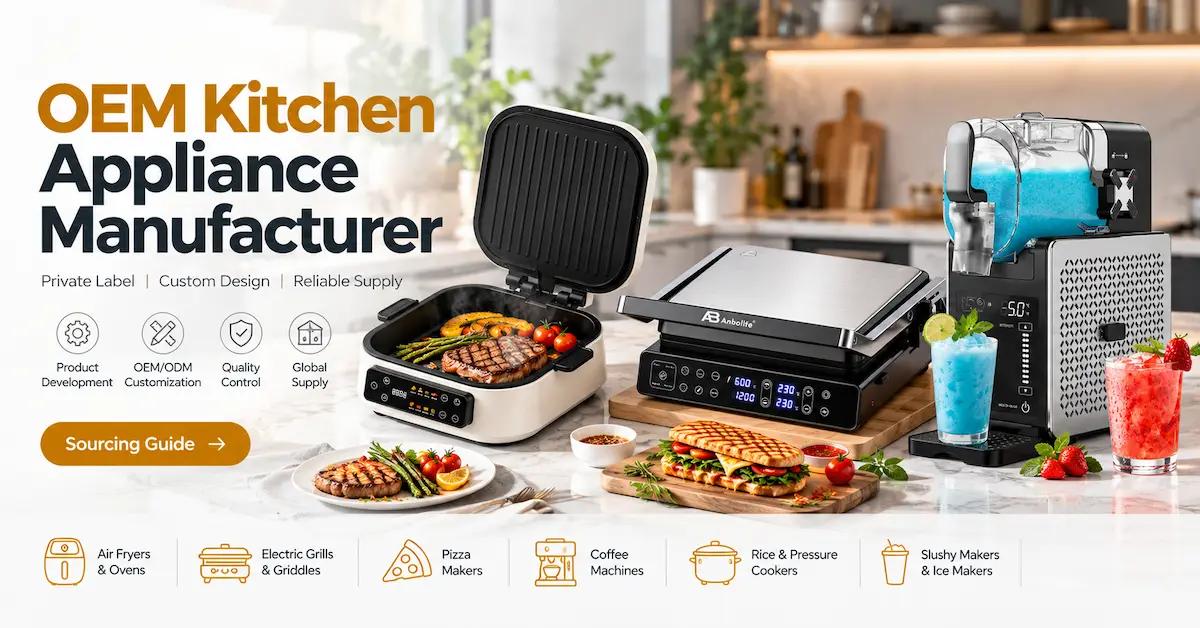
What Should You Look for in an OEM Kitchen Appliance Manufacturer?
Choosing an OEM kitchen appliance manufacturer is not simply about finding a factory that can produce air fryers, coffee machines, or electric grills. For international brands and importers, the more important question is whether a manufacturing partner can convert defined product requirements into an approved, repeatable, and commercially viable appliance.
A capable OEM partner should help buyers review product specifications, evaluate design feasibility, confirm samples, coordinate manufacturing, and establish appropriate quality checkpoints. The precise division of responsibilities depends on the project agreement.
For private-label brands, success depends on controlling three connected areas: the product customers expect, the specification the manufacturer agrees to produce, and the finished goods delivered to the market.
When these elements are not aligned, seemingly minor changes to heating elements, controls, packaging, or materials can create unexpected costs and approval delays.
Buyers evaluating an OEM kitchen appliance supplier should therefore examine product development capabilities, technical documentation, sample procedures, component control, compliance evidence, and commercial transparency before approving bulk production.
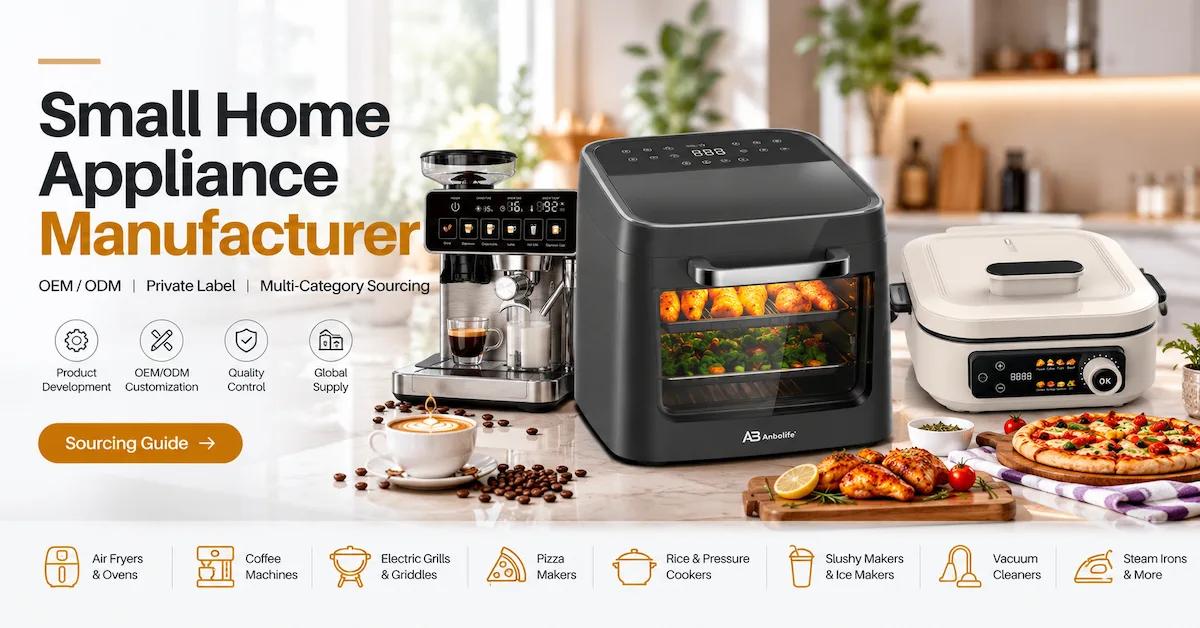
ANBOLIFE supports international appliance projects involving product development, OEM/ODM customization, manufacturing coordination, inspection, and delivery preparation. Its existing product portfolio provides a practical starting point for brands exploring different kitchen appliance categories.
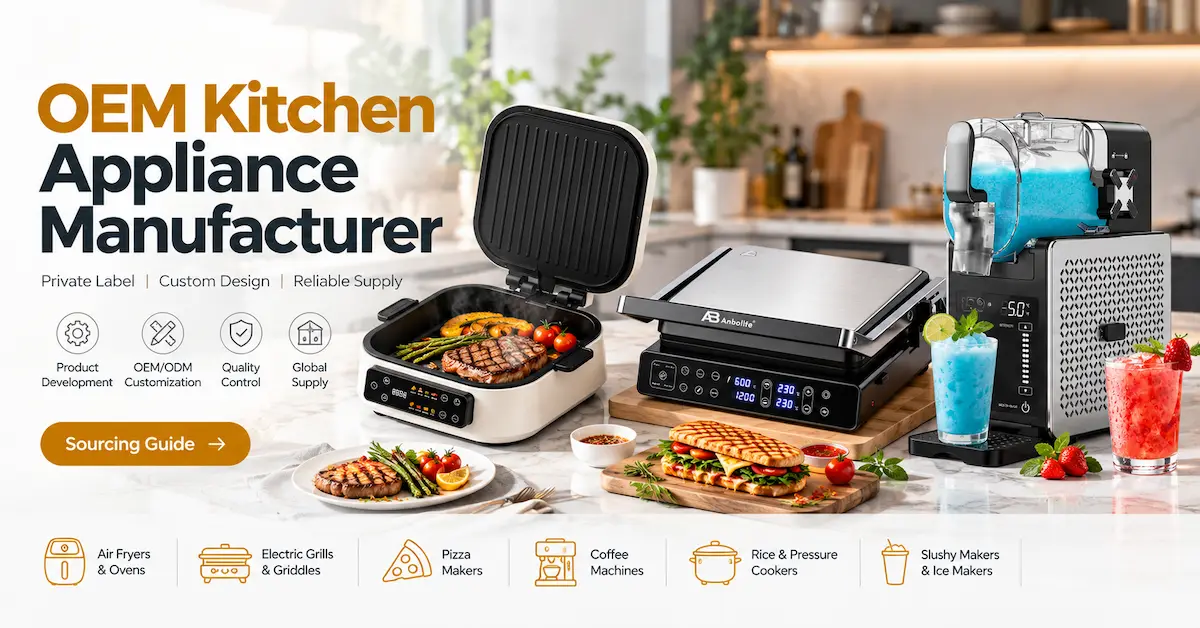
1. OEM vs ODM Kitchen Appliance Manufacturing: Which Is Right for Your Project?
OEM and ODM are closely related manufacturing approaches, but they usually begin with different development requirements.
OEM manufacturing generally starts with customer-defined drawings, functional requirements, technical specifications, or an established design brief. The manufacturer evaluates whether the proposed appliance can be produced according to the agreed requirements.
ODM manufacturing typically begins with an existing product direction or platform. Buyers then discuss available modifications, such as branding, housing color, packaging, and selected configurations.
| Evaluation factor | OEM manufacturing | ODM manufacturing |
|---|---|---|
| Starting point | Customer drawings or specifications | Existing product platform |
| Design flexibility | Defined by engineering feasibility | Limited by available platform options |
| Development requirements | May involve additional engineering work | Depends on the changes requested |
| Branding | Based on approved project requirements | Often available within existing options |
| Tooling | New or modified tooling may be needed | Existing tooling may be reusable |
| Technical verification | Based on the final approved design | Based on the platform and changes |
| Suitable buyers | Established brands with defined product requirements | Importers and brands seeking an existing product starting point |
Neither approach is automatically faster or more economical.
An extensive modification to an ODM platform may require more technical work than a well-documented OEM project. Likewise, a customer-supplied design may need substantial revision before it becomes suitable for production.
ANBOLIFE's OEM/ODM manufacturing services describe both routes. OEM projects can begin with customer drawings and technical requirements, while ODM projects can begin with existing product directions. The final customization scope is reviewed against the selected model.
Procurement recommendation: Choose the development route only after identifying which design elements are essential to your brand and which can remain standard.
2. Which Kitchen Appliances Are Suitable for OEM and Private Label Development?
The right product category depends on your target customers, retail positioning, expected order volume, and available after-sales resources.
A brand selling premium countertop appliances may prioritize digital controls, appearance, and functional differentiation. A wholesale distributor may place greater emphasis on product reliability, competitive pricing, packaging efficiency, and replacement-part availability.
Kitchen Appliance Categories and Sourcing Considerations
| Product category | Typical purchasing applications | Key technical considerations |
|---|---|---|
| Air Fryers & Ovens | Household retail, kitchen appliance brands | Capacity, heating system, controls, accessories |
| Electric Pizza Makers | Multifunction countertop cooking | Heating configuration, operating modes, cooking surfaces |
| Electric Grills | Sandwich and indoor cooking ranges | Plate materials, temperature control, hinges |
| Coffee Machines | Private-label coffee appliance collections | Brewing system, grinder, milk functions, cleaning |
| Electric Pressure Cookers | Family cooking and kitchenware distribution | Capacity, pressure controls, sealing, safety functions |
| Beverage Appliances | Home beverage preparation collections | Cooling system, capacity, cleaning, operating requirements |
These technical considerations help define an RFQ; they are not claims that every model includes the listed functions.
Example A: OEM Air Fryer Oven Development
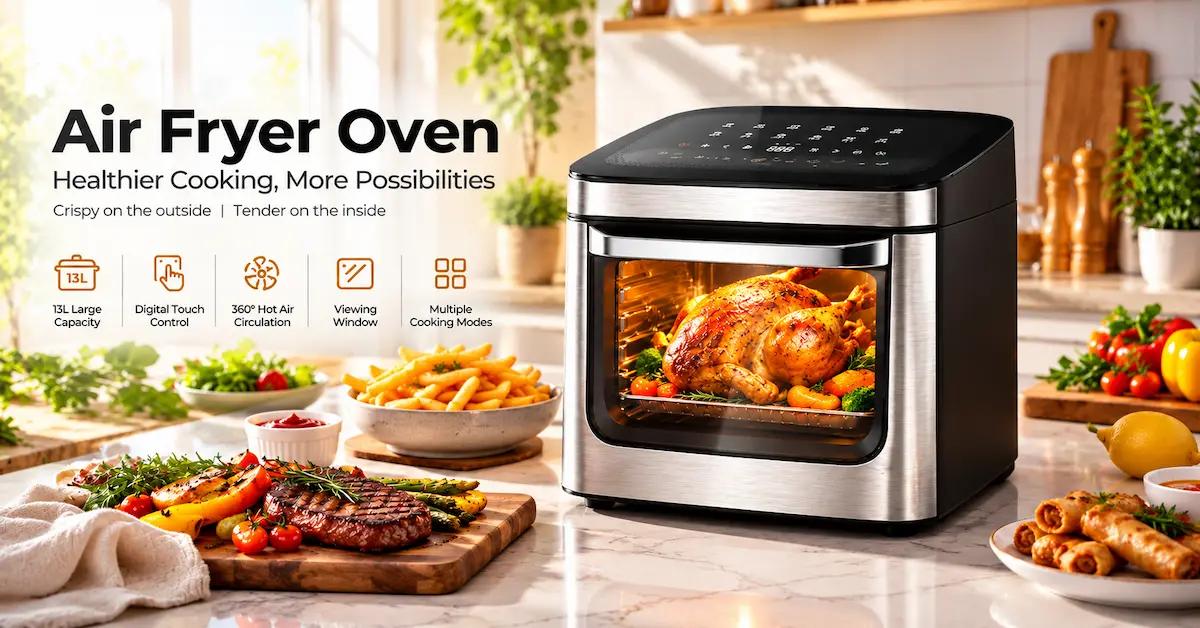
ANBOLIFE's JL Air Fryer 13L-1 is listed with a 13-liter capacity, digital touch controls, a transparent viewing window, and a multi-level rack arrangement.
For a private-label brand, this model can provide a reference point for discussing oven-style air fryer positioning.
Before requesting customization, buyers should confirm rated power, voltage, temperature range, accessories, dimensions, and relevant product documentation.
A different control program, heating configuration, or electrical specification may require further engineering and compliance review.
Example B: Multifunction Electric Pizza Maker
The BP-PA18 Electric Pizza Maker & Grill provides a more detailed published technical reference.
| Specification | Published BP-PA18 information |
|---|---|
| Total rated power | 2,000 W |
| Upper heating plate | 800 W |
| Lower heating plate | 1,200 W |
| Rated voltage | 110–240 V |
| Frequency | 50/60 Hz |
| Opening positions | 105° and 180° |
| Control | Digital multifunction interface |
| Cooking options | Eight displayed menu selections |
| Lower cooking basket | Detachable |
| Cooking surface | Non-stick coated |
These are published product details rather than independently verified test results. Final configurations should be confirmed through approved specifications and applicable documentation.
For OEM buyers, this appliance illustrates why heating arrangements, user controls, safety components, and mechanical construction should be reviewed together.
Changing one component can affect more than appearance.
Example C: Electric Pressure Cookers
ANBOLIFE also lists 6L and 8L digital electric pressure cookers with LED displays and adjustable high/low pressure settings.
Buyers considering this category should pay particular attention to pressure-control architecture, sealing components, inner-pot specifications, safety protection, operating instructions, and destination-market requirements.
Published capacity alone is insufficient to approve a pressure cooker for import.
3. How Does an OEM Kitchen Appliance Project Move From Design to Production?
An effective OEM manufacturing process uses defined approval stages rather than relying on informal conversations.
The buyer and manufacturer should know exactly which product version is being evaluated, which decisions remain open, and which changes require further approval.
Seven Key Project Stages
| Stage | Key activities | Buyer approval |
|---|---|---|
| 1. Project Brief | Define product, target market, quantities and functions | Written requirements |
| 2. Design Review | Check drawings, materials, electrical parameters and feasibility | Approved design direction |
| 3. Sampling | Prepare and evaluate the proposed configuration | Approved sample |
| 4. Branding & Packaging | Confirm logo, labeling, manuals and retail packaging | Approved artwork and files |
| 5. Production | Manufacture to the agreed configuration | Controlled production specification |
| 6. Inspection | Check agreed quality and performance requirements | Inspection results |
| 7. Shipment Coordination | Confirm packing, quantities and shipping arrangements | Shipment documentation |
This sequence is consistent with ANBOLIFE's published OEM/ODM project workflow.
Why Design Approval Matters
A common sourcing mistake is requesting production before technical requirements are finalized.
For example, a buyer may approve an air fryer housing while still discussing the electrical rating, control interface, or cooking accessories.
If production planning begins before these decisions are documented, later changes may affect tooling, component orders, testing, packaging, and delivery.
A practical solution is a design freeze: an agreed point at which the approved specification becomes the production reference. Subsequent changes require documented review.
For a serious OEM program, the approved configuration should include the product drawing or reference, critical components, operating functions, electrical ratings, external appearance, labeling, and packaging requirements.
This gives both parties a common technical baseline.
4. What Customization Options Should Private Label Buyers Discuss?
An OEM kitchen appliance manufacturer may offer several levels of customization, but not every option is available for every model.
The most efficient approach is to separate cosmetic changes from modifications that affect product construction or performance.
Cosmetic and Branding Customization
Possible options include logo placement, product colors, surface finishes, packaging artwork, manuals, and labels.
These changes can help a brand establish a consistent product collection.
Even apparently simple modifications require review. A new housing finish may have material or manufacturing implications, while revised packaging must still protect the appliance during distribution.
Functional and Technical Customization
More complex requests can involve user interfaces, operating programs, electrical configuration, accessories, or selected internal components.
These modifications may influence:
-
Engineering feasibility and component sourcing.
-
Tooling or assembly requirements.
-
Product testing and compliance documentation.
-
Sample approval and production scheduling.
-
Unit costs and minimum order quantities.
Before requesting functional changes, identify which features offer meaningful value to your customers.
Adding functions that do not support your market positioning may increase project complexity without improving the commercial result.
ANBOLIFE publicly describes branding, appearance, packaging, electrical configuration, and selected product requirements as customization topics, subject to individual model review.
5. How Can Buyers Evaluate Kitchen Appliance Quality Control?
Quality control should be defined through agreed specifications, inspection checkpoints, and verifiable evidence.
A factory's general statement about strict quality inspection is not enough to determine whether the manufacturing process suits your product.
For electrical kitchen appliances, quality requirements may involve mechanical assembly, heating components, electrical insulation, temperature control, user-interface operation, and protection against foreseeable hazards.
Recommended Quality Control Framework
| Inspection stage | Main focus | Examples of evidence |
|---|---|---|
| Incoming inspection | Components and materials | Component records, incoming checks |
| In-process inspection | Assembly and manufacturing consistency | Work instructions, inspection records |
| Functional testing | Operation against approved requirements | Test procedures and results |
| Safety verification | Applicable electrical and product safety requirements | Relevant reports and checkpoints |
| Final inspection | Appearance, function, labeling, packaging | Inspection report and acceptance record |
| Document verification | Model and market compliance | Certificates, declarations, technical files |
Not every test needs to be conducted on every production unit. Product type testing, routine production tests, and sample-based inspections serve different purposes.
The Importance of an Approved Reference Sample
Before bulk production, buyers should approve a sample that represents the intended production configuration.
This reference should be linked to the relevant product specification, approved packaging, labeling, and version information.
If the supplier proposes a change to a critical component after sample approval, the buyer should evaluate whether additional testing or approval is necessary.
This reduces the risk of receiving products that differ from the originally approved design.
ANBOLIFE describes incoming review, process inspection, safety checkpoints, and document verification as parts of its quality approach. Buyers should discuss the exact inspection plan for their selected product through the OEM/ODM service team.
6. Which Certifications and Compliance Documents Should Buyers Request?
Kitchen appliance compliance depends on the product category, electrical configuration, intended use, and destination market.
There is no single certification that automatically covers every appliance or every country.
For example, a countertop grill and an electric pressure cooker may require different product-specific technical assessments even when purchased from the same manufacturer.
The IEC 60335 family of standards provides an important international reference for household and similar electrical appliance safety. Relevant product-specific parts and applicable national or regional requirements must also be considered.
For European Union markets, buyers may need to assess applicable electrical safety, electromagnetic compatibility, restricted-substance, labeling, and documentation requirements.
Other markets may have different testing, approval, and importer responsibilities.
Compliance Verification Checklist
| Document or requirement | Buyer verification |
|---|---|
| Product test reports | Exact model and tested configuration |
| Applicable standards | Correct standards and editions |
| Certificates | Scope, issuing organization, model coverage |
| Electrical ratings | Voltage, frequency and rated power |
| Product labeling | Market-specific information |
| User instructions | Applicable language and safety information |
| Technical documentation | Evidence supporting the final approved configuration |
A certificate for one appliance cannot automatically establish compliance for a modified model.
If the OEM project changes electrical components, heating controls, materials, or other safety-related characteristics, the manufacturer and buyer should determine whether the existing evidence remains applicable.
ANBOLIFE displays examples of product-related compliance documents in its company information, but buyers must confirm certificate applicability for their specific model and target market.
7. What Determines OEM Kitchen Appliance Manufacturing Costs?
The total project cost can be significantly different from the quoted factory unit price.
A technically complex customization program may introduce engineering, tooling, sampling, testing, packaging, and production-preparation expenses.
For brand owners, the correct comparison is the cost of obtaining an approved, market-suitable product rather than simply purchasing the lowest-priced appliance.
Common OEM Project Cost Factors
| Cost factor | What buyers should confirm |
|---|---|
| Product configuration | Standard model or modified design |
| Engineering | Development and technical review requirements |
| Tooling | New tools, modifications and ownership |
| Components | Material specifications and supply availability |
| Sampling | Sample quantity, charges and revision costs |
| Testing | Applicable verification and compliance expenses |
| Branding | Printing, labeling and design preparation |
| Packaging | Retail boxes, protective materials and cartons |
| Inspection | Agreed quality verification expenses |
| Logistics | Freight, trade terms and import-related costs |
How MOQ and Lead Time Affect Your Project
Minimum order quantities depend on the appliance model, required materials, components, customization, packaging, and production arrangements.
A standard product configuration may have different quantity requirements from an appliance requiring new tooling or specialized components.
Production schedules also vary according to design maturity, sampling, material availability, testing, and factory planning.
Buyers should request separate estimates for sample development, pre-production approval, mass production, and shipment.
Avoid treating a general company lead time as a guaranteed schedule for a custom OEM project.
8. How Do You Select the Right OEM Kitchen Appliance Manufacturer?
An effective supplier evaluation should connect manufacturing capability with the requirements of the specific product.
Do not select a supplier solely on the number of products in its catalog, the appearance of its website, or its lowest quotation.
OEM Manufacturer Evaluation Scorecard
The following is a suggested internal purchasing tool, not a certified supplier rating.
| Evaluation factor | Suggested weighting |
|---|---|
| Engineering and product development | 20% |
| Technical specifications and manufacturing capability | 20% |
| Quality control and compliance evidence | 25% |
| OEM customization and project management | 15% |
| Commercial transparency | 10% |
| Delivery and after-sales arrangements | 10% |
| Total | 100% |
Safety and mandatory market requirements should be treated as essential acceptance conditions rather than issues that can be offset by a higher commercial score.
A supplier that cannot document a required safety condition should not pass qualification merely because it offers a lower price.
Warning Signs During Supplier Evaluation
Pay particular attention when a supplier cannot provide an identified model specification, gives conflicting information about technical parameters, refuses to clarify critical component changes, or treats all customization as automatically feasible.
Other potential concerns include unclear tooling ownership, undocumented sample approval, vague certification claims, and quotations that exclude important project costs without explanation.
A professional manufacturer should be able to distinguish confirmed capabilities from matters requiring additional review.
9. What Should an OEM Kitchen Appliance RFQ Include?
A detailed request for quotation helps manufacturers assess engineering feasibility and provide commercially useful proposals.
For a private-label kitchen appliance project, include the following information:
| RFQ information | Recommended details |
|---|---|
| Product category | Air fryer, coffee machine, grill, pressure cooker |
| Reference model | Existing product or design drawing |
| Destination market | Country, voltage and market requirements |
| Required specifications | Capacity, functions, materials, dimensions |
| Customization | Logo, colors, packaging, controls, accessories |
| Expected quantity | Initial order and estimated annual demand |
| Sample requirements | Prototype, approval criteria and timeline |
| Quality expectations | Required tests, inspections and documentation |
| Packaging requirements | Labels, manuals, cartons and artwork |
| Commercial terms | Pricing structure, tooling, payment and delivery |
| After-sales requirements | Warranty terms and spare-parts expectations |
Example: Private Label 13L Air Fryer Project
Suppose a kitchen appliance brand wants to launch a 13L air fryer oven for a specific retail market.
Its initial RFQ could reference ANBOLIFE's JL Air Fryer 13L-1 and request the latest technical datasheet, electrical configuration, accessory details, packaging information, customization options, model-specific compliance documents, sample terms, and estimated commercial conditions.
The buyer should also provide the intended destination market, expected order quantity, branding requirements, and target launch schedule.
This is substantially more useful than simply asking for the lowest price.
A complete RFQ allows the manufacturer to identify what is standard, what requires customization, and which technical questions remain open.
10. Why Consider ANBOLIFE for an OEM Kitchen Appliance Project?
ANBOLIFE positions itself as a multi-category home appliance development and manufacturing partner for international brands, importers, retailers, and distributors.
Its published business information covers kitchen appliance product development, engineering review, OEM/ODM customization, sampling, manufacturing coordination, quality inspection, and shipment preparation.
For buyers planning private-label appliance collections, the company provides several relevant starting points.
Product exploration: Review available cooking and beverage appliances through the ANBOLIFE product catalog.
Customization planning: Explore OEM/ODM manufacturing services to discuss customer-defined requirements or existing product platforms.
Technical consultation: Share a specific product reference, target market, order estimate, and customization needs through the ANBOLIFE contact page.
The company describes support for both customer-specified OEM projects and ODM product directions. However, exact technical options, production schedules, pricing, MOQ, and certification coverage are confirmed individually.
For a buyer developing a new kitchen appliance line, this creates a practical sequence: identify a product direction, clarify the technical requirements, request a sample and commercial proposal, and establish approval conditions before bulk manufacturing.
Frequently Asked Questions About OEM Kitchen Appliance Manufacturing
1. What does an OEM kitchen appliance manufacturer do?
An OEM kitchen appliance manufacturer produces appliances according to agreed customer specifications and project requirements. Depending on the agreement, its responsibilities may include engineering review, sampling, manufacturing, inspection, branding coordination, and delivery preparation.
2. Can I customize an existing kitchen appliance instead of developing a new one?
Yes. An existing product platform may support agreed branding, packaging, appearance, or selected configuration changes. Available options depend on the model, engineering feasibility, applicable compliance requirements, and commercial conditions.
3. What is the MOQ for private label kitchen appliances?
MOQ varies according to the appliance, customization scope, components, packaging, and production requirements. Buyers should request a project-specific quotation rather than assuming a fixed minimum quantity across all products.
4. How long does OEM kitchen appliance production take?
The schedule depends on engineering review, tooling, sampling, approval, material availability, testing, and production planning. A manufacturer should provide estimated milestones for the specific project.
5. Do OEM kitchen appliances require new safety testing?
Not always, but changes to the product may affect existing technical evidence. The buyer and manufacturer should review the modified configuration against applicable requirements and determine whether additional testing or documentation is necessary.
6. Who owns the tooling and product design in an OEM project?
Ownership depends on the contract and the origins of the design and tooling. Buyers should establish ownership, permitted use, confidentiality, maintenance responsibilities, and transfer conditions before paying development or tooling charges.
7. Can ANBOLIFE support private-label kitchen appliance development?
ANBOLIFE publicly offers OEM/ODM services involving product review, sampling, branding, packaging, manufacturing, and inspection coordination. The final customization scope and commercial terms must be confirmed for the selected appliance and project.
Conclusion
Choosing the right OEM kitchen appliance manufacturer requires more than comparing product prices. Successful private-label development depends on clear specifications, engineering feasibility, approved samples, quality controls, compliance verification, and transparent commercial terms.
Before committing to bulk production, brands and importers should confirm the final product configuration, customization requirements, testing evidence, and production responsibilities.
Explore ANBOLIFE's kitchen appliance products, review its OEM/ODM manufacturing services, or contact ANBOLIFE to discuss your project and request a quotation.