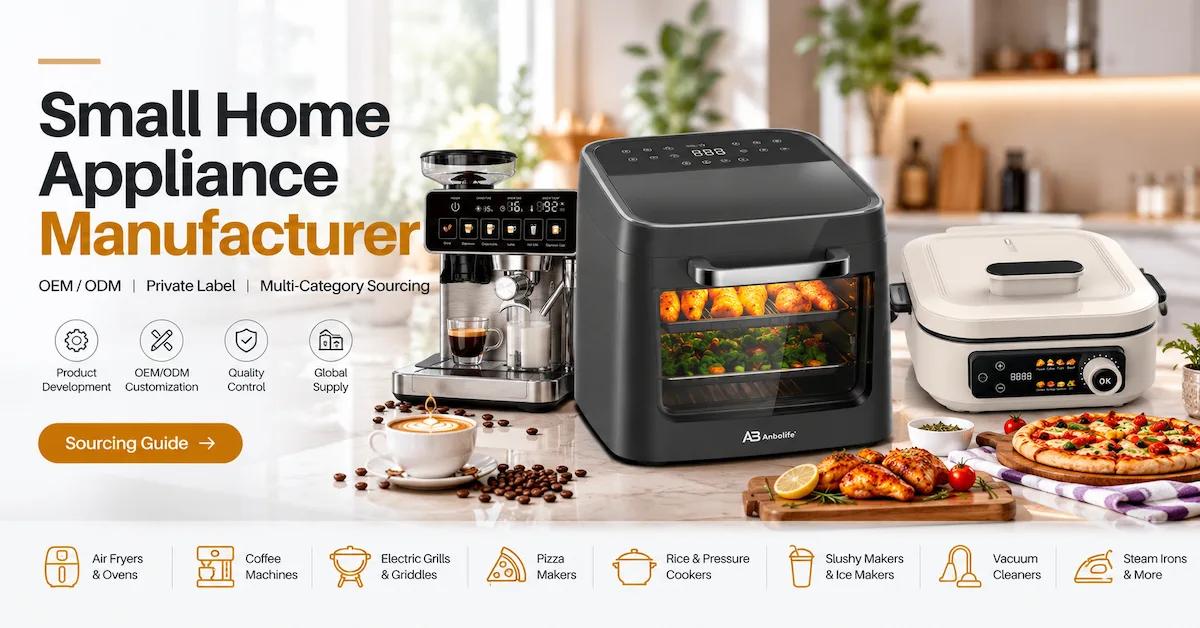
How to Choose a Small Home Appliance Manufacturer
A dependable small home appliance manufacturer should be able to explain not only what it sells but also how each selected appliance is specified, customized, inspected, and prepared for the destination market. For international importers and private-label brands, an attractive catalog or low unit price is not enough to establish purchasing confidence.
The most practical selection method is to verify five factors: product-category fit, manufacturing and engineering responsibilities, OEM/ODM scope, model-specific quality and compliance evidence, and the total commercial terms of the proposed order. These checks apply whether you are sourcing countertop cooking equipment, coffee machines, or household cleaning appliances.
The aim is not to find a supplier that promises everything. It is to choose a partner that documents what can be supplied, identifies what must be confirmed, and helps you compare quotations against the same requirements.
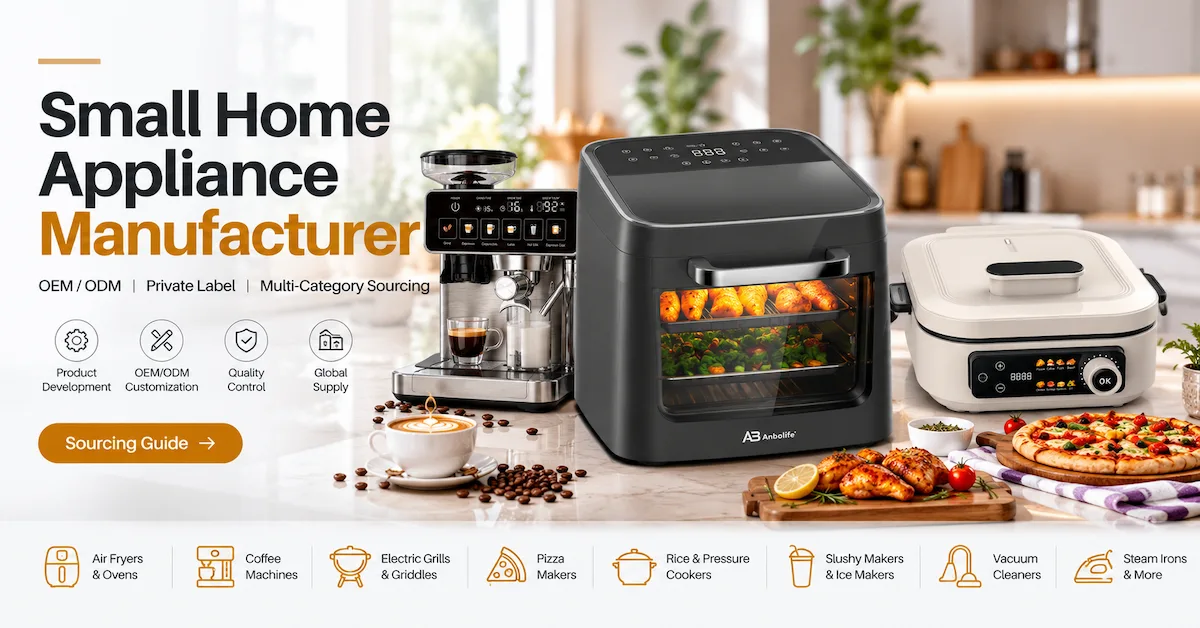
1. Match the Manufacturer's Product Range to Your Buying Plan
Begin with your target customers, not the number of products in a supplier's catalog. A kitchen appliance brand, a home-care distributor, and a general merchandise importer need different combinations of functionality, retail pricing, product support, and documentation.
| Product category | Typical buying priorities | Relevant B2B buyers |
|---|---|---|
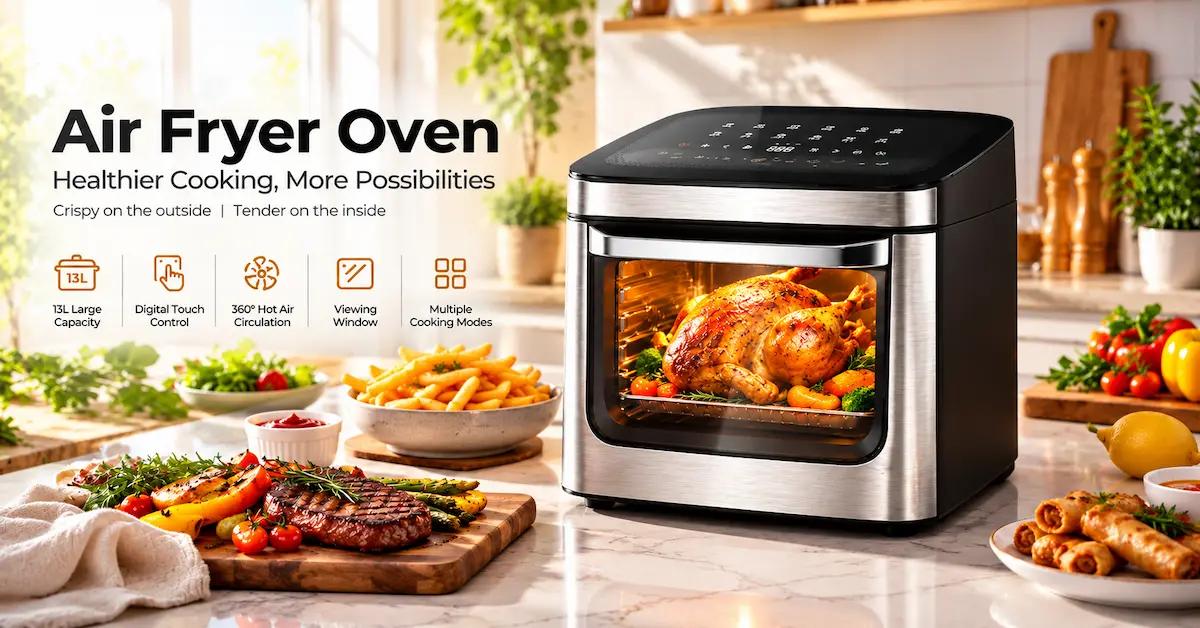
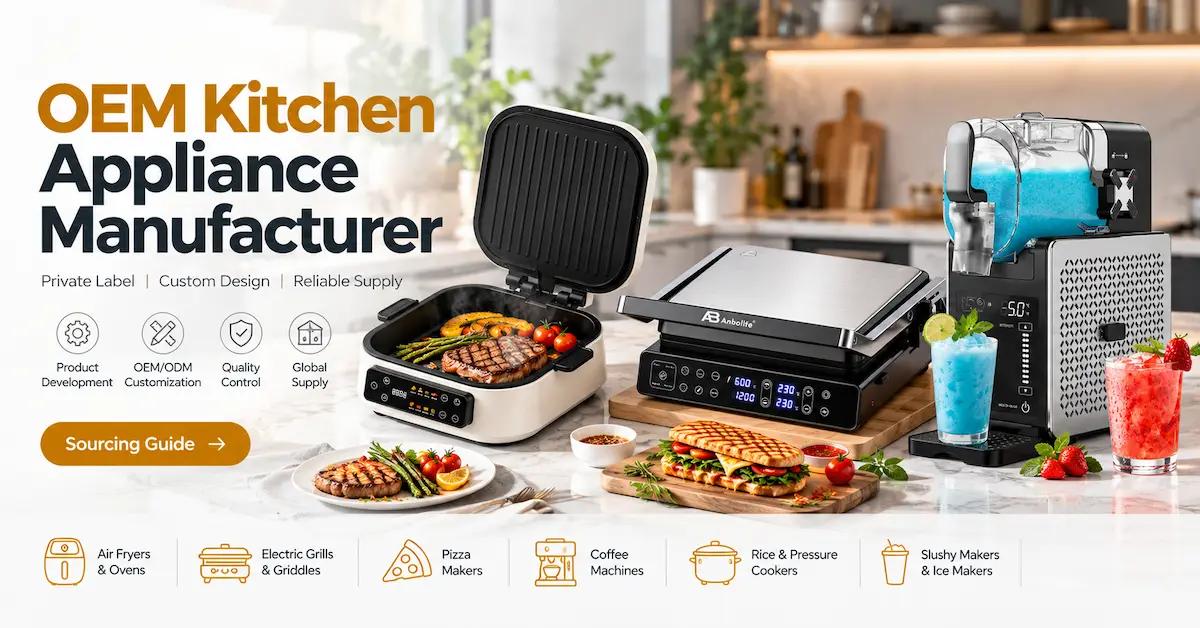
| Air fryers and countertop ovens | Usable capacity, electrical ratings, controls, accessories, cleaning | Kitchen appliance brands, retailers |
| Pizza makers and electric grills | Heating design, temperature control, cooking surfaces, safety | Importers, private-label kitchenware brands |
| Espresso coffee machines | Grinder, brewing functions, milk system, cleaning, spare parts | Coffee equipment distributors, retail brands |
| Pressure cookers | Capacity, pressure controls, seals, safety documentation | General appliance importers |
| Slushie and beverage machines | Cooling system, capacity, duty cycle, maintenance | Beverage appliance distributors |
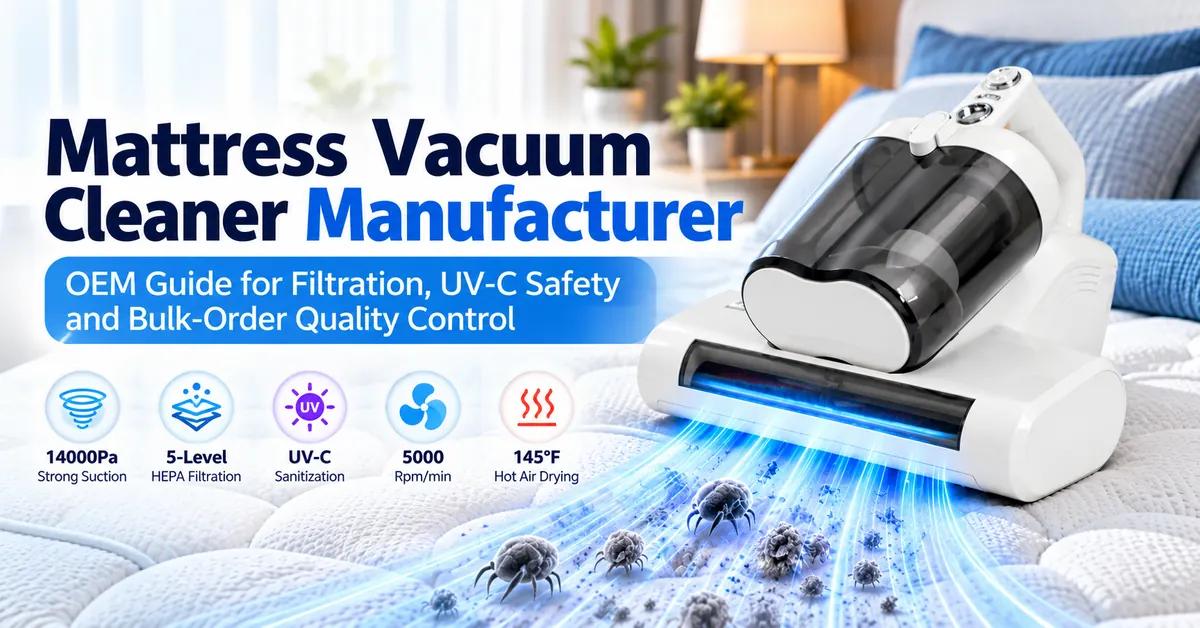
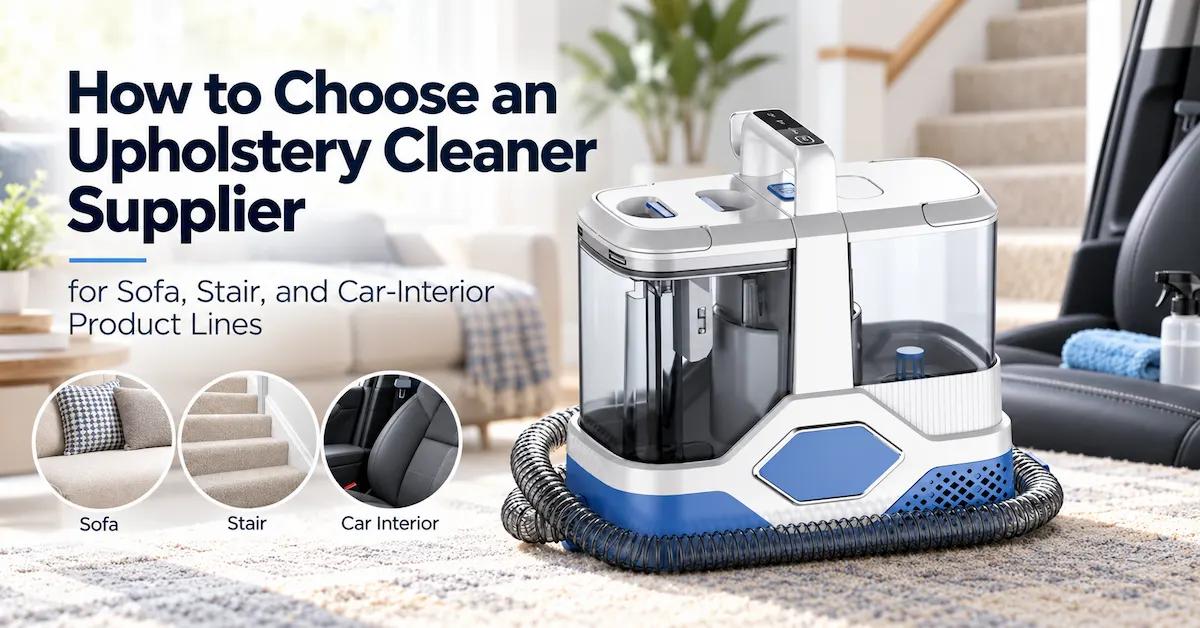
| Upholstery and mattress cleaners | Cleaning method, measured suction, filtration, accessories | Home-care brands, wholesalers |
| Steam irons | Soleplate, steam functions, water tank, thermal protection | Household goods retailers |
These are evaluation criteria, not promises that every product has every feature listed. Always obtain the actual model datasheet.
For example, ANBOLIFE's product catalog covers multiple appliance categories. Its JL Air Fryer 13L-1 is presented as an oven-style air fryer with a 13-liter capacity, a digital interface, and a viewing window. Those features provide a useful starting point, but rated power, dimensions, operating range, accessories, and market-specific documents must be confirmed for the intended order.
When building a range, first shortlist two or three products that serve the same retail customer. Expand into other categories after the initial products pass technical, quality, and commercial review.
2. Verify What the Manufacturer Actually Controls
The word manufacturer does not tell you which activities are completed in-house. A supplier may produce and assemble appliances directly, source selected components, or coordinate specialist partners. What matters is accountability for the ordered configuration.
Ask the supplier to explain who manages:
- Engineering review: electrical, mechanical, and functional specifications.
- Component sourcing: motors, heaters, control boards, wiring, and other critical parts.
- Assembly and inspection: work instructions, production checkpoints, and defect handling.
- Document control: approved samples, specifications, manuals, and changes.
- Packaging and shipment: retail labels, protective packing, and export coordination.
Request evidence relevant to your chosen product rather than relying only on company-wide factory figures. A production photo is useful background, but an inspection plan and approved technical specification are more actionable purchasing documents.
ANBOLIFE describes its company background on the About Us page and outlines manufacturing activities on its Manufacturing page. Company-level descriptions should not be treated as proof of a specific model's capacity, test results, or guaranteed delivery schedule.
3. Decide Whether OEM or ODM Fits Your Project
OEM is generally the better starting point when your business has defined drawings, specifications, or product requirements. ODM may suit a private-label program that wants to adapt an existing product platform rather than develop an appliance entirely from the beginning.
| Decision | OEM route | ODM route |
|---|---|---|
| Product starting point | Customer-defined requirements | Existing product direction or platform |
| Main review | Design feasibility, components, approval criteria | Available modifications, configuration, branding |
| Potential extra work | Tooling, engineering changes, validation | Review of changes to the existing platform |
| Best fit | Brands with established technical specifications | Importers launching a private-label assortment |
Neither route automatically delivers lower cost or faster production. The amount of customization determines the engineering work, testing implications, tooling, and commercial conditions.
For ANBOLIFE, the OEM/ODM service page describes a workflow covering project requirements, product review, sample confirmation, branding and packaging, production, inspection, and shipment coordination. Potential changes to logos, colors, packaging, electrical configurations, or functions should be assessed for the particular model before being promised to a retailer.
Before choosing a route, ask who owns any new drawings and tooling, whether critical component substitutions need written approval, and how the approved sample will be linked to mass-production requirements.
4. Compare Technical Specifications, Not Just Product Photos
Appliances that look alike can have different electrical designs, usable capacities, materials, safety systems, and service requirements. A meaningful comparison starts with one agreed specification sheet.
| Specification | Buyer question |
|---|---|
| Model and revision | Which exact configuration will be supplied? |
| Rated voltage and frequency | Is it appropriate for the destination market? |
| Rated power and operating range | Which values are tested and documented? |
| Capacity and dimensions | Is the capacity nominal or usable, and will it fit the retail brief? |
| Heating, motor, or cooling system | What components and operating conditions apply? |
| Materials and food-contact surfaces | What is the material specification and supporting evidence? |
| Controls and accessories | Which functions and accessories are included in the quotation? |
| Packaging and documentation | What manuals, labels, carton details, and reports are available? |
The priority varies by category. An espresso-machine buyer should review the grinding, water, milk, and cleaning systems. A pressure-cooker buyer should examine the pressure-control and protective mechanisms. A cleaner buyer should confirm whether the appliance performs dry suction, wet extraction, or another defined process; product names alone do not establish the cleaning method.
ANBOLIFE's BP-PA18 pizza maker, for example, has a published multifunction cooking design and electrical specifications. Use its published features to frame a technical inquiry, then verify the precise electrical version, functions, packaging, and supporting documents before placing an order. Never assume that one model's data applies to another appliance from the same brand.
5. Evaluate Quality Control and Compliance Evidence
Quality claims become useful when a manufacturer can show how its processes relate to your product. Ask how incoming components are checked, how production deviations are recorded, which final inspections are performed, and how a rejected batch is handled.
Sample approval and production acceptance are separate stages. A working sample demonstrates an approved configuration; it does not prove that every subsequent unit will be assembled identically. Link the approved sample to written specifications, inspection criteria, and change-control rules.
For international orders, request the documentation applicable to the exact model and destination market. Do not treat CE, CB, RoHS, or other labels as interchangeable or as universal permission to sell any appliance. Model coverage, document scope, issuing organization, test standard, and current applicability all matter.
The IEC 60335 series is a relevant reference point for household appliance safety, while the European Commission's Blue Guide on the Implementation of EU Product Rules 2022 provides guidance on EU product-rule responsibilities. These references inform evaluation; they do not certify a manufacturer or any particular product.
ANBOLIFE discusses inspection and document verification on its Quality & Certifications page. Buyers should still ask for model-specific evidence and obtain qualified advice where market requirements are unclear.
A useful pre-order checklist includes:
- Approved model identification and electrical configuration.
- Product specification and sample-acceptance criteria.
- Applicable test reports, declarations, and certificates.
- Inspection stages, sampling method, and rejection rules.
- Packaging artwork, labels, manual, and final packing list.
- Agreed process for changes, defects, and corrective action.
6. Understand MOQ, Lead Time, and Total Procurement Cost
A low quoted unit price can become expensive when it excludes tooling, customization, testing, retail packaging, inspection, shipping, or after-sales support. Compare suppliers on an equivalent configuration and trade-term basis.
MOQ is model- and project-dependent. A standard appliance may have different quantity requirements from one needing custom colors, printed packaging, new components, or tooling. Likewise, sampling and production lead times should be confirmed for the selected model and project stage, not assumed from a company-wide estimate.
| Cost or schedule factor | Clarification to request |
|---|---|
| Base unit price | Exact specification and quotation quantity |
| MOQ | Standard-product MOQ versus customized-product MOQ |
| Development | Sampling, tooling, artwork, or engineering charges |
| Compliance | Who arranges and pays for required evaluation? |
| Inspection | Scope and cost of pre-shipment checks |
| Shipping | Incoterms, carton data, freight responsibilities |
| After-sales | Warranty conditions, spare parts, defect claims |
| Delivery | Sample approval and production milestones |
For a fair comparison, calculate the total landed and support cost, not only the ex-factory price. The calculation should also reflect duties, taxes, insurance, warehousing, and inventory exposure when they apply to your commercial arrangement.
7. Approve Samples Before Committing to Bulk Production
Samples should be reviewed by the people who will approve product performance, retail presentation, import documentation, and after-sales requirements. A purchasing team should not rely solely on photographs or an informal verbal approval.
A practical evaluation covers operating functions, appearance, materials, markings, user instructions, accessories, cleaning and maintenance, packaging, and the evidence required for market entry. Risk-critical characteristics may need formal testing rather than a visual check.
Keep an identified golden sample or equivalent approved configuration record. Confirm that the final quotation, product specification, manual, and packaging artwork all refer to the same revision. This helps prevent disagreements when the production order differs from the development sample.
If a supplier proposes a component change after approval, request a written explanation of its impact and determine whether additional testing or sample review is needed.
8. Send an RFQ That Produces Comparable Quotes
A precise request for quotation makes it easier to detect differences in specifications and commercial assumptions. At minimum, provide the following information:
| RFQ field | What to include |
|---|---|
| Company and sales channel | Importer, distributor, brand, retailer, or e-commerce seller |
| Product category and reference | Target appliance and preferred model or product image |
| Destination market | Country, relevant electrical configuration, market requirements |
| Key specifications | Capacity, dimensions, functions, materials, accessories |
| Initial quantity and forecast | Trial order and expected repeat volume |
| OEM/ODM needs | Logo, colors, packaging, manuals, technical changes |
| Quality requirements | Sample tests, inspections, documentary evidence |
| Commercial terms | Target schedule, shipment terms, warranty expectations |
For example, instead of asking, “What is your best air fryer price?”, request a quotation for a specified oven-style air fryer, identify the destination market, and ask for its current datasheet, sample terms, packaging options, compliance documents, and MOQ. This gives the manufacturer enough context to explain which options are standard and which require review.
When comparing responses, assign more weight to product suitability, compliance, and documented quality than to an unusually low unit price. Mandatory legal and safety requirements should be treated as pass/fail conditions, not as disadvantages that a lower price can offset.
Buyers exploring multiple categories can begin with the ANBOLIFE product selection, review OEM/ODM options, and submit a model-specific brief through the contact page.
9. Common Supplier-Selection Mistakes to Avoid
Comparing incomplete quotations. Different suppliers may include different accessories, packaging, test documents, and trade terms. Normalize the requirements first.
Assuming all product categories share the same capabilities. Evaluate each appliance family on its own engineering, quality, and compliance requirements.
Accepting generic certification claims. Require documents that match the actual model and applicable destination-market requirements.
Skipping written sample approval. Record the agreed configuration, revision, and inspection criteria before production.
Overlooking after-sales support. Clarify warranty responsibilities, replacement parts, manuals, and handling of confirmed defects before the first substantial order.
These basic controls can prevent avoidable misunderstandings without adding unnecessary complexity to the purchasing process.
10. Frequently Asked Questions
How do I identify a reliable small home appliance manufacturer?
Check the supplier's relevant product experience, manufacturing responsibilities, technical documentation, inspection procedures, and sample-approval process. Verify the proposed product against your requirements before signing a bulk order.
Can I launch a private-label appliance without a new design?
Often, yes. An existing ODM platform may allow branding or selected configuration changes, subject to the model, tooling, engineering review, and compliance implications.
What is a typical MOQ for small appliances?
There is no universal MOQ. Confirm the quantity for the particular model and distinguish standard-product conditions from custom-component or packaging requirements.
Which certificates should I request?
Request the current documents required for your model and target market. Verify model coverage, applicable standards, issuing bodies, and the relationship between the tested version and the product being ordered.
Why is a golden sample important?
It provides an identified reference for the approved configuration. Used together with written specifications and inspection criteria, it helps resolve differences between development samples and production goods.
Conclusion
The right small home appliance manufacturer is one that can match your product brief, explain its OEM/ODM responsibilities, provide model-specific technical and compliance evidence, and support a clearly documented purchasing process. Evaluate total sourcing risk alongside price, and approve specifications and samples before placing a bulk order.
Explore ANBOLIFE's appliance range or contact the team with your target model, market, expected quantity, and customization requirements to discuss a suitable sourcing approach.