How Do You Choose a Reliable Air Fryer Oven Manufacturer?
A reliable air fryer oven manufacturer should provide verifiable product specifications, a structured sample approval process, appropriate quality controls, and documentation relevant to the buyer's destination market.
For private-label brands, importers, and appliance distributors, selecting a supplier involves more than comparing product catalogs. Buyers need to determine whether the manufacturer can deliver consistent cooking performance, support the intended product configuration, and maintain quality throughout repeat production.
Oven-style air fryers require particular attention to usable cooking space, airflow, heating consistency, control systems, door construction, accessories, and electrical safety.
A manufacturer advertising a 13L appliance may offer an attractive product concept, but nominal capacity alone does not establish how much food the oven accommodates or how consistently it cooks.
The most effective sourcing process is to confirm the product design, evaluate a representative sample, verify applicable compliance evidence, and agree on production and inspection requirements before placing a bulk order.
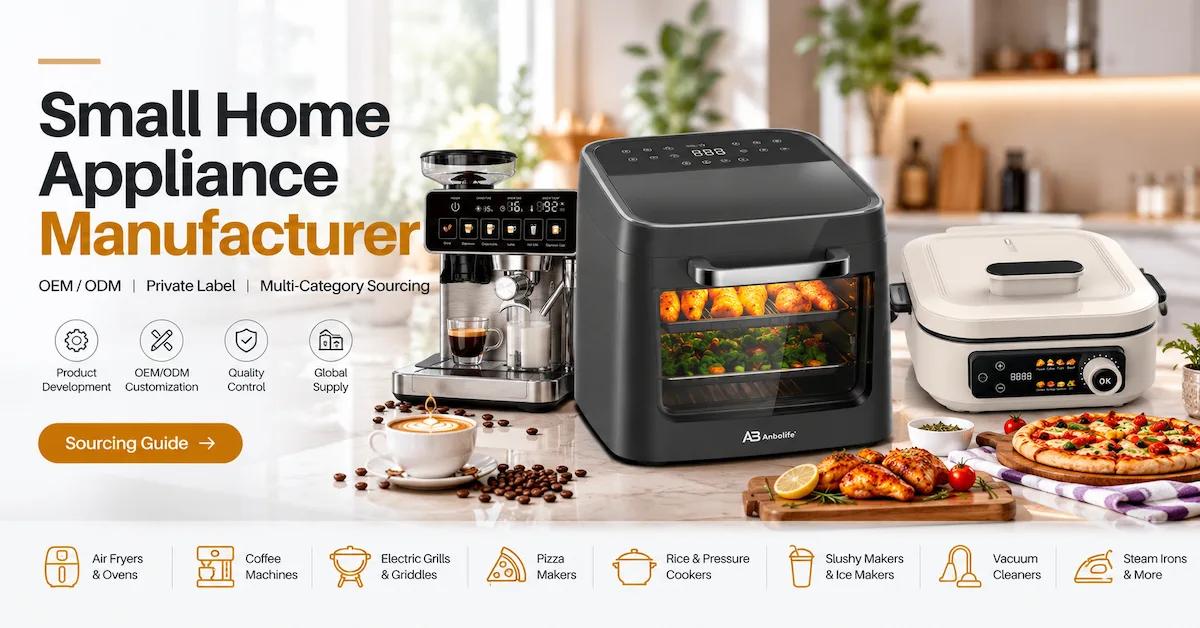
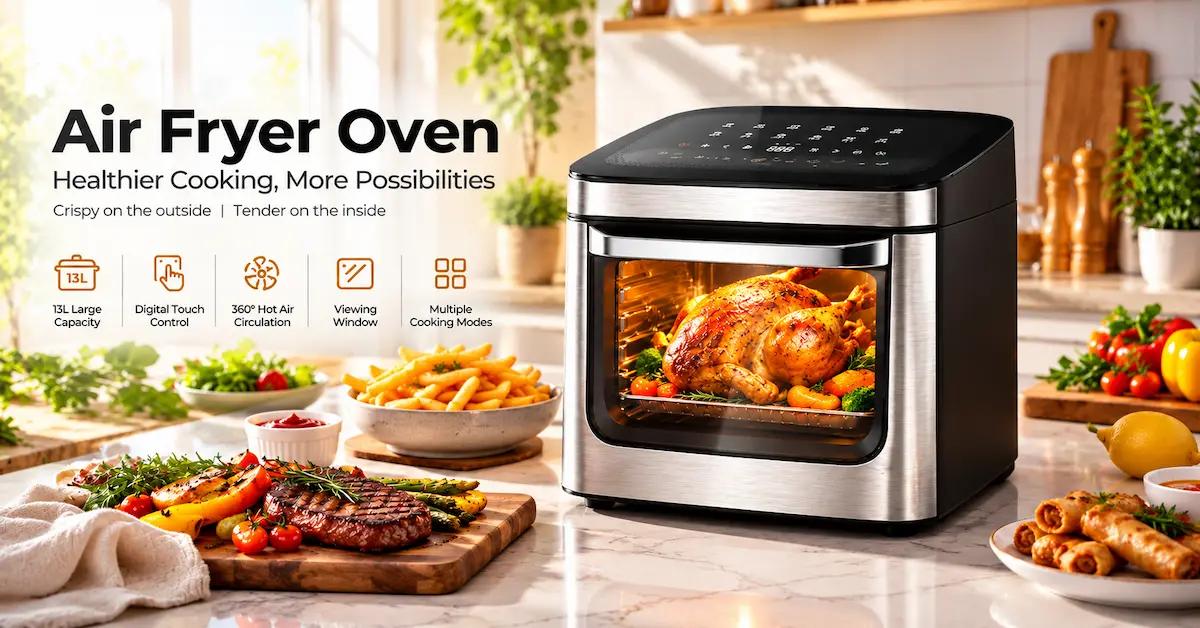
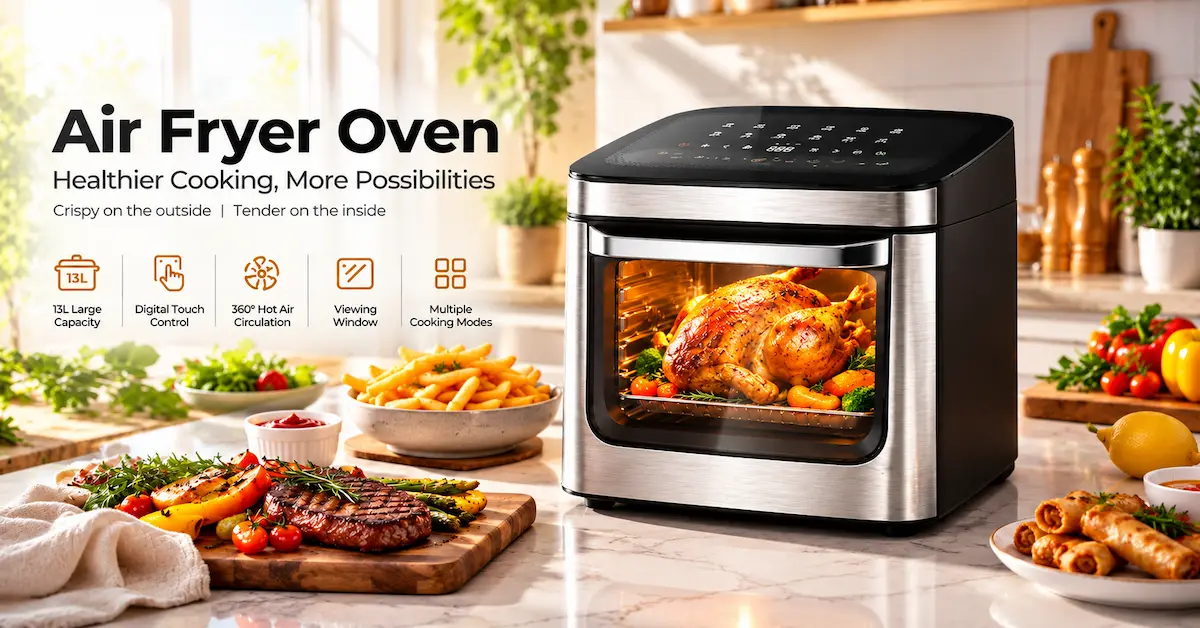
For example, ANBOLIFE offers home appliance manufacturing and OEM/ODM project support for international brands and importers. Its JL Air Fryer 13L-1 provides a practical reference for evaluating an oven-style air fryer with digital controls, a viewing window, and a multi-level rack arrangement.
This guide explains the technical and commercial questions buyers should ask before selecting an air fryer oven manufacturing partner.
1. Air Fryer Oven vs Basket Air Fryer: Which Is Better for Your Market?
Before contacting suppliers, buyers should decide which air fryer structure best matches their target customers.
Basket-style air fryers and oven-style air fryers both use heated air circulation, but their physical construction and user experience differ.
Air Fryer Design Comparison
| Evaluation factor | Basket-style air fryer | Oven-style air fryer |
|---|---|---|
| Cooking chamber | Removable drawer or basket | Oven cavity with racks or trays |
| Food arrangement | Usually concentrated within a basket | Food can be positioned at different levels |
| Product footprint | Depends on capacity and housing | Depends on oven dimensions and layout |
| Accessories | Basket and selected inserts | May include racks, trays, or other accessories |
| Food visibility | Depends on window design | Often features a front viewing window |
| Cleaning | Basket accessibility is important | Racks, cavity and door require attention |
| Retail positioning | Convenient countertop air frying | Multifunction countertop cooking |
Neither design is automatically more energy-efficient or better at cooking every food type.
Performance depends on the actual heating system, airflow, cooking load, operating program, and test conditions.
For retailers serving customers who value a compact and simple cooking experience, basket-style models may be appropriate.
For brands promoting flexible rack arrangements and a more oven-like cooking experience, oven-style models may offer a different product position.
The decision should be supported by actual dimensions, usable cooking area, performance testing, and consumer requirements rather than nominal capacity alone.
2. What Technical Specifications Matter When Sourcing an Air Fryer Oven?
An air fryer oven's specifications directly influence manufacturing cost, consumer experience, electrical compatibility, and product compliance.
A well-prepared purchasing team should obtain a complete technical datasheet before requesting a final quotation.
Essential Air Fryer Oven Specification Checklist
| Specification | Why buyers should verify it |
|---|---|
| Rated capacity | Understand the manufacturer's capacity definition |
| Usable cooking space | Determine practical food and accessory placement |
| Rated power | Evaluate electrical requirements and cooking-system design |
| Rated voltage and frequency | Confirm suitability for the destination market |
| Temperature range | Check the available operating conditions |
| Temperature control | Evaluate control accuracy and repeatability |
| Heating elements | Understand heating configuration and component requirements |
| Air circulation system | Assess fan design and cooking uniformity |
| Control interface | Confirm programs, display, buttons and user functions |
| Cooking accessories | Define racks, trays and other included components |
| Product dimensions | Assess countertop suitability and shipping requirements |
| Construction materials | Review housing, cavity and food-contact components |
| Safety protection | Confirm applicable thermal and electrical safeguards |
| Certification documents | Verify the selected model and market requirements |
Buyers should distinguish published specifications from values that are still under review.
Case Study: ANBOLIFE JL Air Fryer 13L-1
The JL Air Fryer 13L-1 is an oven-style air fryer listed in ANBOLIFE's product portfolio.
Its published specifications provide a useful starting point for a 13L air fryer sourcing project.
| Product information | Published status |
|---|---|
| Model | JL Air Fryer 13L-1 |
| Product type | Air Fryer Oven |
| Rated capacity | 13L |
| Control system | Digital touch panel |
| Viewing window | Yes |
| Rack arrangement | Multi-level design |
| Appearance | Black with metallic-style accents |
| Intended application | Household kitchen appliance |
| Rated power | To be confirmed |
| Rated voltage | To be confirmed |
| Temperature range | To be confirmed |
| Product dimensions | To be confirmed |
| Standard accessories | To be confirmed |
| Model-specific certifications | To be confirmed |
The product's stated features include a transparent front window and top-mounted digital controls.
However, buyers should not infer the exact cooking programs, temperature settings, heating power, or standard accessory package from product photographs.
For a private-label project, ANBOLIFE can be contacted to confirm the complete specification, available configurations, samples, and commercial requirements.
3. How Should Buyers Evaluate Heating Performance and Airflow?
Heating performance is one of the most important differences between air fryer oven models.
An appliance may reach its programmed temperature while producing different cooking results at different rack positions.
For that reason, buyers should evaluate temperature behavior under representative operating conditions.
Four Technical Areas Worth Testing
Temperature stability
Evaluate how the cooking temperature behaves during normal operation. Buyers should define measurement locations, loading conditions, operating modes, and acceptance limits before testing.
Heating uniformity
Examine cooking consistency at different positions in the chamber. A multi-level rack design may provide flexible placement, but it does not automatically guarantee identical heating results across all levels.
Air circulation
The fan and internal airflow path influence heat distribution. Buyers should consider whether the design supports the intended cooking applications and whether airflow is affected by accessory placement.
Control consistency
Review how the appliance responds to selected temperature and time settings. Touch controls should operate reliably, and the final instruction manual should accurately describe available functions.
Recommended Sample Performance Checks
| Test | Practical evaluation |
|---|---|
| Preheating | Record the time and conditions required to reach a defined temperature |
| Temperature behavior | Observe performance at selected operating settings |
| Multi-rack cooking | Compare results across approved rack positions |
| Control operation | Check buttons, display and available functions |
| Door operation | Assess opening, closing and repeated handling |
| Cleaning access | Review cavity, rack and window accessibility |
| Noise | Measure under clearly defined operating conditions |
Testing procedures should be appropriate to the final product design. The table provides procurement evaluation topics, not a claim that a particular ANBOLIFE model has achieved specific test results.
4. What Materials and Components Affect Air Fryer Oven Quality?
The long-term quality of an air fryer oven depends on more than its exterior finish.
Heating elements, electrical connections, temperature sensors, fan components, internal surfaces, door assemblies, and control boards all contribute to the finished appliance.
Buyers should identify which parts are critical to product performance or safety and establish appropriate controls.
Important Component Evaluation Areas
| Component | Purchasing consideration |
|---|---|
| Heating elements | Specification, installation and component consistency |
| Fan and motor | Operating behavior, mounting and reliability |
| Temperature sensor | Placement, measurement and control integration |
| Electronic control board | Functions, approved configuration and change control |
| Door assembly | Fit, movement, visibility and construction |
| Internal cavity | Materials, cleaning requirements and durability |
| Cooking racks | Dimensions, surface treatment and load suitability |
| Power cord and plug | Destination-market electrical requirements |
Food-contact materials and coatings require particular attention.
A general claim that a product uses safe materials is not a substitute for evidence showing that the specific materials are appropriate for their intended use.
The relevant material requirements depend on the product construction, contact conditions, and destination market.
When evaluating an air fryer oven factory, ask how changes to critical components are approved.
A component substitution should not be treated as an insignificant purchasing decision when it may affect performance, safety, or existing compliance evidence.
5. Can an Air Fryer Oven Manufacturer Support OEM/ODM Customization?
Private-label appliance buyers often require a product that fits their brand identity, packaging system, and market positioning.
However, there is an important distinction between branding an existing appliance and changing its technical design.
Common Customization Areas
| Customization type | Examples | Buyer considerations |
|---|---|---|
| Branding | Logo placement and printing | Appearance approval |
| Housing appearance | Color and selected finish options | Material and manufacturing feasibility |
| Retail packaging | Box graphics and protective inserts | Packaging approval and transport suitability |
| Product documentation | Instructions, labels and barcode information | Language and market requirements |
| Electrical configuration | Voltage and plug requirements | Safety and compliance review |
| Control functions | Selected interface or operating changes | Engineering and testing implications |
| Accessories | Proposed rack or tray configurations | Compatibility and product evaluation |
ANBOLIFE's OEM/ODM service describes support for product requirements, sample confirmation, branding, packaging, production and inspection.
Customization options depend on the selected model and approved project requirements.
For example, a brand considering the JL Air Fryer 13L-1 may wish to discuss customized retail packaging, logo placement, and destination-market electrical requirements.
Those requests should be reviewed individually. They should not be interpreted as a guarantee that every structural or electronic modification is available.
OEM or ODM: Which Route Should You Choose?
OEM generally suits buyers with defined drawings, specifications, and technical requirements.
ODM generally suits buyers beginning with an existing product direction and seeking permitted modifications.
The choice depends on your design assets, customization requirements, development budget, and target launch schedule.
For many private-label buyers, starting with an available air fryer oven platform can make early product evaluation more straightforward. The actual cost and schedule advantages must still be confirmed through quotation.
6. How Can Buyers Verify Air Fryer Oven Safety and Compliance?
Air fryer ovens are electrical heating appliances. Their compliance requirements depend on the final construction, intended application, destination market, and applicable regulations.
A manufacturer should be able to identify the product version covered by relevant technical documentation.
The IEC 60335 series provides an international framework for household and similar electrical appliance safety.
IEC 60335-1 addresses general safety requirements, while IEC 60335-2-9 addresses particular requirements for grills, toasters and related portable cooking appliances. Buyers should verify the applicable edition and national adoption for their product.
For European markets, relevant obligations may include electrical safety, electromagnetic compatibility, restricted substances, and product documentation, depending on the product and applicable legislation.
Other markets have their own requirements and approval procedures.
Documents to Request Before Bulk Ordering
-
Product-specific electrical safety test reports.
-
Applicable conformity declarations and certificates.
-
Model and electrical-rating identification.
-
Information on covered product configurations.
-
Required product labels and user instructions.
-
Relevant food-contact material documentation.
-
Records of modifications that may affect testing.
A certificate for one model does not automatically cover another model or an altered electrical configuration.
ANBOLIFE explains that testing and documentation should be matched to the selected model and destination market through its quality and certification process.
Buyers should request the actual applicable documentation rather than relying only on company-level certification information.
7. How Should Air Fryer Oven Samples Be Evaluated?
Sample approval should happen before a private-label air fryer oven enters mass production.
A sample helps the buyer verify appearance, functions, materials, accessories, and other agreed requirements.
It also provides an opportunity to identify problems that may be costly to correct later.
Air Fryer Oven Sample Approval Checklist
| Evaluation item | What to check |
|---|---|
| Exterior appearance | Color, finish, gaps, printing and assembly |
| Product dimensions | Actual measurements against drawings |
| Cooking chamber | Rack fit, interior condition and usable space |
| Temperature system | Operation against agreed test criteria |
| Digital controls | Display, functions and control response |
| Viewing window | Visibility, fit and cleaning access |
| Accessories | Quantity, dimensions and installation |
| Electrical configuration | Ratings, plug and required documents |
| Retail packaging | Protection, markings and approved artwork |
| User manual | Functions, warnings and correct language |
A successful demonstration does not replace a documented inspection plan.
Buyers should identify the approved product version and define which changes require additional review.
When possible, maintain a reference sample and written acceptance requirements for subsequent production.
From Approved Sample to Mass Production
The production process should follow the approved specifications rather than an earlier development proposal.
ANBOLIFE publicly describes project stages covering the initial brief, design review, sample confirmation, branding and packaging, production, inspection, and shipment coordination.
A buyer should confirm the responsibilities and expected deliverables at each stage before authorizing production.
8. How Does Quality Control Affect Bulk Air Fryer Orders?
An air fryer oven may perform correctly during sample testing yet develop problems if component specifications or assembly procedures change during production.
Quality control should therefore cover incoming materials, production operations, relevant functional and electrical checks, and final inspection.
Recommended Production Quality Checkpoints
| Stage | Main objective |
|---|---|
| Incoming inspection | Verify specified components and materials |
| Assembly inspection | Confirm controlled assembly and workmanship |
| Functional checks | Assess agreed operating requirements |
| Electrical safety checks | Apply the appropriate approved test plan |
| Final product inspection | Review appearance, functions and labeling |
| Packaging inspection | Verify accessories, cartons and packing information |
Quality expectations should reflect the selected model and its actual risks.
A buyer may also specify an agreed sampling plan, defect categories, acceptance criteria, and corrective-action process.
Avoid treating a general factory inspection claim as proof of a particular model's reliability.
The most useful evidence is connected to the products and production batches being purchased.
9. What Determines Air Fryer Oven Manufacturing Cost and MOQ?
An air fryer oven quotation depends on more than capacity.
Component selection, heating and control systems, housing design, accessories, customization, packaging, testing, and order quantity all affect the commercial proposal.
A model with a larger stated capacity is not automatically more expensive or more suitable than another design.
Main Cost Drivers
| Cost factor | Why it matters |
|---|---|
| Heating and airflow system | Component specifications and assembly |
| Digital controls | Display and electronic configuration |
| Housing and door design | Materials, construction and finishing |
| Cooking accessories | Included racks, trays and other parts |
| Branding | Logo application and product appearance |
| Packaging | Retail presentation and transport protection |
| Compliance work | Applicable verification and documentation |
| Order quantity | Purchasing and production arrangements |
| Logistics | Carton dimensions, freight and shipping terms |
For importers, the relevant financial comparison should include product cost, agreed customization charges, testing, inspection, packaging, transportation, and applicable import expenses.
What Is the MOQ for a Private Label Air Fryer Oven?
There is no universal MOQ for air fryer oven manufacturing.
The minimum order quantity may differ between an existing standard configuration and a project requiring customized components, tooling, or packaging.
Ask the manufacturer for a model-specific MOQ, sample cost, proposed production schedule, and price quotation based on your forecast.
ANBOLIFE invites bulk purchasing inquiries for the JL Air Fryer 13L-1, but its public product page does not establish a fixed MOQ or guaranteed lead time.
10. What Should Buyers Include in an Air Fryer Oven RFQ?
A complete request for quotation helps suppliers identify the required product configuration and reduces uncertainty during negotiation.
Recommended RFQ Information
| RFQ field | Information to provide |
|---|---|
| Product | Air fryer oven and reference model |
| Capacity | Required stated and usable capacity |
| Destination market | Country and relevant electrical requirements |
| Cooking functions | Required operating modes and controls |
| Technical requirements | Power, voltage, dimensions and accessories |
| Customization | Logo, appearance, packaging and documentation |
| Quantity | Trial order and estimated future demand |
| Sample requirements | Testing and approval expectations |
| Compliance | Applicable documents and verification needs |
| Commercial terms | Pricing, MOQ, payment and shipping conditions |
| Delivery | Target schedule and destination |
Example: RFQ for a 13L Private Label Air Fryer Oven
A brand could begin its request with the following product brief:
Product reference: JL Air Fryer 13L-1.
Market: Specify the intended country or region.
Product requirements: Confirm rated power, voltage, operating temperature, internal dimensions, cooking programs and standard accessories.
Branding: Request available logo and packaging options.
Quality requirements: Ask for relevant test documents, sample procedures and agreed inspection conditions.
Commercial requirements: Provide estimated order volume, target schedule and preferred shipping terms.
This gives the manufacturer enough information to identify missing technical decisions and prepare a relevant response.
Buyers can submit a project brief through the ANBOLIFE contact page.
11. Why Consider ANBOLIFE for Air Fryer Oven Sourcing?
ANBOLIFE presents itself as a home appliance manufacturer and OEM/ODM partner serving international brands, importers, retailers and distributors.
Its published product offering includes the JL Air Fryer 13L-1, an oven-style appliance with a stated 13L capacity, digital touch control panel, viewing window and multi-level rack arrangement.
The company also describes project support covering product review, sampling, customization, manufacturing coordination, quality inspection and shipment preparation.
For buyers planning private-label air fryer collections, the following pages provide starting points:
The final specifications, available customization, sample arrangements, MOQ, certification scope, and production terms must be confirmed for the selected project.
Frequently Asked Questions About Air Fryer Oven Manufacturers
1. What should I check before choosing an air fryer oven manufacturer?
Evaluate product specifications, heating performance, manufacturing processes, sample approval, quality control, compliance documentation, OEM/ODM options, and commercial terms. A supplier should clearly identify confirmed specifications and provide supporting evidence when required.
2. Is a 13L air fryer oven suitable for private-label brands?
A 13L oven-style air fryer may be suitable for brands targeting consumers who want a countertop appliance with flexible food placement. However, buyers should evaluate usable space, external dimensions, operating performance, accessories, and the intended retail market.
3. Can an air fryer oven manufacturer customize logos and packaging?
Many OEM/ODM suppliers offer branding and packaging discussions. Availability depends on the specific model, materials, customization scope, and order requirements. ANBOLIFE offers OEM/ODM project consultation, subject to confirmation.
4. What certifications should I request for an air fryer oven?
Request the safety and compliance evidence applicable to the exact model and destination market. Verify relevant standards, test reports, electrical configuration, issuing organization, scope, and document status.
5. How can I test air fryer oven heating performance?
Use a documented sample evaluation procedure with defined temperatures, cooking loads, rack positions and acceptance criteria. Assess temperature behavior, heating consistency, controls, door operation and relevant safety characteristics.
6. What is the typical MOQ for wholesale air fryer ovens?
MOQ varies by model, customization, components, packaging and production planning. Buyers should request a quotation based on the intended order quantity and approved product configuration.
Conclusion
Selecting an air fryer oven manufacturer requires careful evaluation of real product specifications, heating consistency, materials, quality control, compliance evidence, and OEM/ODM capabilities.
For brands and importers developing a 13L private-label air fryer, the most effective approach is to verify the available product configuration, approve a representative sample, and establish clear purchasing requirements before bulk production.
Explore ANBOLIFE's JL Air Fryer 13L-1, review its OEM/ODM manufacturing services, or contact ANBOLIFE to request technical specifications and a quotation.