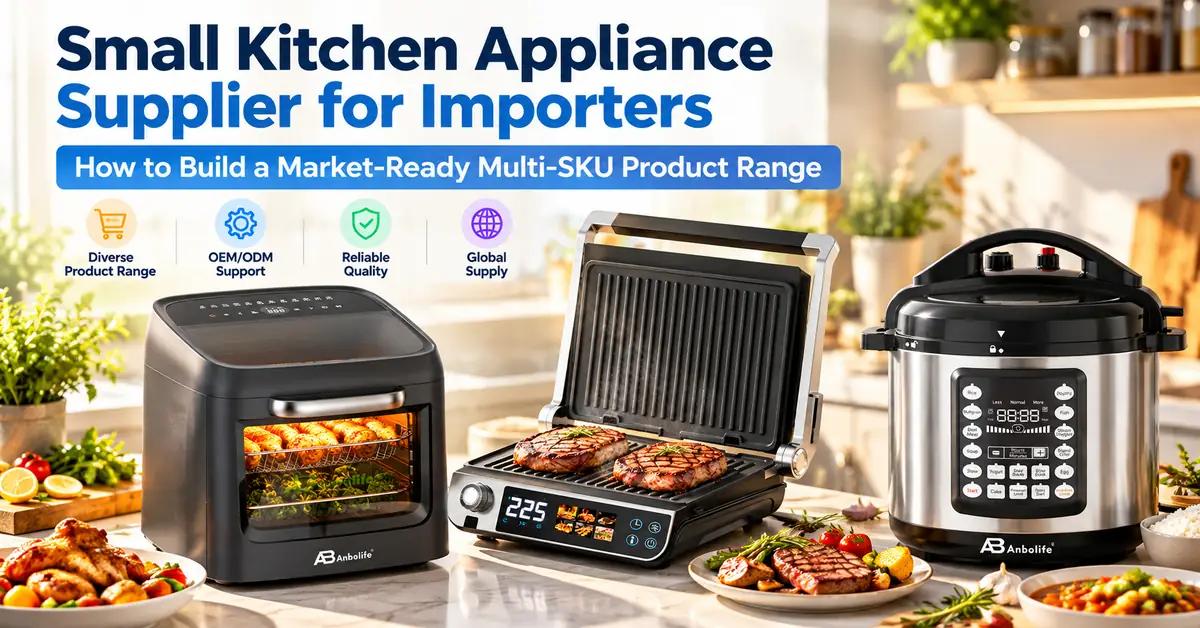
Finding a reliable small kitchen appliance supplier for importers requires more than comparing factory prices or browsing product catalogs. International importers must select appliances that match local demand, meet destination-market requirements, protect profit margins, and remain practical to distribute and support after shipment.
A successful sourcing strategy starts with a focused product portfolio, verified technical specifications, model-specific compliance documentation, realistic landed-cost calculations, and an agreed quality-control process. For importers building private-label or wholesale ranges, OEM/ODM capabilities and repeat-order consistency are equally important.
ANBOLIFE is a China-based home appliance manufacturing and development partner serving international brands, importers, wholesalers, retailers, and distributors. Its primary kitchen appliance categories include air fryers, coffee machines, electric grills, and pizza makers, with additional selected cooking and beverage appliances.
This guide explains how importers can structure a multi-SKU sourcing program, compare kitchen appliance platforms, reduce import-related risks, and prepare a commercially useful RFQ before committing to production.
1. What Should Importers Expect from a Small Kitchen Appliance Supplier?
A dependable small kitchen appliance supplier should help buyers connect product selection with the practical requirements of international distribution.
For importers, the purchasing decision involves five interconnected areas:
-
Product-market fit: Does the appliance solve a recognizable need for the intended customer?
-
Technical suitability: Are its capacity, dimensions, power requirements, features, and materials appropriate?
-
Market compliance: Is the required documentation available for the exact model and destination market?
-
Commercial viability: Can the expected selling price support freight, import duties, distribution costs, and after-sales service?
-
Supply continuity: Can the agreed configuration be reproduced consistently for future orders?
These requirements explain why the lowest unit quotation is not always the best purchasing option.
An inexpensive appliance may create additional costs through excessive packaging volume, unsuitable electrical specifications, inconsistent performance, or unsupported replacement parts.
Importers should therefore evaluate complete procurement programs rather than isolated product prices.
Which Buyers Benefit Most?
This sourcing approach is particularly suitable for household appliance importers, regional distributors, retail purchasing teams, online private-label brands, and wholesalers expanding their countertop appliance collections.
It is less suitable for buyers who expect every household model to withstand intensive commercial foodservice use without separate duty-cycle and safety verification.
2. Build a Focused Kitchen Appliance Portfolio Before Requesting Quotations
One of the most common import mistakes is selecting too many products before confirming market demand and operating requirements.
A large catalog creates opportunities, but it also increases complexity.
Every additional SKU may introduce different spare parts, packaging dimensions, electrical requirements, inventory risks, and customer-support needs.
A practical starting point is to choose a small number of complementary appliances serving a clearly defined customer segment.
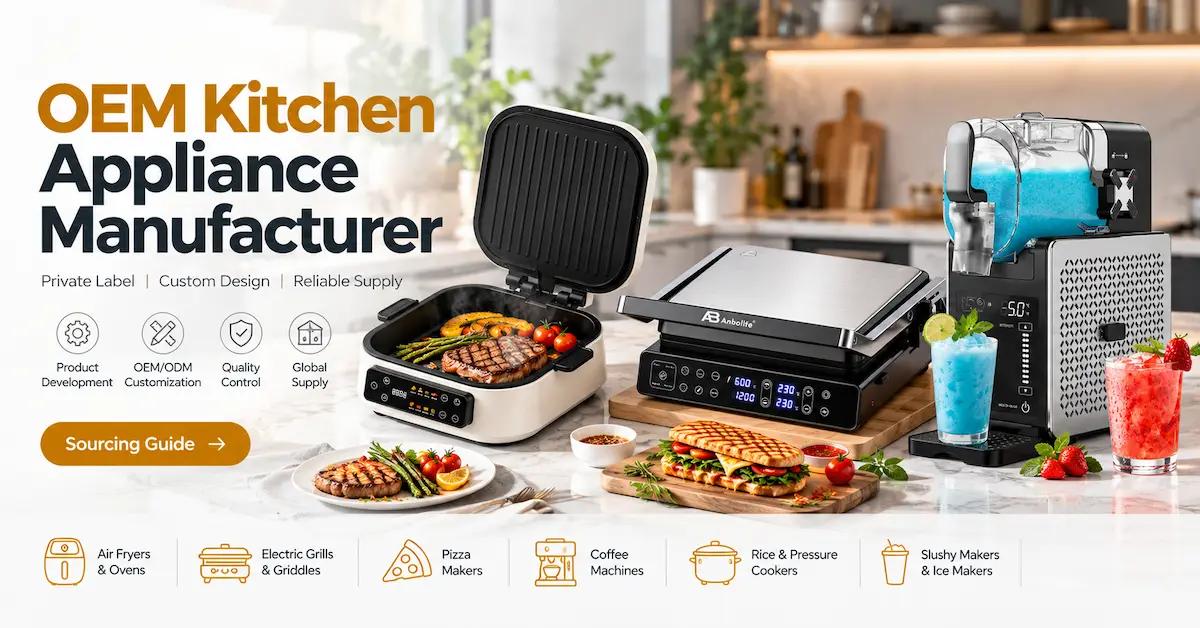
ANBOLIFE Kitchen Appliance Portfolio
ANBOLIFE's kitchen appliance product catalog provides several product directions for importers building cooking and beverage ranges.
| Product category | Available product direction | Typical target market | Important buying criteria |
|---|---|---|---|
| Air Fryers & Ovens | 13L oven-style air fryer | Family kitchen and countertop appliance retail | Usable capacity, controls, accessories, cleaning |
| Coffee Machines | Automatic espresso machine with grinder | Home coffee appliance brands | Brewing workflow, grinder, milk system, maintenance |
| Pizza Maker Ovens | BP-PA18 multifunction electric pizza maker | Home cooking and specialty kitchenware | Heating configuration, controls, cooking surfaces |
| Electric Grills & Griddles | Four-slice electric Panini grill | Breakfast and indoor cooking appliances | Plate area, temperature control, handling |
| Rice Cookers category | 6L/8L electric pressure cooker | Family cooking and multicooker retail | Pressure safety, capacity, inner pot |
| Slushy Makers & Ice Makers category | Frozen beverage/slushie machine | Seasonal beverage appliance retail | Cooling performance, batch capacity, cleaning |
The product directions above represent different purchasing opportunities rather than a claim that every model has identical configuration or certification options.
For example, the currently listed 6L/8L appliance is an electric pressure cooker. Buyers should not treat it as an ordinary non-pressure rice cooker without checking its functions.
Likewise, a slushie machine is not interchangeable with an ice-making appliance.
Which Products Should Importers Prioritize?
Product selection should reflect the intended retail customer.
For a family kitchen appliance range, an air fryer oven and a multifunction cooking appliance may create a coherent product offering.
For a more specialized premium countertop range, an espresso coffee machine may provide a different retail positioning.
Importers seeking a breakfast-oriented portfolio might consider electric grills and compatible cooking appliances.
Start with the most commercially promising two or three SKUs, test them thoroughly, and expand only when the first products demonstrate acceptable quality, margins, and inventory performance.
3. Match Product Categories to Local Customers and Sales Channels
Different sales channels require different appliance characteristics.
| Importer customer | Main purchasing priorities | Recommended sourcing focus |
|---|---|---|
| Retail chains | Clear benefits, packaging, consistent supply | Proven product configuration and retail readiness |
| Kitchenware wholesalers | Competitive landed cost and repeat availability | Standardized SKUs and shipment planning |
| E-commerce brands | Differentiation and low damage risk | Private-label presentation and packaging tests |
| Regional distributors | Stable specifications and service support | Spare parts, documentation and replenishment |
| Premium appliance brands | Distinctive appearance and functionality | ODM feasibility and sample validation |
Country-specific preferences also matter.
Countertop space, household size, cooking habits, electrical systems, languages, and acceptable retail price points can influence the ideal product specification.
An importer serving several countries should not automatically assume one electrical or packaging version is suitable for every destination.
Procurement principle: Define the sales channel and end-user requirements before choosing appliances, rather than trying to create demand for unsuitable inventory.
4. Technical Specifications Importers Must Verify Before Bulk Purchasing
Technical documentation provides the foundation for reliable quotations, sample approval, and quality inspection.
Every shortlisted appliance should have a controlled specification sheet.
Essential Small Kitchen Appliance Specification Checklist
| Technical parameter | Required verification | Why it matters |
|---|---|---|
| Product identity | Model number and configuration revision | Prevents ordering the wrong variant |
| Voltage and frequency | Rated electrical requirements | Destination-market compatibility |
| Rated power | Confirmed product-specific value | Electrical safety and performance |
| Capacity | Nominal and usable capacity where relevant | Customer suitability |
| Product dimensions | External size and operating clearance | Countertop fit and storage |
| Heating or brewing system | Operating mechanism and controls | Consistent functionality |
| Food-contact materials | Actual material and coating specifications | Safety and regulatory review |
| Controls | Functions, display and operating instructions | Customer usability |
| Accessories | Included parts and replacements | Retail value and maintenance |
| Packaging | Retail carton and master carton dimensions | Freight and warehouse planning |
| Compliance | Reports covering the actual model | Import readiness |
Importers should request specifications for the precise electrical version being purchased.
Product photographs and model titles are useful references, but they do not replace approved technical documentation.
Model-Specific Technical Examples
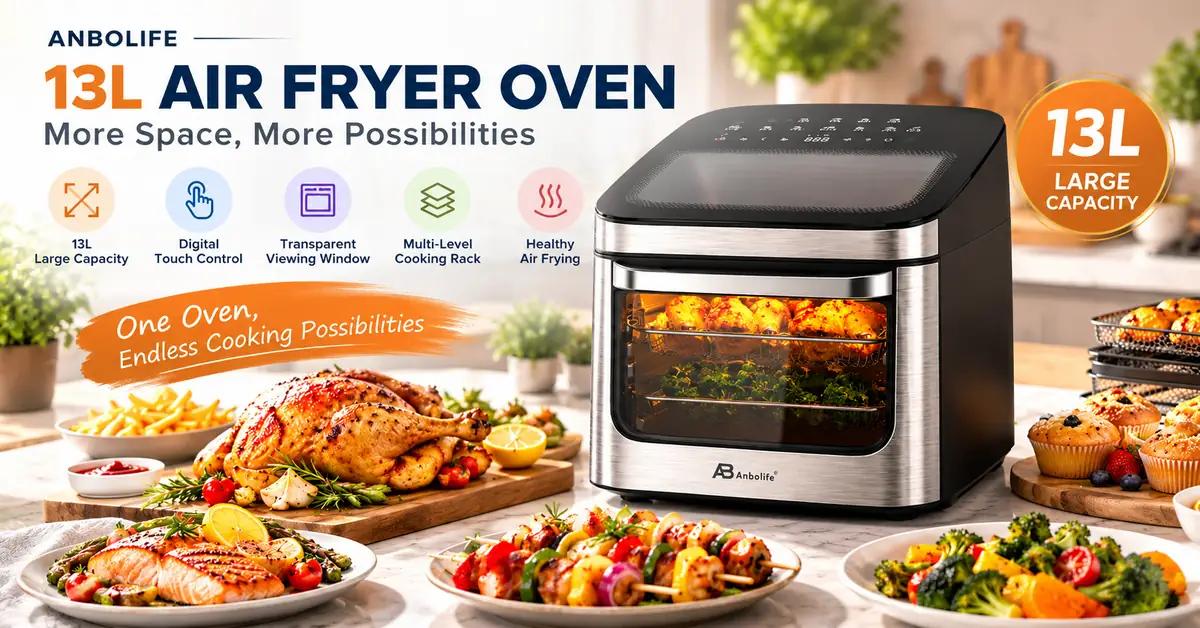
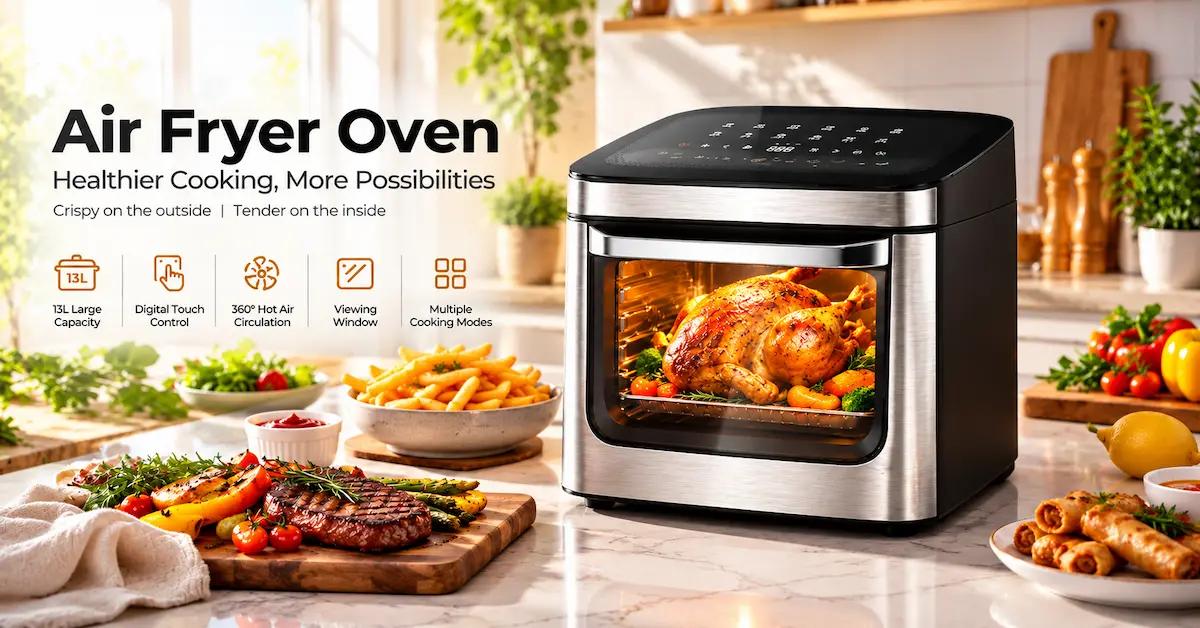
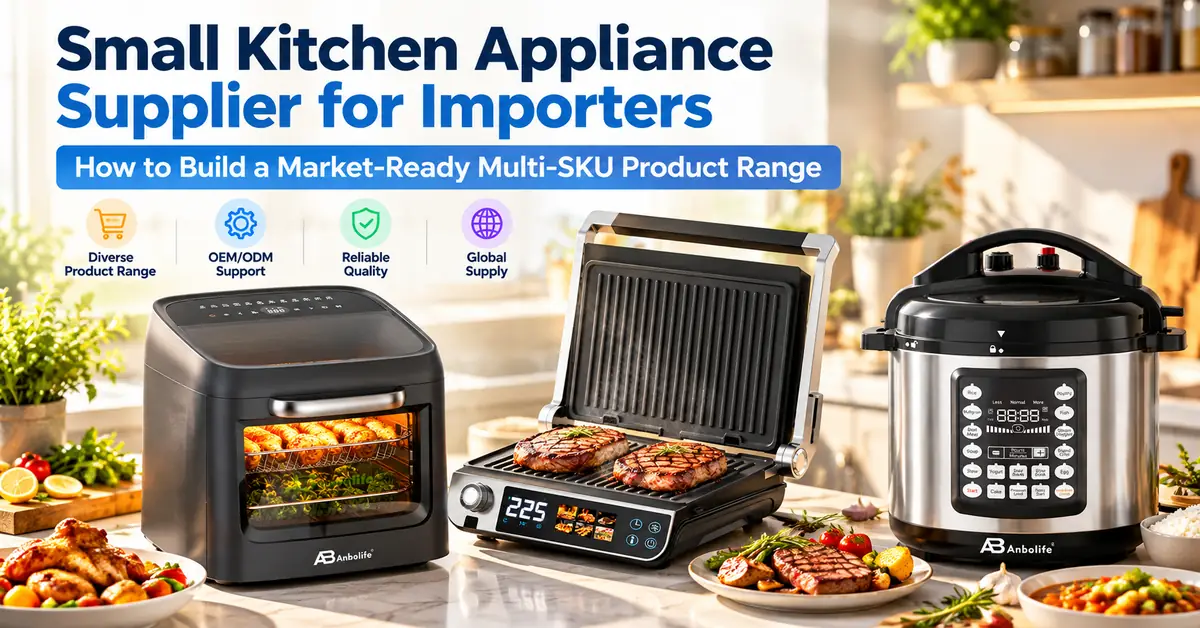
The ANBOLIFE 13L air fryer range includes an oven-style platform with digital controls and a viewing window.
For this category, importers should check usable tray space, accessory dimensions, heating consistency, and temperature controls.
The BP-PA18 electric pizza maker category offers a multifunction cooking direction involving upper and lower heating.
Buyers should evaluate cooking-surface materials, heating distribution, control functions, and operation in its different opening positions.
For automatic espresso coffee machines, the sourcing focus changes to grinder performance, water handling, brewing consistency, milk preparation, and cleaning requirements.
These distinctions make category-specific sample testing essential.
5. Compare Appliance Platforms by Commercial and Technical Risk
When importing several product categories, buyers should compare more than features.
Each appliance introduces a different operational risk profile.
Product Platform Comparison for Importers
| Appliance platform | Main product value | Main technical risk | Importer priority |
|---|---|---|---|
| 13L air fryer oven | Multifunction family cooking | Heating consistency and usable capacity | Cooking tests and accessories |
| BP-PA18 pizza maker | Versatile countertop cooking | Heating zones and surface performance | Temperature and safety verification |
| Automatic espresso machine | Integrated coffee preparation | Grinder and milk-system maintenance | Repeatability and spare parts |
| Four-slice Panini grill | Convenient indoor grilling | Plate coating, hinge and heat control | Surface durability and cleaning |
| 6L/8L pressure cooker | Larger-capacity pressure cooking | Pressure system and sealing | Safety testing and instructions |
| Slushie machine | Frozen beverage preparation | Cooling performance and maintenance | Batch testing and cleaning |
This comparison is designed for purchasing evaluation, not as a ranking of product quality.
A buyer should never approve a higher-risk appliance solely because it offers a lower price or an attractive retail presentation.
In particular, pressure-cooking systems and water-contact electrical appliances require careful attention to their applicable safety and material requirements.
6. Materials, Components and Manufacturing Workmanship
Product reliability depends on the interaction between design, component selection, manufacturing processes, and assembly quality.
Important kitchen appliance components may include heating elements, thermostats, control boards, wiring, seals, hinges, motors, metal parts, plastic housings, and food-contact surfaces.
Different appliances require different critical-component controls.
For an electric grill, plate coating and hinge durability may be important. For an air fryer oven, heating performance, airflow, controls, and door construction deserve attention.
For an espresso machine, the water path, grinder, brewing system, and removable cleaning components are central to the user experience.
Importers should request material specifications and, where appropriate, supporting documents for parts that contact food.
They should also ask whether critical component substitutions require prior approval.
ANBOLIFE describes engineering review, production equipment, assembly, and inspection through its manufacturing capabilities.
For an actual order, buyers should confirm which processes and inspections apply to their selected model rather than relying only on company-wide manufacturing descriptions.
7. How Should Importers Verify Kitchen Appliance Safety and Compliance?
Regulatory readiness is one of the most important responsibilities of international appliance importers.
Requirements depend on the product type, destination country, electrical characteristics, materials, and applicable legislation.
European Union Market
The European Commission explains that importers placing goods from non-EU countries on the EU market must verify compliance with applicable requirements, including the availability of relevant technical documentation and conformity information.
For applicable appliances, the review may involve electrical safety, electromagnetic compatibility, restricted substances, labeling, and traceability.
Importers must identify the exact requirements for each model rather than relying on a general supplier statement.
Food-Contact Materials
Regulation (EC) No 1935/2004 establishes the EU framework for food-contact materials.
The European Commission identifies requirements intended to prevent materials from transferring constituents into food in harmful amounts or adversely changing food characteristics.
For kitchen appliance sourcing, the relevant review may involve cooking plates, inner pots, removable trays, water-contact parts, and other applicable components.
Electrical Safety Standards
IEC 60335-1 provides general safety requirements for household and similar electrical appliances.
Product-specific standards and applicable national or regional versions must also be considered.
A report should be checked for its product model, tested configuration, standard edition, scope, and issuing organization.
ANBOLIFE Compliance Documentation
ANBOLIFE presents selected product testing and certification documents on its Quality & Certifications page.
However, documents for one air fryer, coffee machine, or other appliance do not automatically cover another product.
Importers should request a model-specific compliance document package before final purchase approval.
That package should identify applicable requirements, product specifications, test evidence, labeling, instructions, and other information needed for the destination market.
8. Quality Control: From Sample Approval to Container Shipment
A small kitchen appliance supplier should provide a clear method for connecting approved samples with the products ultimately shipped.
Step 1: Incoming Component Inspection
Relevant components should be checked against agreed specifications before assembly.
The inspection requirements depend on the product design and the importance of individual components.
Step 2: In-Process Inspection
Production checkpoints should review assembly quality, relevant wiring, mechanical fit, surface finishes, and other model-specific characteristics.
Step 3: Functional and Safety Testing
Functional tests should cover the agreed operating modes.
Applicable electrical safety checks should be documented according to the selected model.
Step 4: Finished Product Inspection
Finished appliances should be checked for appearance, functionality, accessory completeness, labeling, and packaging accuracy.
Step 5: Pre-Shipment Verification
Before shipment, the importer should confirm purchase-order consistency, carton information, model identifiers, quantities, and agreed inspection results.
ANBOLIFE states in its company profile that it inspects all products before shipment and performs high-voltage testing on AC-powered products.
Importers should confirm the exact inspection procedures, records, and acceptance criteria for their specific appliance program.
Important: A manufacturer's internal inspection is not automatically equivalent to an independent third-party inspection. Buyers should decide whether additional verification is appropriate for the order's risk level.
9. MOQ, Production Capacity and Lead Time for Multi-SKU Imports
A multi-product import program requires more detailed planning than a single-SKU order.
Each appliance may have a different minimum order quantity, packaging arrangement, component supply schedule, and production lead time.
ANBOLIFE reports a 30,000 m² facility, 800 employees, 20 engineers, and a broad home appliance portfolio in its company profile.
These company-level figures provide useful background, but they do not establish a guaranteed MOQ or production capacity for every kitchen appliance category.
Questions Importers Should Ask
-
What is the MOQ for each selected product and customization version?
-
Can several SKUs be coordinated within one purchasing program?
-
Which packaging or design changes affect order quantity?
-
When does the production lead-time calculation begin?
-
Are there separate schedules for samples, artwork, production, and inspection?
-
What happens if one product category is ready before another?
Importers should confirm all answers in writing.
Mixed-SKU coordination may offer logistical advantages, but it should not be described as guaranteed mixed-container availability without project-specific confirmation.
10. Calculate Total Landed Cost Instead of Comparing Unit Prices Alone
Wholesale prices provide only part of the financial picture.
An importer must also consider the costs of bringing products into inventory and preparing them for sale.
Small Kitchen Appliance Landed-Cost Framework
| Cost component | Examples |
|---|---|
| Product procurement | Agreed factory price for the approved configuration |
| Customization | Branding, tooling, packaging and artwork where applicable |
| Testing and inspection | Product assessment and additional verification |
| Origin-side logistics | Handling and transport under the agreed terms |
| International freight | Sea, air or other transport |
| Insurance | Cargo coverage where arranged |
| Import duties and taxes | Destination-specific obligations |
| Local logistics | Customs handling, storage and domestic delivery |
| After-sales provision | Spare parts, warranty service and expected returns |
Landed cost per saleable unit can be estimated by dividing the relevant total landed expenditure by the number of saleable units received.
For a useful comparison, apply the same accounting treatment and delivery assumptions to every supplier quotation.
The International Chamber of Commerce's Incoterms 2020 rules define the allocation of specified delivery obligations, costs, and risks between buyers and sellers.
Importers should therefore identify the exact agreed Incoterm and named place when comparing quotations.
Why Packaging Dimensions Matter
Two products with similar factory prices may have different shipping economics.
A large countertop appliance can occupy considerably more transport volume than a compact alternative.
Importers should request carton dimensions, gross weight, packing quantity, and verified container-loading information before estimating freight costs.
These details may materially affect the final margin.
11. Reduce Inventory Risk with a Multi-SKU Procurement Plan
Successful importers balance product diversity against inventory exposure.
A practical portfolio can separate products into three purchasing roles.
Core SKUs: Products with the strongest expected repeat demand and operational familiarity.
Differentiation SKUs: Products intended to create distinct retail value or support private-label positioning.
Test SKUs: Smaller-scale commercial opportunities that require additional demand validation.
Importers should evaluate likely selling periods, after-sales requirements, spare-parts complexity, and replenishment timing for each group.
For instance, frozen beverage appliances may have different seasonal demand patterns from general countertop cooking products.
A useful inventory plan also includes clear product identifiers, replacement-parts arrangements, packaging revisions, and procedures for handling product changes.
The goal is not to maximize the number of available items. It is to develop a manageable product range that can be supported profitably.
12. OEM/ODM Kitchen Appliances: Build a Differentiated Import Product Range
OEM and ODM services allow importers to align kitchen appliances with their sales channels and brand identity.
ANBOLIFE offers both customer-specified OEM projects and ODM development based on existing product directions.
Through its OEM/ODM service, buyers can discuss product specifications, logo application, colors, finishes, packaging, manuals, and selected configuration changes.
Available modifications depend on the model and approved project scope.
OEM vs. ODM Comparison
| Project type | Starting point | Main consideration |
|---|---|---|
| OEM manufacturing | Buyer's drawings and specifications | Engineering feasibility and approved requirements |
| ODM development | Existing product direction | Available modifications and platform suitability |
| Private-label branding | Selected product configuration | Logo, packaging and brand presentation |
A simple packaging change and a major electrical redesign should not be treated as equivalent projects.
Before proceeding, buyers should determine which features are commercially essential and which can remain standard.
This distinction helps control development complexity and supports more accurate quotation comparisons.
13. Supplier Evaluation and RFQ Checklist for Importers
Before selecting a supplier, use a structured evaluation process.
A useful purchasing scorecard can assign attention to product suitability, technical documentation, quality evidence, customization, pricing transparency, and supply planning.
However, mandatory safety and compliance conditions should be treated as pass-or-fail requirements, not weaknesses that can be offset by lower prices.
Recommended Importer RFQ Information
| Information to provide | Why it matters |
|---|---|
| Target countries | Determines relevant market requirements |
| Product categories and reference models | Establishes the purchasing scope |
| Expected quantity by SKU | Supports quotation and production planning |
| Required electrical configurations | Prevents unsuitable market versions |
| Functional priorities | Defines sample testing |
| Packaging and branding needs | Establishes customization requirements |
| Documentation expectations | Supports import readiness |
| Delivery requirements | Clarifies logistics and scheduling |
| After-sales expectations | Supports long-term distribution |
ANBOLIFE's product and project pages provide a starting point for discussing a coordinated kitchen appliance purchasing program.
Importers can explore available models through the ANBOLIFE product catalog, review the available customization process, and submit a category-specific purchasing brief.
14. Frequently Asked Questions About Small Kitchen Appliance Suppliers
1. How do I choose a reliable small kitchen appliance supplier for importers?
Start by defining your target customers, preferred appliances, and destination markets.
Verify product specifications, sample performance, applicable compliance documents, manufacturing responsibilities, pricing, and after-sales arrangements.
Choose a supplier that can demonstrate how its proposed products meet your requirements rather than relying solely on a broad catalog or low quotations.
2. Can I import several different kitchen appliances from one supplier?
Potentially, yes. A multi-category supplier may support several appliance directions within one purchasing relationship.
However, each product can have different specifications, MOQs, testing requirements, packaging dimensions, and production schedules.
Confirm whether your selected SKUs can be coordinated within the desired ordering and shipment plan.
3. Which small kitchen appliances should importers source first?
The best starting products depend on consumer demand, retail positioning, technical requirements, and available after-sales resources.
Air fryers, electric grills, pizza makers, and coffee machines serve different buying occasions.
A focused initial range is generally easier to evaluate and manage than a large untested catalog.
4. What is the minimum order quantity for wholesale kitchen appliances?
There is no universal MOQ applicable to all appliance models.
Order minimums depend on product configuration, customization, packaging, components, and production requirements.
Ask ANBOLIFE for a quotation identifying the MOQ separately for each selected SKU and customization option.
5. What certifications do I need to import kitchen appliances?
Requirements depend on the destination market and product design.
Relevant considerations may include electrical safety, electromagnetic compatibility, material restrictions, food-contact requirements, labeling, and traceability.
Request documentation covering the exact production model, and confirm the obligations applicable to your importing business.
6. Can I customize appliances with my own brand and packaging?
ANBOLIFE offers OEM/ODM project support that includes branding and packaging discussions.
Potential changes can include logos, colors, retail boxes, manuals, labels, and selected product requirements.
The final customization scope, cost, MOQ, and development schedule require model-specific confirmation.
7. How can importers compare wholesale kitchen appliance prices accurately?
Compare quotations based on identical technical specifications, quality requirements, accessories, packaging, quantities, and trade terms.
Then calculate the relevant landed cost, including freight, customs expenses, local handling, and expected after-sales costs.
A lower factory quotation may not result in a better final margin.
8. How long does kitchen appliance production take?
Production timing depends on the selected models, component availability, customization, sample approval, testing, order quantity, and manufacturing schedule.
Importers should request written timing assumptions for each SKU.
A company-wide production-capacity figure should not be treated as a guaranteed order-specific lead time.
9. Why is sample approval important before bulk importing?
Sample approval allows buyers to evaluate actual cooking or beverage performance, materials, controls, safety requirements, cleaning, packaging, and usability.
An approved sample and specification document also provide references for production inspection.
This reduces the risk of receiving goods that differ from the expected configuration.
10. How can I request a multi-SKU kitchen appliance quotation from ANBOLIFE?
Prepare a list of the product categories you want to source, target markets, estimated quantities, preferred electrical configurations, customization requirements, and delivery expectations.
Include any reference models and documentation needs.
Submit your requirements through the ANBOLIFE contact page to discuss product availability, samples, technical specifications, MOQ, and quotation arrangements.
Conclusion
Selecting the right small kitchen appliance supplier for importers is fundamentally a portfolio-management and risk-control decision.
A successful import program requires more than competitive wholesale pricing. Buyers must identify suitable products, verify technical specifications, understand market responsibilities, calculate realistic landed costs, and establish inspection and replenishment procedures for each SKU.
For importers building a differentiated kitchen appliance range, OEM/ODM customization can provide additional opportunities, provided the technical and commercial requirements remain clearly defined.
ANBOLIFE supports international appliance projects through product development, manufacturing coordination, OEM/ODM services, sample evaluation, and quality inspection.
Its portfolio provides sourcing directions across air fryers, coffee machines, electric grills, pizza makers, and selected additional cooking and beverage appliances.
Explore ANBOLIFE's kitchen appliance product range to identify suitable products, or review its OEM/ODM manufacturing services to evaluate private-label opportunities.
Planning a multi-SKU kitchen appliance import program?
Contact ANBOLIFE with your target market, product shortlist, expected order quantities, and branding requirements to discuss model-specific specifications, samples, documentation, and wholesale quotation options.
Build your next appliance collection around verified product suitability, realistic commercial planning, and a sourcing partner that understands the requirements of international importers.