What Should Buyers Look for in a Slushie Machine Manufacturer?
A slushie machine manufacturer should do more than provide a product image and a unit price. For an importer, distributor, retail chain, or private-label brand, the supplier must help define the intended drinks, operating environment, product configuration, sample tests, cleaning process, documentation, packaging, and repeat-order requirements.
The most useful first question is not “How fast does the machine freeze?” It is: “Which drinks must this specific model prepare, under what conditions, and how will we verify the results?” A frozen beverage made from juice may behave differently from a sweetened soft drink, dairy-based frappe, or alcoholic recipe. The liquid formulation, starting temperature, fill volume, room conditions, and selected program can all affect texture and preparation time. A single demonstration cannot establish performance for every menu.
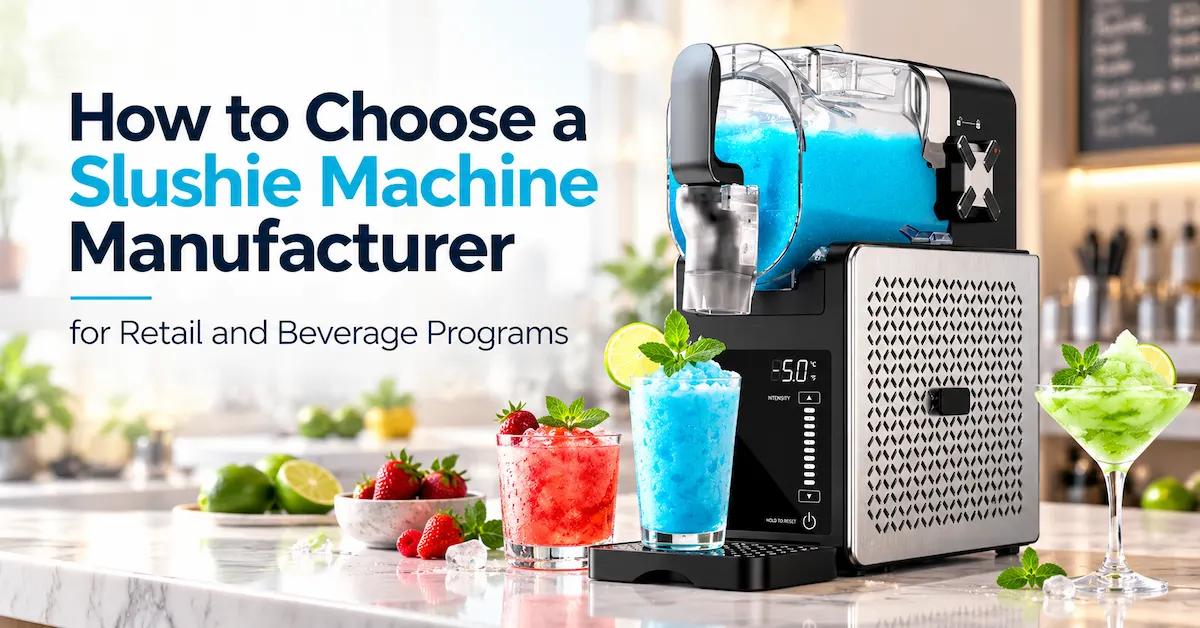
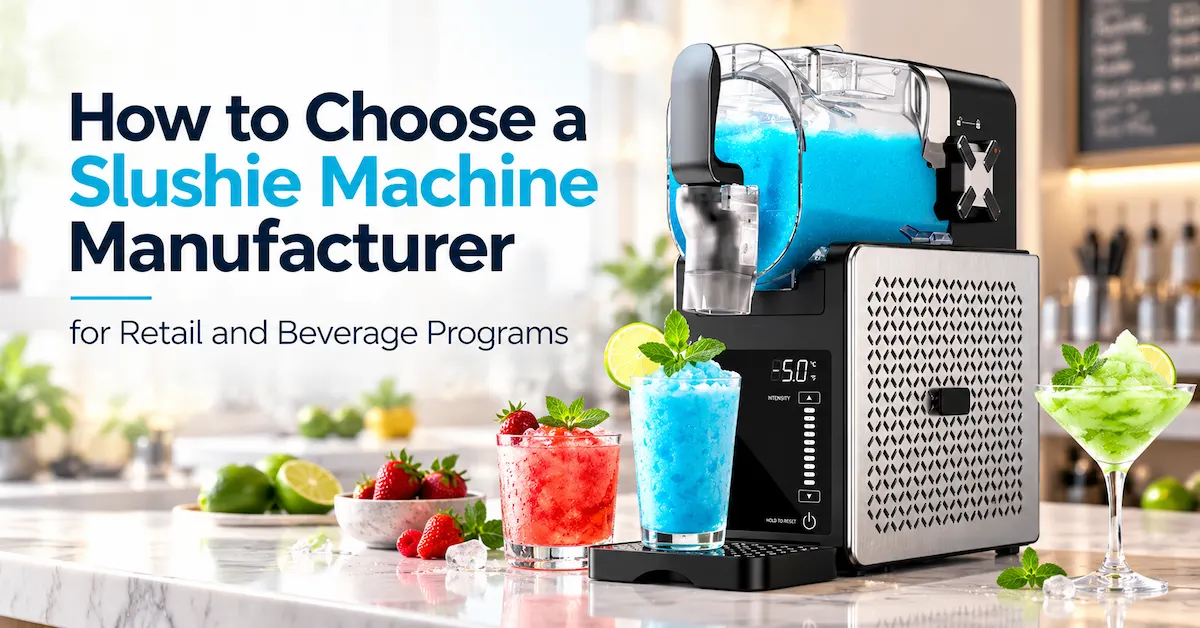
Anbolife lists a Professional Slushie Machine with Rapid Chill Technology and 5 Preset Programs. Its product page describes an electric machine for slushies and compatible frozen beverages, with rapid cooling technology. It positions the product for household beverage preparation, entertaining, retail distribution, private-label programs, and selected beverage-service settings.
That listing is a starting point for sourcing, not a complete technical specification. The page does not publish confirmed capacity, rated power, voltage, dimensions, weight, quantitative cooling time, or a detailed list of the five programs. Buyers should request the current model-specific specification and test a production-representative sample before making those claims in packaging or sales materials.
Define the Product Before Comparing Suppliers
“Slushie machine” is used for appliances with different intended users and operating patterns. Some are designed for occasional household drinks. Others are developed for repeated beverage service. A buyer should not assume that a product with “professional” in its name is automatically suitable for continuous commercial operation.
Household and Entertaining Programs
A household product may be purchased for family gatherings, parties, summer drinks, or occasional frozen beverages. These customers may value a compact footprint, straightforward controls, accessible cleaning, appealing appearance, and understandable recipes.
For this channel, ask whether the product can be demonstrated simply. Can a new user identify an appropriate drink setting? Can they remove or clean food-contact parts without a complicated procedure? Does the manual explain which liquids are suitable and which are not?
Household retailers also need accurate expectations. If the sales page suggests that every drink turns into slush at the same speed, customer disappointment may follow. Product content should explain that results depend on the approved recipe and operating conditions.
Selected Beverage-Service Settings
A café, snack shop, hotel, or event operator may be interested in frozen drinks, but its operational questions differ from those of a home user. It needs to know serving volume, repeat-cycle behavior, cleaning time, permitted recipes, placement clearance, noise, and service support.
The selected model should be evaluated against the actual daily workflow. How many drinks are needed during a busy period? Must the machine recover quickly after a batch? Is it operated by trained staff? How much time can staff allocate to cleaning? These questions determine whether the machine is suitable for that project. Do not label a model “heavy-duty commercial” without specific operating and test evidence.
Retail and Private-Label Programs
A private-label buyer needs product performance and a coherent brand experience. The machine, carton, recipe guidance, manual, control-panel language, photographs, and support policy must all describe the same configuration.
The buyer should decide which attributes are essential to the offer: a particular color, number of modes, removable drink container, beverage texture, recipe range, compact size, or price point. The manufacturer can then explain which attributes belong to an existing product platform and which require engineering or tooling.
Slushie Machine Versus Ice Maker or Blender
The Anbolife Slushy Makers & Ice Makers category advises buyers to separate frozen-drink preparation from ice production. These are distinct purchasing briefs with different inputs, outputs, and maintenance needs.
| Product type | Primary output | Main buying test | Common mistake |
|---|---|---|---|
| Slushie machine | A suitable liquid prepared as a frozen drink | Recipe compatibility, texture, serving volume, cleaning | Assuming it produces loose ice |
| Ice maker | Ice in a specified format | Ice output, storage, water supply, drainage | Assuming it prepares a finished beverage |
| Blender | Mechanically blended ingredients, often including added ice | Blending result, noise, blade access, cleaning | Assuming it chills liquid without added cooling |
A retailer can sell more than one of these appliances, but each needs its own product page and customer promise. A buyer seeking ready-to-serve slush should evaluate the drink-making workflow, not compare only the wattage or carton price of unrelated appliance types.
What Is Confirmed About the Anbolife Reference Product?
The Anbolife product listing confirms an electric slushie machine positioned for slushies and compatible frozen beverages. It describes rapid cooling technology and identifies possible applications including household drinks, parties, appliance retail, wholesale distribution, private-label programs, and selected cafés or beverage-service businesses.
Its title identifies five preset programs. However, the public specification section does not name or describe each program. The page also leaves capacity, rated power, voltage, dimensions, and weight for confirmation on the selected model. A buyer should therefore avoid converting the title into an unsupported menu chart.
The product listing mentions frozen juices and fruit-flavored drinks as potential applications, subject to compatibility. Its URL contains additional beverage words, but a URL is not technical evidence that every named drink is approved for the current production version. Ask for the manual and test report for each beverage category you intend to advertise.
A Model-Specific Specification Checklist
| Specification | Public-page status | Procurement action |
|---|---|---|
| Product type | Electric slushie machine | Confirm exact model identifier |
| Cooling concept | Rapid cooling technology described | Request operating description and sample test |
| Preset programs | Five stated in product title | Obtain program names, logic, and instructions |
| Suitable beverages | Slushies and compatible frozen drinks | Agree on test recipes and exclusions |
| Capacity | Not published | Confirm fill limits and usable serving volume |
| Rated power | Not published | Confirm for each electrical version |
| Voltage and frequency | Not published | Confirm for destination market |
| Dimensions and weight | Not published | Confirm product and carton measurements |
| Food-contact materials | Not published | Request component specifications and documents |
| Cleaning method | Not detailed | Test removal, washing, drying, and reassembly |
| MOQ and lead time | Not published | Request a project-specific quotation |
This distinction between confirmed, described, and to be verified information is important. It protects the buyer from building packaging, advertising, or a launch schedule around assumptions.
Evaluate Cooling Performance With Real Recipes
A useful sample evaluation begins with recipes that match the target customer. Testing only water or one demonstration liquid may tell a buyer very little about actual product performance.
Create a Recipe Test Matrix
Select a small number of representative drinks. For example, a household retail program might evaluate a fruit drink, a sweetened soft drink, and one additional recipe approved in the supplier’s instructions. A café project might also examine a recipe reflecting its actual menu.
For each recipe, record:
- Ingredient list and formulation
- Starting liquid temperature
- Fill volume
- Room conditions
- Selected program
- Time to the agreed serving state
- Texture and consistency
- Ease of dispensing or pouring
- Residual liquid or ice
- Cleaning effort afterward
Sugar concentration and alcohol content can change how a beverage freezes. Dairy or particulate ingredients may introduce different texture and cleaning issues. These are reasons to test each proposed recipe, not proof that the listed model accepts every formulation. Request the supplier’s approved ingredient limits and avoid testing unsuitable liquids contrary to the manual.
Define “Finished” Before Starting the Timer
“Ready in minutes” has little value without a defined endpoint. One reviewer may stop the timer when the first ice crystals appear; another may wait for a pourable, even slush. Agree on a practical serving standard before comparing products.
A simple test sheet can rate texture, pourability, uniformity, and customer suitability using the same criteria for every sample. Record the actual result rather than adjusting the endpoint to make a machine appear faster.
Test Repeatability
Run more than one batch under comparable conditions. Observe whether the second preparation behaves differently after the appliance has warmed, cooled, or been cleaned. If the target channel involves successive orders, a single first-batch demonstration is insufficient.
Do not promise an output rate or continuous-duty performance until a production-representative unit has been tested under a documented workload. The product page does not publish a verified hourly serving capacity.
Investigate a Poor Result Methodically
If a drink does not reach the desired texture, first check the recipe, fill level, starting temperature, program selection, placement, and operating instructions. Then compare the result with another sample of the same approved configuration. This helps distinguish user-method problems from a design or production issue.
The finding should be written in the sample report. “Texture not good” is hard for engineering and purchasing teams to resolve; “liquid remains uneven after the agreed cycle under the specified recipe and conditions” is more actionable.
Capacity, Serving Volume, and Placement
A tank or container capacity figure, once confirmed, does not by itself establish how many finished servings the appliance will produce. Buyers should distinguish between nominal container size, minimum and maximum fill marks, practical recipe volume, serving size, and any liquid remaining after dispensing.
For retail, the product page should explain the serving concept without implying that every full container yields a fixed number of cups. For beverage service, the buyer should test the actual portion size and how efficiently staff can refill, serve, and restart the machine.
Check the Installation Environment
Ask for the product’s dimensions, weight, ventilation clearances, electrical rating, recommended room conditions, and permitted countertop placement. A refrigeration-based or cooled beverage appliance should not be positioned where heat and restricted airflow undermine its intended operation. Follow the selected model’s installation instructions rather than a generic countertop-appliance rule.
A distributor should also consider whether the machine fits common shelves, kitchen counters, back bars, hotel service areas, and parcel packaging limits in its target market. These factors influence both customer satisfaction and landed cost.
Cleaning Is a Commercial Feature
Frozen beverage equipment touches sweet, acidic, dairy-based, or otherwise perishable ingredients depending on approved recipes. Cleaning design therefore affects hygiene, flavor carryover, staff time, reviews, and warranty questions.
The Anbolife category guide tells buyers to evaluate access to food-contact components and clarify maintenance steps. During sample review, ask a user unfamiliar with the machine to complete the prescribed cleaning procedure using only the supplied manual.
Record:
- Parts that can be removed
- Parts that must remain attached
- Tools required
- Access to corners and seals
- How liquid is drained
- Washing and rinsing steps
- Drying requirements
- Reassembly difficulty
- Time needed before the next use
- Any replacement consumables
Do not claim that a container, blade, paddle, or other component is dishwasher-safe unless the exact model’s manual confirms it. Likewise, avoid “self-cleaning” as a sales claim unless the feature and its limitations are documented.
Review the Instructions for Different Users
A household customer may need first-use instructions and simple cleaning diagrams. A café team may need a repeatable end-of-day procedure and clear responsibilities. If the product is being sold across markets, the translated manual must retain accurate ingredient, electrical, cleaning, and safety information.
For a private-label program, the buyer should approve the manual alongside the physical sample. A strong machine with poor instructions can still create avoidable complaints.
A Six-Stage Sample Approval Process
A sample should serve as the reference for production, not merely as a showroom demonstration. Both parties should know exactly what was tested and which changes remain open.
Stage 1: Identify the Configuration
Record the model and variant, electrical rating, plug, color, software or control version where relevant, container and food-contact materials, included parts, and proposed packaging. Photograph the sample and note whether it is fully production-representative.
If a different component or temporary artwork is used, mark it clearly. An unrecorded sample substitution can make later comparisons unreliable.
Stage 2: Inspect Appearance and Assembly
Check panel alignment, housing finish, container fit, lid closure, handle feel, buttons, printed text, feet, cable routing, and visible fasteners. Confirm that any removable part fits securely without excessive force.
Create a written appearance standard. “Premium finish” is subjective; agreed color references, photographs, allowable marks, and assembly tolerances are easier to inspect.
Stage 3: Run the Recipe Matrix
Prepare the drinks selected for the target market. Use the supplier’s permitted ingredients and operating instructions. Record starting conditions, fill volumes, settings, timing, finished texture, and serving result.
If the product title advertises five programs, ask the supplier to demonstrate all five and provide their names, intended recipes, and relevant restrictions. Do not assume that a program automatically validates every drink named in marketing material.
Stage 4: Review Repeat Use and Cleaning
Complete multiple normal cycles appropriate to the intended channel. Observe control behavior, vibration, noise, leaks, ease of serving, residue, and the prescribed cleaning sequence. A qualified specialist should handle any abnormal-condition or electrical testing under an approved procedure.
Stage 5: Review Documentation and Packaging
Check the user manual, product label, carton, accessories, recipe information, warnings, and replacement-part list against the actual sample. Confirm the language and electrical details required for the destination market.
Inspect how the container and vulnerable housing areas are protected in the box. A sample delivered by hand may not reveal damage risks present in export or parcel transport.
Stage 6: Sign Off the Production Reference
The approved reference should include the physical unit or controlled sample record, specification sheet, photographs, artwork revision, manual revision, inspection criteria, and any open items with owners and due dates.
Do not proceed to mass production while critical questions about performance, electrical configuration, food-contact materials, or market documentation remain unresolved.
Quality Control and Documentation
An effective quality system links the approved configuration to incoming materials, production checks, functional testing, packing inspection, and shipment records. Anbolife describes a project-specific quality path on its Quality and Certifications page, including incoming review, process inspection, safety checkpoints, and document verification.
For a slushie machine project, ask how the supplier checks:
- Cooling-system components against the approved specification
- Electrical parts, cable, and plug
- Container and food-contact parts
- Seals, fittings, and liquid-contact areas
- Control-panel response
- Assembly fit and appearance
- Normal operating functions
- Leakage under applicable test conditions
- Packaging contents and carton markings
The precise inspection plan should depend on the model and order. A company-level statement about quality control does not replace the selected product’s written acceptance criteria.
Verify Documents Against the Exact Version
Request documents applicable to the target market and selected electrical configuration. Check the product name or model, technical scope, issuing organization, report date, and validity where relevant. Food-contact information should address the actual materials in contact with the beverage, not an unrelated appliance.
Anbolife’s public certificate gallery includes selected documents for other appliance categories. Those images should not be treated as proof that this slushie machine has the same certification. Ask for model-specific evidence before making a compliance claim.
Control Changes Between Orders
A component or software change may affect drink results, cleaning, electrical behavior, or published specifications. The purchase agreement should define which changes require buyer notification and reapproval.
Repeat-order consistency matters for brands that have already invested in recipes, product photography, listings, customer reviews, and after-sales materials. A slightly cheaper later component is not a saving if it changes the customer experience.
OEM and ODM Options for Beverage Appliance Brands
The Anbolife OEM/ODM page describes two project routes. OEM starts from the buyer’s drawings or defined technical requirements. ODM starts from an existing product direction and reviews suitable changes for the target market. The available scope depends on the selected model and project.
ODM for a Faster Product Direction
A buyer interested in the listed slushie machine can ask about logo placement, housing color, surface finish, packaging, manual language, electrical version, and selected configuration changes. Each item needs confirmation; the existence of an ODM service does not mean every requested alteration is available at every order volume.
The supplier should distinguish between artwork changes, component changes, and new tooling. These categories have different implications for sampling, cost, testing, and launch timing.
OEM for a Defined Product Brief
A buyer with its own drawings, interface requirements, approved materials, or performance targets may require an OEM development review. The brief should define the intended drinks, capacity, operating conditions, cleaning method, market requirements, and acceptance tests.
Before committing to a schedule, the supplier should review manufacturability and identify any conflict between features. For example, a smaller housing, larger serving volume, quieter operation, and a lower target price may all be desirable, but they need to be assessed together rather than promised separately.
Branding That Supports Conversion
A custom logo is only one part of private labeling. Successful launch materials should make it easy for a buyer to understand:
- Who the machine is for
- Which drinks are approved
- What ingredients are needed
- How the programs are selected
- How long preparation may take under stated conditions
- How to serve and clean the machine
- What is included in the box
- Where to find support
All claims should reflect the final approved version. Photographs of an earlier prototype or a different variant can create confusion and returns.
Compare Suppliers on Total Cost of Ownership
The lowest unit quotation may not produce the best commercial outcome. A full comparison should include the appliance, customization, testing, shipping, support, and expected product-life costs.
| Cost area | Questions to ask |
|---|---|
| Unit price | Which exact configuration, electrical version, and accessories are included? |
| Development | Are samples, tooling, artwork changes, or engineering charged separately? |
| Documentation | Which model-specific reports and files are available? |
| Packaging | Is the quotation for export cartons, retail boxes, or parcel-ready packing? |
| Freight | What are the final carton dimensions, weights, and loading assumptions? |
| Inspection | What factory checks are included, and can a third party inspect? |
| After-sales | Which parts can be replaced, and how are defects handled? |
| Returns | What failures or misunderstandings might create customer claims? |
A more expensive unit may be commercially preferable if it has clearer instructions, better packaging, a suitable recipe range, and more reliable repeat production. Conversely, a feature-rich model may not justify its cost in a channel that only needs occasional household slush preparation.
Make the Quote Comparable
Send the same specification brief to each candidate supplier. Ask them to identify deviations line by line. One offer may include branded packaging and a localized manual, while another covers only an unbranded machine in a basic carton. Comparing their unit prices without adjusting for scope is misleading.
Keep one-time costs separate from recurring costs. Tooling and development charges should not be hidden inside an unexplained per-unit figure, especially if the buyer expects repeat orders.
MOQ, Lead Time, and Shipping Questions
The public product page does not state a universal minimum order quantity, production lead time, carton size, or container loading quantity. These should be confirmed for the exact model, customization, packaging, and expected order volume.
Ask for a milestone schedule covering:
- Technical brief and model selection
- Sample quotation and preparation
- Recipe and performance evaluation
- Artwork and manual approval
- Any required testing or document review
- Pre-production sample approval
- Component procurement
- Mass production
- Final inspection
- Packing and shipment readiness
“Production takes four weeks” would not necessarily include the time needed to approve recipes, artwork, or documentation. A written schedule makes dependencies visible and helps buyers plan a realistic launch.
For export logistics, confirm net and gross weight, retail carton and master-carton dimensions, units per carton, pallet arrangement if applicable, and loading calculations after the final packaging is approved.
Common Sourcing Mistakes
Assuming Every Drink Recipe Will Work
A machine suitable for one frozen drink is not automatically suitable for every juice, dairy drink, cocktail, or low-sugar recipe. Request approved ingredient guidance and test the drinks you intend to sell.
Publishing a Cooling Time Without Test Conditions
A preparation-time claim should state the recipe, starting temperature, fill amount, selected mode, room conditions, and definition of a finished drink. The Anbolife page does not publish a verified universal cooling-time figure.
Treating “Professional” as a Duty Rating
A marketing name does not establish continuous commercial capacity. Test the planned workload and obtain the model’s intended-use guidance before selling it into a high-volume venue.
Ignoring Cleaning and Service
A machine that produces an attractive sample drink but takes too long to clean may be unsuitable for a busy operator. Evaluate disassembly, washing, drying, reassembly, and parts supply.
Approving Branding Before Technical Specifications
Changing a plug, rating, program, or component after printing the carton can require relabeling or new packaging. Finalize the configuration before artwork release.
Relying on Certificates for Another Product
Ask for documents that match the slushie machine model, materials, electrical version, and destination market. A certificate image on a general company page is not a blanket approval.
A Supplier Scorecard for Purchasing Teams
A weighted scorecard helps procurement, product development, sales, and quality teams reach a common decision. Score the evidence, not the supplier’s promises.
| Evaluation area | Evidence | Approval question |
|---|---|---|
| Recipe fit | Controlled sample tests | Does it produce the target drinks acceptably? |
| Operating fit | Repeat-use and placement review | Does it suit the intended environment? |
| Cleaning | Observed cleaning procedure | Can the target user maintain it properly? |
| Technical clarity | Model-specific specification | Are critical details confirmed? |
| Compliance | Applicable reports and material records | Can the exact version be marketed in the target market? |
| OEM/ODM | Change list and approved samples | Can the brand requirements be reproduced? |
| Cost | Itemized quotation and landed-cost calculation | Does the product support the channel margin? |
| Supply | Milestone plan and change-control process | Can repeat orders remain consistent? |
A failed market-compliance requirement should be treated as an approval blocker rather than offset by a strong price score.
What to Include in a High-Quality Inquiry
A detailed project brief allows a slushie machine manufacturer to respond with a relevant model, realistic customization scope, and useful quotation. Through the Anbolife contact page, provide:
- Destination country and sales channel
- Household or selected beverage-service application
- Target customer and expected use frequency
- Reference product link
- Drinks and recipes to be tested
- Required serving volume
- Electrical version and plug
- Expected first order and annual volume
- Logo, color, packaging, and manual language
- Food-contact and electrical documentation needs
- Sample acceptance criteria
- Spare-parts and warranty expectations
- Target launch schedule
- Delivery destination and quotation term
For example: “We are evaluating a private-label electric slushie machine for household retail in our market. Please send the current specification, capacity, voltage options, five-program descriptions, approved recipes, cleaning instructions, sample terms, MOQ, custom-carton options, applicable documents, and a milestone-based lead-time estimate.”
That request tells the supplier what must be confirmed. It also makes the next conversation more valuable than an exchange of generic catalogs and “best price” messages.
Frequently Asked Questions
Is Anbolife’s listed product a slushie machine or an ice maker?
The linked product is described as an electric slushie machine for slushies and compatible frozen beverages. An ice maker has a different output and should be evaluated separately.
Does the machine have five preset programs?
Five presets appear in the product title. The public specification does not list their names or detailed operating logic. Ask for the current manual, program matrix, and sample demonstration before publishing a program list.
How long does it take to make a slushie?
The product page does not state a universal preparation time. Results should be tested using a defined recipe, starting temperature, fill volume, room condition, program, and serving-texture standard.
Can it make frozen cocktails or frappes?
Do not assume compatibility from a product URL or broad beverage description. Ask the supplier which recipes and ingredient ranges are approved for the selected model, then test any drink you intend to advertise or serve.
Is this a commercial slushie machine?
The product page mentions household use and selected commercial applications. Suitability for a particular café or other venue depends on serving demand, operating pattern, cleaning needs, and the exact model’s intended-use specification. Do not infer heavy-duty continuous operation.
What is the machine’s capacity?
Capacity is marked for confirmation on the public listing. Request nominal volume, minimum and maximum fill levels, practical serving volume, and container dimensions for the selected variant.
Can the logo and packaging be customized?
Anbolife discusses OEM/ODM branding and packaging, subject to model and project confirmation. Ask for the available printing positions, artwork requirements, MOQ, sample process, and additional costs.
What voltage versions are available?
The public product page does not specify voltage. Provide your destination market and plug requirement, then request the exact electrical version and its documentation.
How do I verify product quality?
Approve a production-representative sample, run controlled recipe tests, evaluate repeat use and cleaning, review model-specific documents, and agree on production inspection criteria. Check packaging and final labeling as part of the same approval.
What is the MOQ?
No universal MOQ is published for the product. The minimum quantity may depend on whether the order uses a standard version or requires custom color, packaging, components, or artwork. Request a written quotation for your exact configuration.
Can one sample approve every drink in a marketing campaign?
No. Test the representative beverage types you plan to claim and check the manufacturer’s approved recipe guidance. Ingredients can change the freezing behavior and cleaning requirements.
What should be confirmed before mass production?
Confirm the product specification, electrical version, food-contact parts, programs, approved recipes, appearance, branding, manuals, packaging, inspection plan, applicable documents, MOQ, price, and delivery milestones. Keep the signed-off sample and files as the production reference.
Conclusion
Choosing a slushie machine manufacturer is a product-validation decision as much as a purchasing decision. The right supplier should help buyers confirm what the machine can prepare, how its programs work, how it is cleaned, which market version is being ordered, what documentation applies, and how production will match the approved sample.
Anbolife’s Professional Slushie Machine provides a starting point for frozen beverage retail and private-label discussions. Its rapid cooling positioning and five-program title should be evaluated alongside a model-specific specification and controlled drink tests; capacity, power, voltage, dimensions, program details, and commercial suitability still require confirmation.
Importers, distributors, and brands can review the slushy maker product category and submit a project brief through Anbolife’s OEM/ODM process or contact page. Include the intended market, target recipes, order volume, branding scope, documentation needs, and sample acceptance criteria to move from a general inquiry to a verifiable product proposal.