What Should Buyers Expect From an Electric Pressure Cooker Supplier?
An electric pressure cooker supplier should help a buyer define, verify, and reproduce a complete product configuration. That includes the cooking capacity, pressure-control functions, inner pot, lid and sealing system, electrical version, user interface, safety verification, packaging, documentation, and inspection criteria. A quotation without those details is difficult to compare and risky to approve.
For an importer or private-label brand, the purchasing question is not simply, “Can you supply a pressure cooker?” It is, “Can you supply the same approved pressure cooker, with the correct documentation and packaging, across samples, the first shipment, and repeat orders?”
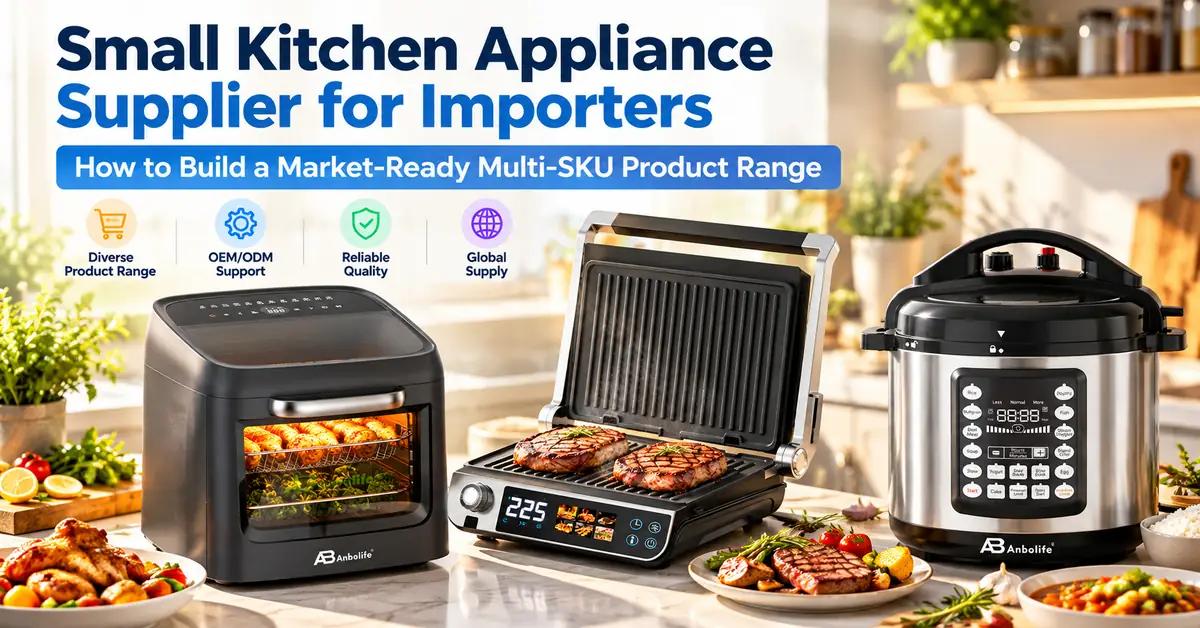
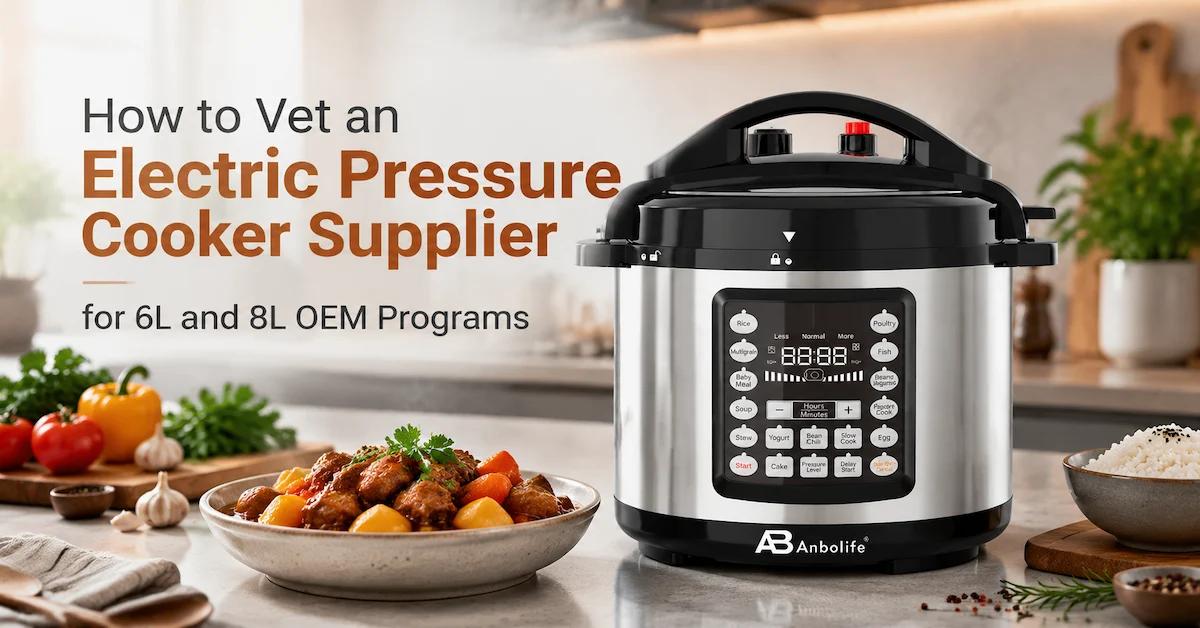
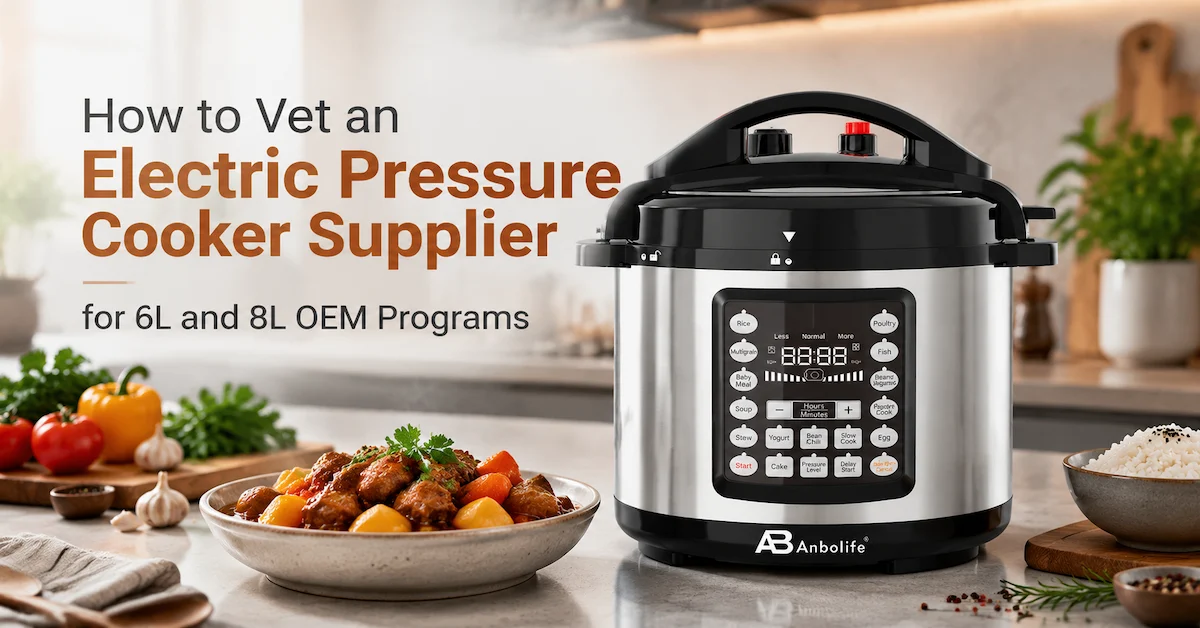
The Anbolife Digital Electric Pressure Cooker is a relevant product reference for this evaluation. Its published product information identifies 6L and 8L capacity options, an LED digital display, and adjustable high and low pressure settings. It is positioned for household appliance importers, wholesalers, distributors, retailers, and private-label brands.
Those published features provide a starting point, not a complete purchase specification. The product page leaves rated power, voltage and frequency, inner pot material, cooking programs, safety protection, dimensions, and weight for model-specific confirmation. A serious buyer should resolve these items before approving a sample, printing packaging, or making performance claims.
Start With the Intended Market and User
The best product configuration depends on where the appliance will be sold and how it will be used. A pressure cooker for a family-oriented retail range may require a different capacity and interface from one intended for compact urban households. A product for online marketplaces may require stronger parcel packaging and more detailed customer instructions than one supplied through an established appliance distributor.
Importers and Regional Distributors
Importers typically balance product appeal against landed cost, documentation, inventory risk, warranty exposure, and repeat-order reliability. They may need an electrical version and plug suitable for one country or several markets. They also need enough technical information to support local retailers and answer after-sales questions.
A distributor should decide whether the product will occupy an entry-level, mid-range, or premium position. An LED interface and high/low pressure selection may support a more feature-led proposition, but the final price position depends on the confirmed pot, controls, accessories, finish, packaging, and warranty arrangement.
Private-Label Appliance Brands
A private-label buyer needs more than a logo on an existing housing. The control-panel language, carton artwork, manual, product label, recipe guidance, photography, and support documents must tell a consistent story. If a brand promises a particular cooking program or inner pot material, that promise must match the approved production version.
The buyer should identify which features are essential to the brand and which are negotiable. This distinction helps the supplier recommend a suitable existing platform or determine whether development work is required.
Retail Chains and E-Commerce Sellers
Retail chains need clear shelf positioning, legible packaging, dependable supply, and a manageable return rate. E-commerce sellers also need product content that answers customer questions before purchase: What does 6L or 8L mean? How is pressure released? Which parts need cleaning? What is included in the box?
Unclear claims create costly friction. A seller should not describe a pressure cooker as having a particular number of presets, a stainless steel inner pot, an automatic pressure-release mode, or a specific safety system until these features have been verified for the selected version.
Hospitality and Foodservice Buyers
Some buyers may consider pressure cookers for staff kitchens, guest facilities, or other managed environments. They should first confirm whether the selected appliance is approved for the intended level and type of use. A household model should not be presented as heavy-duty commercial equipment merely because it can prepare large meals.
For these projects, operating frequency, user training, cleaning procedures, electrical installation, service access, and replacement parts deserve particular attention.
6L or 8L: How to Choose the Right Capacity
Capacity is one of the first filters in an electric pressure cooker sourcing project. Anbolife lists 6L and 8L versions, but the nominal volume should not be confused with the maximum amount of food that may be pressure-cooked. The allowable fill level depends on the appliance instructions and the ingredients being prepared.
A larger nominal capacity may suit a buyer targeting batch cooking or larger households. It may also increase countertop footprint, carton size, freight cost, and storage requirements. A smaller version may be easier to position for everyday family meals, but that judgment should be tested against real recipes and the target market.
| Buyer consideration | 6L direction | 8L direction | What to confirm |
|---|---|---|---|
| Customer positioning | Everyday household cooking | Larger households or batch preparation | Target users and typical recipes |
| Retail presentation | Potentially easier to position for standard kitchens | Larger-capacity value proposition | Final dimensions and packaging |
| Food preparation | Test representative family meals | Test larger portions and repeat use | Usable fill limits in the manual |
| Logistics | May require less storage space | May require more carton and shelf space | Final carton dimensions and loading |
| Product economics | Compare confirmed configuration | Compare confirmed configuration | Price, freight, and warranty assumptions |
This is a selection framework, not a claim that one version has a particular footprint, price, or cooking yield. Request the actual pot dimensions, cooking instructions, carton specification, and samples for both versions if capacity is central to the purchase decision.
Test Meals, Not Just Liters
The most useful capacity test starts with foods the end customer will actually prepare. For one market, that may be rice and soup. For another, it may be beans, stews, or larger cuts of meat. Test the permitted ingredient quantity, preparation time, pressure cycle, serving result, and cleaning workload.
Record the recipe, water quantity, selected setting, timing method, and final result. Without a defined test method, two samples can appear different simply because they were prepared with different food loads or instructions.
Digital Controls and High/Low Pressure Settings
The Anbolife reference model lists an LED digital display and adjustable high and low pressure settings. These features can help buyers communicate a more flexible cooking proposition, but the precise operation must be checked on a working sample.
Evaluate the User Interface
Ask the supplier to demonstrate every visible button, display symbol, and operating state. The sample reviewer should be able to answer:
- How does the user select high or low pressure?
- When does the display begin counting cooking time?
- What happens during preheating and pressure build-up?
- How are errors or incomplete lid closure communicated?
- Can a user cancel a program safely?
- What happens after the cooking cycle ends?
- Which settings are retained or reset after a power interruption?
The product page does not publish a confirmed list of cooking programs. Do not infer one from photographs or use unapproved preset names in retail copy. Request a control-function matrix showing the exact behavior of the selected model.
Assess the Value of Two Pressure Settings
High and low pressure can give users more flexibility across suitable recipes, subject to the operating instructions. From a buyer’s perspective, the value lies in whether the interface makes the distinction clear and whether the cooking results are repeatable.
A sample test should compare representative recipes under the appropriate approved settings. Record when the unit reaches its operating condition, how it maintains the setting, and how the user completes the pressure-release procedure. Do not assume that “high” and “low” correspond to a particular pressure value until the supplier supplies a model-specific specification.
Keep the Manual Aligned With the Controls
Every control-panel term must match the instruction manual and packaging. If the panel says “Low Pressure,” the manual should explain when that setting is appropriate and how the user selects it. If different languages are required, check that translated labels fit the display area and retain their technical meaning.
This alignment is particularly important for private-label programs. An attractive custom panel will not help conversion if buyers later encounter confusing instructions or support tickets.
Pressure-Cooker Safety Must Be Verified by Model
Pressure cooking adds safety questions that do not arise in the same way for a conventional rice cooker. Buyers need to understand how the selected product prevents unsafe operation, how pressure is regulated and released, and what users must do before opening the lid.
The Anbolife product page marks safety protection as “to be confirmed.” That means the article cannot responsibly claim that this model has a specific lid interlock, sensor, valve arrangement, overpressure mechanism, or number of safety protections. Instead, these are essential items for the supplier’s technical response and sample review.
Questions About the Lid and Sealing System
Request drawings or a component description for the lid, gasket, locking arrangement, steam path, and user-operated release mechanism. During evaluation, check that the lid closes consistently and that the manual clearly describes correct seating, cleaning, inspection, and replacement of sealing parts.
Ask what happens if the lid is not correctly fitted. Ask how the design addresses attempted opening while pressure remains. These answers should be supported by the exact model’s test plan and documentation, not a generic safety diagram for another appliance.
Questions About Pressure Control
The buyer should request the rated cooking-pressure information, the high/low setting specification, the control method, and the applicable test evidence. The supplier should explain what components regulate normal operation and how abnormal conditions are evaluated.
Testing must use the agreed configuration, including the correct pot, lid, gasket, electrical version, and firmware where applicable. A component substitution after approval may change the relevance of earlier test evidence.
Questions About User Instructions
The manual should explain fill limits, ingredients that require special precautions, the permitted pressure-release procedure, cleaning of steam passages, gasket care, and what to do if the cooker does not operate normally. It should also tell users when the lid may be opened and identify actions they must not take.
A buyer should have the local manual reviewed for both technical accuracy and plain-language clarity. Pressure-related warnings are not a suitable place for rushed machine translation.
Inner Pot, Food-Contact Parts, and Cleaning
The inner pot affects cooking performance, durability, cleaning, product positioning, and the claims a brand can make. The published Anbolife reference page does not confirm its inner pot material. Buyers should request the exact construction and food-contact documentation for the proposed version.
Define the Pot Specification
The specification should identify:
- Base material and construction
- Coating, if any
- Nominal and usable capacity information
- Thickness or other controlled dimensions
- Surface and appearance acceptance criteria
- Cleaning method
- Replacement-pot availability
- Packaging protection
Do not describe the pot as stainless steel, non-stick, dishwasher-safe, or compatible with metal utensils unless the selected configuration and instructions support that statement.
Review All Parts That Contact Food or Steam
Depending on the design, the relevant parts may include the pot, lid underside, gasket, steam-release components, condensation collector, and accessories. Request a component-level material list and ask which documents support the destination market’s food-contact requirements.
For European-market projects, buyers should have their compliance team review the applicable food-contact framework and material-specific requirements. A general statement that a product is “food grade” is not a substitute for documentation tied to the materials and final configuration.
Make Cleaning a Sample-Acceptance Criterion
After cooking representative dishes, assess whether the user can access and clean the lid, gasket area, pot, steam path, and condensation points according to the manual. Record any residue traps or awkward steps.
Cleaning is not merely an after-sales topic. If routine maintenance is difficult, it can affect reviews, warranty claims, and the willingness of customers to use the appliance regularly.
A Practical Sample-Approval Protocol
A sample should become the reference for mass production. Before testing begins, agree on the version being evaluated and create a record of the product, accessories, electrical configuration, packaging, and documentation.
Stage 1: Document the Sample
Record the model identifier, capacity, serial or sample reference, voltage, plug, visible component markings, software version if applicable, inner pot specification, and all included accessories. Photograph the unit and packaging from several angles.
Mark any provisional features. An evaluation sample may contain components or artwork that will change before production; those changes must be resolved and approved rather than carried forward informally.
Stage 2: Inspect Appearance and Assembly
Check housing color, finish, panel alignment, printed text, display visibility, pot fit, lid movement, handle feel, gasket placement, cable routing, and countertop stability. Note scratches, gaps, rough edges, loose parts, or inconsistent markings.
Appearance should be judged against an agreed standard, not a vague description such as “good quality.” A buyer can approve photographs and written acceptance criteria alongside the physical sample.
Stage 3: Run Representative Cooking Tests
Use several recipes relevant to the target market, including one that exercises each pressure setting where the instructions permit it. Test with the same ingredient quantities and preparation method when comparing units.
Record the user steps, total cycle experience, visible display behavior, food result, pressure-release procedure, and cleaning time. If a result is unsatisfactory, distinguish a product problem from an incorrect recipe or operating method before requesting a design change.
Stage 4: Review Abnormal and Safety Conditions
Safety verification requires a qualified test plan. The buyer should request the supplier’s applicable reports and have a competent laboratory or compliance specialist determine whether additional testing is needed for the destination market.
Do not improvise hazardous overfill, blocked-vent, forced-lid, or electrical-fault tests in an office or showroom. Such evaluations belong within controlled, documented testing procedures.
Stage 5: Check the Complete Customer Experience
Open the retail carton as an end customer would. Are the parts protected? Is the manual easy to find? Are the first-use and cleaning steps clear? Does the product label match the carton and manual? Are all accessories listed and present?
The buyer should approve the final sample, technical specification, artwork files, manual revision, packaging structure, and inspection checklist together. Approving only the appliance leaves too many opportunities for a mismatch at shipment.
Quality Control and Model-Specific Documentation
A useful supplier quality process connects the approved specification to incoming components, assembly checks, functional inspection, safety checkpoints, and final packing. Anbolife describes this type of project-specific approach on its quality and certifications page. The page also states that applicable checks and documents depend on the appliance model and destination market.
For this pressure-cooker project, ask the supplier to define:
- Which components are inspected on arrival.
- Which assembly and appearance checks occur during production.
- Which functional tests are performed on finished units.
- Which pressure-related and electrical checks are included in the approved test plan.
- How inspection results are recorded and linked to a production batch.
- How nonconforming units are handled.
- Whether a buyer-appointed inspection can be accommodated.
- How approved components and firmware are protected from unreviewed changes.
Verify the Evidence, Not Just a Certificate Image
When a supplier presents a certificate or test report, confirm the model number, applicant or manufacturer, covered product description, electrical version, standard or regulation, issuing body, dates, and scope. Ask whether the tested construction matches the version being purchased.
Anbolife’s public quality gallery displays documents for selected appliance categories. It should not be interpreted as proof that the 6L/8L electric pressure cooker holds those same certificates. Request pressure-cooker-specific evidence for the intended market.
For household and similar electric pressure cookers, applicable safety standards and national requirements should be determined for the exact configuration and destination. Food-contact obligations may need a separate review from electrical safety. A supplier’s ability to provide documents should be confirmed during the project, not assumed from a general company page.
OEM and ODM: Choose the Right Development Route
The Anbolife OEM/ODM process describes two starting points. An OEM project begins with the buyer’s drawings, technical requirements, and quality criteria. An ODM project starts from an existing product direction and reviews changes needed for the buyer’s market. The available changes depend on the selected model and project scope.
When an ODM Route Makes Sense
An ODM route may suit a buyer who likes the 6L or 8L digital pressure-cooker platform but needs changes to its branding, appearance, packaging, manual, electrical version, or selected functions. It can reduce the amount of initial product definition required, although every proposed change still needs feasibility review and sample approval.
Ask the supplier to separate customization into three groups:
- Artwork changes: logo, carton graphics, manual, labels, and product name.
- Configuration changes: market-specific plug, voltage, accessories, finish, or available control options.
- Engineering changes: pot construction, pressure system, lid design, housing structure, or new control behavior.
The last group can require additional tooling, development time, testing, and documentation. Do not assume it is included in a standard private-label quotation.
When an OEM Route Makes Sense
An OEM project is appropriate when the buyer already has a defined technical brief or product design. That brief should identify critical safety requirements, dimensions, materials, control logic, packaging, and acceptance tests.
The supplier should review manufacturability before committing to a production schedule. Drawings and requirements need revision control so that both parties know which version was sampled, tested, quoted, and approved.
Protect the Approved Product Identity
For either route, put the following into a controlled specification:
- Model and capacity
- Electrical configuration
- Pressure settings and control behavior
- Inner pot and food-contact components
- Lid and gasket construction
- Accessories
- Appearance and logo
- Manual and label files
- Packaging
- Testing and inspection criteria
- Permitted substitutions and change-approval process
This document is more useful than a long email chain when a production issue or repeat-order question arises.
Electric Pressure Cooker Versus Conventional Rice Cooker
A buyer researching the Anbolife rice-cooker category will find the electric pressure cooker listed within that broader cooking-appliance range. However, a pressure cooker and a conventional rice cooker should not be treated as interchangeable products.
| Decision factor | Electric pressure cooker | Conventional rice cooker |
|---|---|---|
| Core proposition | Pressure-based cooking for suitable recipes | Rice preparation and related non-pressure routines |
| Buyer evaluation | Pressure control, lid system, release procedure, safety documentation | Rice results, programs, pot, and keep-warm behavior |
| User instructions | Pressure-specific warnings and maintenance | Model-specific cooking and cleaning instructions |
| Product positioning | Multi-meal cooking where supported by the model | Rice-focused everyday convenience |
| Evidence required | Confirm pressure and electrical safety for the exact version | Confirm electrical and food-contact requirements for the exact version |
Neither product is automatically “better.” A rice-focused buyer may prefer a simpler appliance, while a household that prepares stews, beans, and other suitable dishes may value pressure cooking. The decision should be based on target recipes, customer expectations, operating instructions, retail price, and the supplier’s verified model configuration.
Do not market the 6L/8L pressure cooker as having a particular rice, yogurt, slow-cook, or sterilization program unless the selected version includes and documents it.
Calculate Total Procurement Cost, Not Just Unit Price
A quotation should show what is included and what changes the final cost. Compare suppliers on an equivalent configuration, delivery term, packaging standard, and documentation scope.
The total project cost may include:
- Appliance unit price
- Sample and development charges
- Tooling or component changes
- Logo application
- Retail packaging and manuals
- Testing and documentation
- Third-party inspection
- Freight and insurance
- Import duties and local handling
- Warehousing
- Replacement parts
- Warranty claims and customer support
- Returns and damaged inventory
A lower factory price can be offset by a larger carton, more fragile packaging, an unclear manual, or expensive warranty handling. Conversely, a more elaborate interface or finish is only worth paying for if the target customer recognizes its value.
Compare Quotations With a Landed-Cost Worksheet
Create one line for every cost element and record whether it is quoted, estimated, or still unknown. Keep one-time development charges separate from per-unit charges. Calculate freight using the final carton dimensions and actual shipment plan, not an early product rendering.
Then test a realistic selling scenario: expected wholesale or retail revenue less landed cost, channel fees, marketing, returns, and warranty allowance. The exact figures belong to the buyer’s business model, but the comparison method makes supplier differences visible.
Ask What Happens on a Repeat Order
The first shipment is not the whole program. Ask whether packaging plates, printed materials, approved components, and replacement parts can be maintained for future orders. Confirm the process for notifying the buyer about component changes.
Repeat-order stability may have more value than a small saving on the first purchase, particularly when a brand has already invested in listings, reviews, and customer-support materials.
MOQ, Lead Time, and Logistics: Get Written Answers
The Anbolife product and category pages do not publish a universal MOQ, production lead time, or container-loading figure for this pressure cooker. Those values should be confirmed for the selected 6L or 8L configuration, packaging, customization level, and order plan.
A useful quotation should distinguish:
- Standard product MOQ
- Private-label MOQ
- MOQ for custom colors or components
- Sample preparation time
- Time for artwork and manual approval
- Production lead time after all approvals
- Inspection and corrective-action time
- Estimated shipment readiness
- Carton dimensions and weight
- Loading calculation based on final packaging
Avoid treating “lead time” as one number when the project includes sampling, testing, artwork revisions, and production. The schedule should identify dependencies and the point at which the production clock actually starts.
Packaging Is a Product Requirement
Pressure cookers include a pot, lid, gasket, electrical components, and often multiple accessories. The packaging must protect their fit and finish in transit. Evaluate the retail box, internal cushioning, component placement, accessory control, and outer carton.
For e-commerce, discuss parcel handling and the expected delivery route. A package optimized only for palletized distribution may perform differently when individual units move through a parcel network.
Common Sourcing Mistakes and How to Avoid Them
Mistake 1: Treating All 6L or 8L Models as Equivalent
Nominal capacity does not establish the same usable fill, pot construction, power, controls, or carton size. Request model-specific drawings, instructions, and samples.
Mistake 2: Assuming Safety Features
A product photograph cannot verify pressure protection. Request the exact construction description and applicable testing evidence before making claims.
Mistake 3: Approving a Sample Without a Specification
If there is no controlled document, the buyer may struggle to demonstrate what was approved. Record components, functions, appearance, packaging, and inspection criteria.
Mistake 4: Changing the Control Panel Without Retesting the User Journey
Custom labels and language changes can create confusing or incorrect instructions. Review the panel, display, manual, carton, and actual operation together.
Mistake 5: Comparing Quotes With Different Inclusions
One quotation may include a retail carton and manual; another may not. Normalize the scope before comparing unit prices.
Mistake 6: Making Unsupported Marketplace Claims
Claims about wattage, pressure value, cooking speed, coating, certification, or program count should come from the approved model documentation. A vague supplier message is not enough.
Mistake 7: Ignoring Parts After Shipment
Gaskets, pots, valves, and other model-specific parts may matter for long-term support. Confirm the applicable replacement-part list, availability, ordering method, and compatibility rules.
A Supplier Evaluation Scorecard
A simple scorecard can make the final selection more defensible. Give each area a defined weight based on your business, then score only what you can verify.
| Evaluation area | Evidence to request | Decision question |
|---|---|---|
| Product fit | Sample, functions, cooking tests | Does it meet the target user’s needs? |
| Safety and compliance | Model-specific reports and technical review | Can it be sold in the intended market? |
| Quality consistency | Inspection plan and approved sample | Can the same configuration be reproduced? |
| OEM/ODM execution | Change scope, artwork process, samples | Can branding be delivered accurately? |
| Commercial terms | Itemized quotation and MOQ | Does the total cost support the channel? |
| Delivery | Milestone schedule and packaging data | Is the launch plan realistic? |
| After-sales | Parts and defect-handling process | Can customer issues be resolved? |
A high score should not compensate for a failed safety or market-compliance requirement. Those are approval gates, not optional points.
What to Send for a Useful Quotation
A supplier can respond more accurately when the first inquiry contains a practical project brief. Buyers can use the Anbolife contact page to start the discussion and attach or describe the following requirements:
- Market: destination country and intended sales channel.
- Buyer type: importer, distributor, retail chain, or private-label brand.
- Product: 6L, 8L, or both; include the reference product link.
- Electrical version: required voltage, frequency, and plug.
- Cooking needs: target recipes and essential functions.
- Branding: logo, housing finish, display language, manual, and carton.
- Quantity: trial order and estimated repeat volume.
- Documentation: target-market electrical and food-contact requirements.
- Sample review: tests and acceptance criteria.
- Schedule: desired sample date and launch window.
- Logistics: delivery destination and preferred quotation term.
A concise inquiry could read: “We are evaluating the 6L and 8L digital electric pressure cooker for private-label household retail in our target market. Please confirm model-specific power, voltage, inner pot, pressure settings, safety documentation, sample availability, MOQ, custom packaging scope, lead time, carton dimensions, and replacement-part options.”
This is more likely to produce an actionable response than “Send your best price.” It also gives the supplier an opportunity to identify unsuitable assumptions before the buyer commits to packaging or marketing content.
Frequently Asked Questions
Does Anbolife list both 6L and 8L electric pressure cookers?
Yes. Its digital electric pressure-cooker product page lists 6L and 8L capacity options. Buyers should confirm the selected version’s usable fill guidance, dimensions, electrical specification, accessories, packaging, and price before ordering.
Does the published model have adjustable pressure?
The product page lists high and low pressure settings. It does not publish the exact pressure values or detailed operating logic. Request those specifications and test the selected settings on a sample.
What cooking programs are included?
The public product page does not provide a confirmed program list. Ask for a current control-function matrix, manual, and sample demonstration. Do not copy program names from an unrelated model.
What is the inner pot made from?
The published specification marks inner pot material for confirmation. Ask for the pot construction, coating details if relevant, cleaning instructions, and applicable food-contact documents for the exact production version.
What safety protections are included?
Safety protection is also marked for confirmation on the product page. Request a model-specific description and relevant test evidence covering the selected lid, pressure-control, electrical, and thermal design.
Can I order a private-label version?
Anbolife discusses OEM/ODM cooperation, branding, packaging, and selected customization according to the project. Confirm which requested changes are available for the pressure-cooker model, their MOQ, cost, development work, and sample process.
What is the MOQ for an OEM electric pressure cooker?
No universal MOQ is confirmed on the public product page. MOQ can differ between a standard version and a version requiring custom artwork, color, components, or packaging. Request a written quotation for the exact scope.
How long does production take?
The final timeline depends on the approved specification, sample, documentation, artwork, component availability, order quantity, and production schedule. Ask for milestone dates instead of relying on a generic lead-time estimate.
Can a certificate for another Anbolife appliance cover this pressure cooker?
Do not assume so. Check that each document identifies the relevant pressure-cooker model, construction, electrical version, covered scope, issuer, and validity. Ask the supplier for the documents applicable to the destination market.
Should I choose a 6L or 8L version?
Choose based on target recipes, household size, permitted fill level, countertop space, carton size, and retail positioning. If both customer groups matter, test both samples and compare the complete landed cost and customer experience.
What is the difference between a supplier and a manufacturer?
A supplier is the party that sells and coordinates the product for the buyer. Manufacturing, engineering, testing, packaging, and export responsibilities may be organized differently by company and project. Ask who controls the production specification, quality checkpoints, component changes, and after-sales process instead of relying on a label alone.
What should I request before paying for a sample?
Request the proposed model specification, sample configuration, price, available documents, what the sample fee covers, expected preparation time, and how sample changes will be handled. This prevents a sample from arriving with a configuration that does not match the intended market.
Conclusion
The right electric pressure cooker supplier should make a 6L or 8L project easier to verify, not harder to question. Buyers should begin with the target market and recipes, then confirm pressure-control behavior, inner pot construction, safety design, electrical version, user instructions, sample performance, packaging, model-specific documentation, and repeat-order controls.
Ambolife's 6L/8L Digital Electric Pressure Cooker offers a clear starting platform with an LED display and high/low pressure settings. Several important technical and commercial details remain project-specific, so they should be settled in writing before a quotation becomes a purchase decision.
To move toward an accurate proposal, send Anbolife your destination market, preferred capacity, electrical requirements, expected volume, branding and packaging scope, required documents, sample criteria, and launch schedule through its OEM/ODM project process or contact page.