
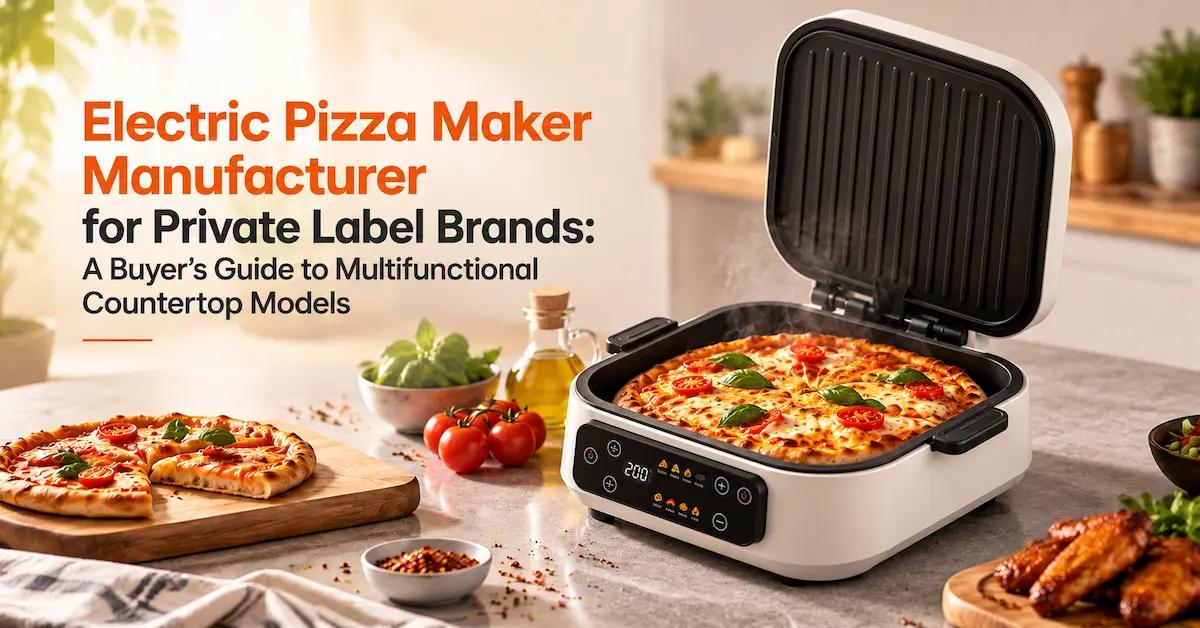
How to Choose an Electric Pizza Maker Manufacturer for Profitable B2B Growth
Choosing an electric pizza maker manufacturer is a strategic purchasing decision for importers, distributors, private-label brands, hospitality suppliers, and foodservice equipment buyers. The supplier affects more than the initial unit price. It also influences product reliability, market positioning, packaging quality, compliance readiness, delivery performance, after-sales cost, and the potential for repeat orders.
A suitable manufacturer should help buyers answer practical questions before production begins:
- Is the product suitable for the target customer and sales channel?
- Does the electrical configuration match the destination market?
- Can the product support multiple cooking applications?
- Are the heating structure and control system reliable for repeated use?
- Can the factory provide consistent quality across future orders?
- Are OEM and ODM options available?
- Can the supplier support packaging, labeling, manuals, and product documentation?
- How can the buyer reduce return rates, complaints, and warranty costs?
This guide explains how professional buyers can evaluate an electric pizza maker manufacturer, using the BP-PA18 Multifunctional Electric Pizza Maker & Grill as a product reference. The article focuses on product structure, technical evaluation, customer segmentation, commercial applications, OEM/ODM purchasing, quality control, total cost, and conversion-focused procurement decisions.
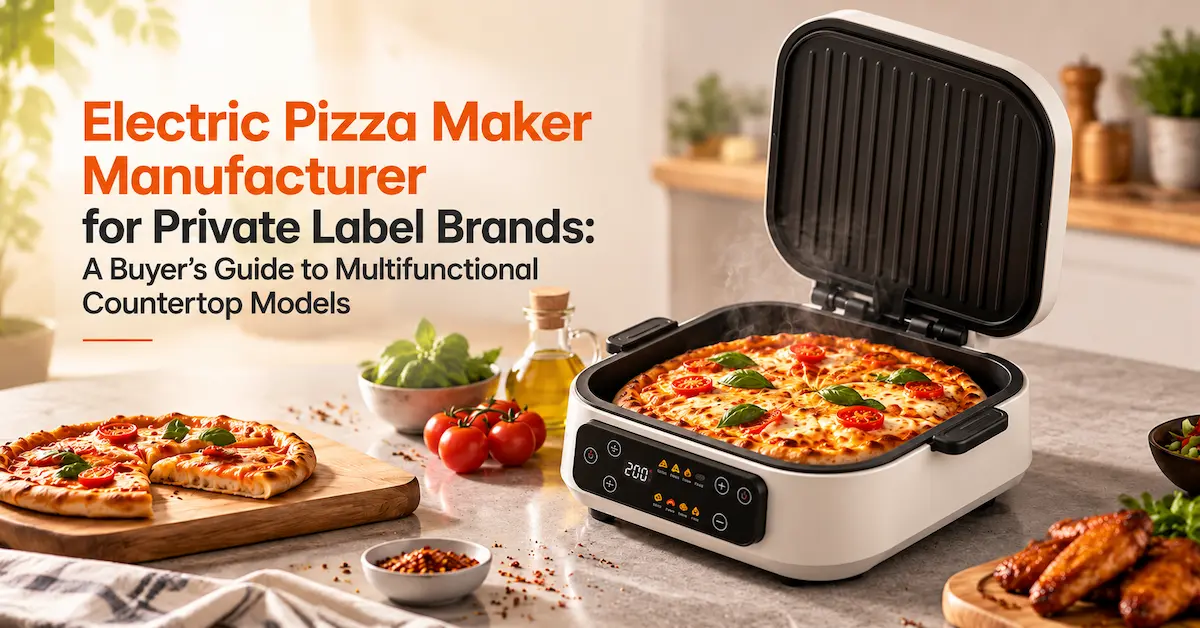
What an Electric Pizza Maker Manufacturer Should Provide
An electric pizza maker manufacturer should provide more than a product catalog and a quotation. B2B buyers need a supplier that can connect product design, production, testing, packaging, and commercial positioning.
Product Development Support
A capable supplier should understand how product structure affects user experience and market performance. For an electric pizza maker, the key design factors include:
- Upper and lower heating configuration
- Total rated power
- Cooking plate design
- Heat distribution
- Control interface
- Opening angle
- Food loading space
- Cleaning access
- Handle temperature
- Thermal protection
- Product stability
- Packaging protection
These elements determine whether the appliance is suitable for home kitchens, small cafés, hotel breakfast areas, snack bars, foodservice counters, or retail appliance programs.
A buyer should also explain the target market before selecting a model. An appliance intended for European household retail may require a different plug, manual, packaging format, and compliance process from a product intended for commercial distributors in North America or the Middle East.
Manufacturing and Production Consistency
A product sample may perform well while future production varies if the manufacturing process is not properly controlled. Professional buyers should evaluate whether the supplier can maintain consistency in:
- Heating elements
- Thermostats and protection components
- Non-stick plate coating
- Housing assembly
- Handle alignment
- Control-panel printing
- Electrical wiring
- Cord and plug configuration
- Product color
- Packaging materials
- Final inspection standards
Production consistency is particularly important for private-label brands. Once a product is launched, customers expect every future batch to have the same appearance, functions, performance, and user instructions.
Commercial Communication
Technical communication is another important supplier capability. A reliable electric pizza maker manufacturer should be able to provide clear answers about specifications, customization, product testing, sample approval, packaging, shipping, and after-sales handling.
Buyers should avoid suppliers that provide vague answers such as “all specifications can be customized” without explaining what is technically available, what requires tooling, and what may affect cost or lead time.
BP-PA18 Electric Pizza Maker and Grill: Product Reference
The BP-PA18 Electric Pizza Maker & Grill is a multifunctional countertop cooking appliance designed for pizza, grilling, sandwiches, meat, fish, sausages, and other food preparation applications.
According to the product information, the model includes:
- Total rated power of 2,000W
- Upper plate power of 800W
- Lower plate power of 1,200W
- Rated voltage of 110–240V
- Rated frequency of 50/60Hz
- Digital multifunction touch screen
- Rotary OK selector
- Pizza, cake, fish, beef, chicken, sausage, sandwich, and DIY menu options
- 105° and 180° opening positions
- Detachable lower basket
- Non-stick coated plates
- Cool-touch handle
- Thermal cut-out
- Thermo fuse
- Skid-resistant feet
The lower basket is listed at approximately 33.7 × 32.8 × 6.7 cm, while the upper plate is listed at approximately 32.7 × 29.8 × 1.2 cm. The stated reference loading is 704 pieces for a 20GP container and 1,710 pieces for a 40HQ container. Buyers should reconfirm loading quantities after the final packaging design, carton dimensions, and shipping configuration are approved.
The BP-PA18 is useful as a reference product because it combines pizza preparation with broader grilling and sandwich applications. This makes it easier for a buyer to develop multiple sales messages around one appliance platform.
Why Multifunctional Cooking Appliances Have Stronger Commercial Potential
A single-purpose pizza maker may appeal to a narrow audience. A multifunctional model can address several customer needs and support broader product positioning.
More Use Cases for the Same Product
The BP-PA18 menu options include pizza, cake, fish, beef, chicken, sausage, sandwich, and DIY. This allows buyers to develop different marketing messages for different customer groups.
For household customers, the product may be positioned as a compact appliance for family meals, weekend cooking, breakfast, snacks, and casual entertaining.
For cafés and snack businesses, it may be positioned as a countertop appliance for sandwiches, grilled foods, sausages, and quick-service menu items.
For hospitality buyers, it may support breakfast areas, guest kitchens, buffet preparation, or light cooking stations.
For retailers, multifunctional features create more opportunities for product demonstrations, recipe content, comparison pages, and seasonal campaigns.
Better Shelf and Warehouse Efficiency
A multifunctional appliance can help distributors serve more use cases without stocking several separate product types. This may simplify inventory planning and make the product more attractive for e-commerce sellers that need a compact product with multiple benefits.
However, multifunctionality should not be treated as a reason to make unlimited claims. Each advertised program should be tested, documented, and explained accurately. Buyers should confirm how the menu programs operate and whether the product is intended for household, light commercial, or other approved applications.
Stronger Content and Search Potential
Products with multiple use cases can generate more content opportunities. Buyers may create content around:
- How to choose a pizza maker for a small kitchen
- Pizza maker versus sandwich press
- Countertop grill for cafés
- Multifunctional cooking appliances for apartments
- Electric pizza maker for hotel breakfast service
- Compact cooking equipment for snack shops
- Private-label countertop kitchen appliances
- How to evaluate a pizza maker supplier
This broader content range can support organic search visibility and attract buyers at different stages of the purchasing process.
Technical Evaluation of the Heating System
Heating performance is one of the most important areas when evaluating an electric pizza maker manufacturer. Buyers should assess not only total wattage but also how the power is distributed and controlled.
Upper and Lower Heating Power
The BP-PA18 uses an 800W upper plate and a 1,200W lower plate, producing a total rated power of 2,000W. The lower heating zone provides stronger contact heat, while the upper plate adds top-side heating.
This configuration can be useful for foods that require heat from both sides. It may support pizza bases, toasted sandwiches, grilled meat, sausages, and other foods that benefit from direct plate contact.
The power rating alone does not prove cooking quality. Buyers should evaluate:
- Heating response time
- Heat consistency across the plate
- Recovery after opening
- Cooking results during repeated cycles
- Surface browning
- Food release
- Temperature stability
- Control accuracy
- Heat around the handle and housing
A sample test should use representative food loads rather than empty heating alone.
Destination-Market Electrical Requirements
The BP-PA18 is listed with a rated voltage of 110–240V and a frequency of 50/60Hz. This broad voltage range may support different market configurations, but the final production version must still be confirmed for each destination.
Buyers should verify:
- Voltage range
- Frequency
- Plug type
- Cord length
- Power rating on the label
- User manual specifications
- Packaging markings
- Destination-market test requirements
- Importer labeling requirements
The electrical configuration should be approved before packaging artwork is finalized. Changing the electrical version after artwork approval can create rework, relabeling, and shipment delays.
Cooking Surface, Opening Design, and User Experience
Non-Stick Coated Plates
The BP-PA18 uses non-stick coated plates. This feature can support easier food release and reduce routine cleaning effort. It is especially relevant for pizza, sandwiches, cheese-based foods, and marinated ingredients that may otherwise adhere to the cooking surface.
Buyers should request confirmation of:
- Coating specification
- Approved utensils
- Cleaning instructions
- Abrasion-resistance testing
- Surface inspection standards
- Replacement policy
- Packaging protection for the plates
The user manual should explain how to clean the plates without damaging the coating. Product listings should avoid unsupported claims such as “scratch-proof” or “lifetime non-stick” unless those claims are verified by approved testing.
105° Opening Position
The 105° opening position can support standard loading and unloading. It provides access to the lower cooking surface while keeping the upper plate positioned for contact cooking.
During sample evaluation, buyers should check whether the opening angle is stable, whether the hinge feels secure, and whether food can be loaded without excessive contact with the upper plate.
180° Opening Position
The 180° opening position allows the appliance to open flat. This expands the cooking surface and may make the appliance more versatile for grilling and larger food portions.
For small kitchens and foodservice counters, the flat opening can provide flexibility without requiring a separate grill. Buyers should evaluate the stability of both plates when fully opened and confirm that the appliance remains steady on the work surface.
Detachable Lower Basket
The detachable lower basket is listed at approximately 33.7 × 32.8 × 6.7 cm. A removable component can improve cleaning access and simplify food handling.
The buyer should inspect the basket for:
- Secure attachment
- Smooth removal
- Stable placement
- Easy cleaning access
- Edge finishing
- Resistance to deformation
- Compatibility with the cooking plate
- Packaging protection during transport
If the product is intended for high-frequency use, cleaning design can significantly affect customer satisfaction and after-sales feedback.
Safety Features Buyers Should Review
An electric pizza maker manufacturer should clearly identify the product’s safety components and explain how they are verified.
The BP-PA18 includes a thermal cut-out and thermo fuse. These components are intended to provide overheating protection within the appliance’s safety system. The model also includes a cool-touch handle and skid-resistant feet.
Thermal Protection
A thermal cut-out can interrupt operation if the appliance reaches an unsafe temperature condition. A thermo fuse provides another protection layer in the event of excessive heat.
Buyers should request model-specific information about:
- Component specifications
- Activation conditions
- Assembly location
- Production inspection
- Electrical safety testing
- Replacement procedures
- Applicable market requirements
Safety components should not be treated as marketing decoration. They must be installed correctly and included in the final production configuration.
Cool-Touch Handle
A cool-touch handle can reduce the risk of accidental contact with hot surfaces during normal operation. Buyers should test the handle after repeated heating cycles and evaluate:
- Grip comfort
- Handle stability
- Surface temperature
- Screw or mounting strength
- Alignment with the housing
- Resistance to repeated opening
The final evaluation should reflect real use rather than a short demonstration.
Skid-Resistant Feet
Skid-resistant feet help the appliance remain stable during loading, opening, closing, and cooking. Stability is particularly important when the 180° opening position is used.
The buyer should test the appliance on common countertop surfaces and assess whether it moves when pressure is applied to the handle or when food is placed on the plates.
Customer Segments for an Electric Pizza Maker Manufacturer
Importers and Kitchen Appliance Distributors
Importers generally seek products with broad market appeal, stable supply, reasonable container utilization, and clear technical documentation. A multifunctional pizza maker can fit several distribution channels, including home appliance stores, kitchenware retailers, hospitality suppliers, and online marketplaces.
Their main purchasing concerns often include:
- Product consistency
- Packaging quality
- Electrical compatibility
- Commercial margin
- Stock availability
- Warranty exposure
- Spare parts
- Repeat-order stability
- Supplier communication
A buyer should prepare a product specification sheet before requesting a quotation. This avoids comparing different configurations under the same product name.
Private-Label Brands
Private-label brands require coordinated control over product appearance, labeling, packaging, and customer-facing documentation. The buyer may want a custom housing color, logo, model name, packaging design, manual language, or accessory combination.
The Anbolife OEM/ODM page can be used as a starting point for discussing customization requirements.
Before requesting OEM pricing, the buyer should define:
- Target market
- Expected annual volume
- Preferred product configuration
- Branding requirements
- Packaging requirements
- Compliance expectations
- Sample approval process
- Target retail price
- Desired delivery schedule
This information helps the manufacturer determine whether the project is a standard customization or requires engineering development.
Café and Snack-Shop Suppliers
Small food businesses often need compact equipment that can prepare several menu items without occupying excessive counter space. A multifunctional electric pizza maker may be suitable for:
- Toasted sandwiches
- Pizza slices
- Sausages
- Grilled chicken
- Fish portions
- Beef portions
- Breakfast foods
- Snack preparation
The buyer should avoid automatically describing the product as heavy-duty commercial equipment unless the intended use and approved specifications support that positioning. Instead, the product can be evaluated for the specific operating conditions of the customer.
Hotel and Hospitality Suppliers
Hotels, guesthouses, serviced apartments, and hospitality operators may value appliances that are easy to understand and suitable for compact food preparation areas.
Potential applications include:
- Breakfast stations
- Guest kitchenettes
- Staff kitchens
- Small buffet preparation areas
- Holiday rental properties
- Event catering support
- Compact hospitality counters
The buyer should evaluate cleaning, safety, user instructions, electrical compatibility, and service support because hospitality products may be used by many different operators.
E-Commerce and Retail Sellers
Online sellers need products that are visually clear, easy to demonstrate, and supported by accurate specifications. Features such as a digital touch screen, multifunction menu, 180° opening, detachable basket, and non-stick plates can be explained through product images, short videos, recipe content, and comparison charts.
At the same time, online product claims must remain factual. Sellers should not publish unconfirmed cooking temperatures, guaranteed cooking times, certifications, commercial ratings, or capacity claims.
OEM and ODM Questions for Product Buyers
OEM and ODM projects should begin with a clear product brief.
Product Appearance
Buyers should ask whether the following can be customized:
- Housing color
- Logo location
- Control-panel graphics
- Button labels
- Model number
- Product name
- Decorative elements
- Packaging design
- Instruction manual
- Barcode and label files
Some changes may require new tooling, while others may only require artwork changes. The manufacturer should explain the difference before the buyer approves the project.
Electrical and Market Versions
Buyers should confirm whether the same platform can support different:
- Voltage versions
- Plug types
- Frequency requirements
- Cord specifications
- Labeling standards
- Manual languages
- Packaging markings
The final electrical version should be tested and approved before mass production.
Packaging and Retail Presentation
Packaging should protect the appliance and present the product clearly. Buyers should evaluate:
- Inner protection
- Carton strength
- Product immobilization
- Accessory placement
- Printed specifications
- Warning labels
- Barcode placement
- Shipping marks
- Retail display requirements
For online sales, packaging should also be considered in relation to parcel handling, drop risk, and customer unboxing experience.
Sample Approval Process Before Mass Production
A professional buyer should use a written sample approval process. The sample should become the reference standard for future production.
Stage One: Specification Review
Confirm the model, rated power, voltage, frequency, plate configuration, opening positions, basket dimensions, control system, safety components, accessories, and packaging requirements.
Stage Two: Functional Testing
Test every listed cooking mode and verify the operation of the touch screen and rotary selector. Confirm that the control behavior matches the manual and product description.
Stage Three: Repeated Heating Test
Operate the appliance through repeated heating and cooking cycles. Monitor control response, handle condition, housing temperature, cooking surface performance, and protection behavior.
Stage Four: Cleaning Assessment
Remove the detachable lower basket and assess access to the plates and surrounding areas. Confirm the recommended cleaning process and check for areas where food residue may accumulate.
Stage Five: Packaging Test
Review the final packing method and inspect the product after simulated handling or transport. Check whether the plates, handle, housing, control panel, and accessories remain protected.
Stage Six: Approval Documentation
Record approved photographs, measurements, artwork, user manual versions, component specifications, and packaging files. This documentation can reduce disputes during later production.
Quality Control Checklist
Buyers can use the following checklist when evaluating an electric pizza maker manufacturer:
Incoming Materials
- Heating elements match approved specifications
- Housing materials and colors are consistent
- Non-stick plates are free from visible defects
- Handles and feet meet the approved design
- Electrical components are traceable
Assembly
- Screws are properly tightened
- Hinges operate smoothly
- Upper and lower plates align correctly
- Wiring is protected
- Control components are securely installed
- Thermal protection components are correctly positioned
Functional Inspection
- Power-on operation is normal
- Touch-screen functions respond correctly
- Rotary selector operates as expected
- Menu options match the approved model
- Heating zones work properly
- Opening positions remain stable
- Detachable parts fit correctly
Appearance Inspection
- Housing has no scratches or dents
- Logo is correctly positioned
- Control-panel printing is clear
- Gaps are within the approved standard
- Handle alignment is correct
- Feet are stable and complete
Packing Inspection
- Product is protected from movement
- Accessories are included
- Manual and labels are correct
- Carton markings are accurate
- Packaging matches the approved artwork
- Carton dimensions match the shipping plan
Total Cost of Ownership
The unit price is only one part of the total procurement cost. Buyers should evaluate:
- Product cost
- Custom packaging
- Tooling
- Testing
- Certification
- Inspection
- Freight
- Warehousing
- Spare parts
- Warranty replacement
- Customer returns
- Product relabeling
- After-sales labor
A low-cost supplier may become expensive if the buyer experiences high defect rates, inconsistent production, poor packaging, or delayed communication.
A higher-value supplier can support better profitability by reducing avoidable costs across the product lifecycle. The objective is not always to find the lowest quotation. The objective is to achieve the best balance between product quality, commercial positioning, supply stability, and total cost.
Internal Links for Product and Supplier Evaluation
Buyers can review the Anbolife products page to understand the broader product range and compare available appliance categories.
For company background, manufacturing capabilities, and business positioning, visit the Anbolife About Us page.
For project discussions, product questions, sample requests, customization, and quotation requirements, use the Anbolife Contact Us page.
These pages can help buyers organize their supplier evaluation before starting a detailed product discussion.
Questions to Ask Before Requesting a Quotation
Technical Questions
- What is the final rated power?
- What voltage and frequency versions are available?
- What are the upper and lower heating powers?
- Which cooking modes are included?
- Are the plates detachable?
- What are the confirmed plate and basket dimensions?
- What safety components are included?
- What is the recommended cleaning method?
- Which product claims can be used in marketing materials?
Commercial Questions
- What is the MOQ for the standard version?
- What is the MOQ for private-label production?
- What is the sample charge?
- What is the sample lead time?
- What is the mass-production lead time?
- What are the payment terms?
- What are the packaging options?
- What are the final carton dimensions?
- What is the confirmed loading quantity?
Quality Questions
- What inspections are completed before shipment?
- Can the buyer appoint a third-party inspection company?
- How are production defects handled?
- Is a pre-production sample approved before mass production?
- How are component changes controlled?
- What is the warranty process?
- Are spare parts available?
Compliance Questions
- Which documents are available for the selected market?
- Are test reports available for the exact model?
- Does the electrical version match the destination country?
- Are labels and manuals available in the required language?
- Are packaging markings compliant with the buyer’s import requirements?
FAQ for Electric Pizza Maker Buyers
What is the main advantage of a multifunctional electric pizza maker?
The main advantage is that one countertop appliance can support several cooking applications. The BP-PA18 includes menu options for pizza, cake, fish, beef, chicken, sausage, sandwich, and DIY use. This gives distributors and brands more ways to position the product.
Is the BP-PA18 suitable for different voltage markets?
The product information lists a rated voltage of 110–240V and a frequency of 50/60Hz. The exact production configuration, plug, cord, labeling, and destination-market requirements should be confirmed before ordering.
Does the product have upper and lower heating?
Yes. The BP-PA18 is listed with an 800W upper plate and a 1,200W lower plate, for a total rated power of 2,000W.
Can the appliance open flat?
Yes. The model supports 105° and 180° opening positions. The 180° position allows the plates to open flat for grilling and broader food preparation.
Is the lower basket detachable?
Yes. The lower basket is listed as detachable and measures approximately 33.7 × 32.8 × 6.7 cm.
Does the product include safety protection?
The listed safety features include a thermal cut-out, thermo fuse, cool-touch handle, and skid-resistant feet. Buyers should request model-specific documentation and verify the final production configuration.
Can the product be customized?
OEM and ODM possibilities should be discussed according to the required changes. Potential topics may include logo, housing color, control-panel graphics, packaging, manuals, labels, and electrical versions.
What information should a buyer provide for a quotation?
A buyer should provide the target country, expected order quantity, preferred product configuration, branding requirements, packaging needs, required certifications or documents, and desired delivery schedule.
How to Improve Inquiry Conversion for This Product
A high-quality product page or buyer inquiry should focus on specific commercial information rather than general promotional language.
A strong inquiry should include:
- Target market
- Customer type
- Product application
- Required voltage and plug
- Expected quantity
- Branding requirements
- Packaging requirements
- Desired delivery date
- Required documentation
- Sample evaluation plan
For example, a distributor can explain that the product will be sold through hospitality suppliers in a 220–240V market and request confirmation of the applicable plug, packaging, documentation, sample cost, MOQ, and lead time.
A private-label brand can specify the target retail segment, desired color, logo position, packaging style, manual language, and estimated annual demand.
A foodservice equipment supplier can describe the intended operating environment, expected daily usage, cleaning requirements, and customer menu applications.
The more specific the inquiry, the easier it is for the electric pizza maker manufacturer to provide a useful technical and commercial response.
Conclusion
Selecting the right electric pizza maker manufacturer requires a complete evaluation of product design, heating performance, electrical compatibility, safety structure, cooking flexibility, quality control, packaging, customization, and long-term supply support.
The BP-PA18 Electric Pizza Maker & Grill provides a practical multifunctional product reference. It combines 2,000W total rated power, an 800W upper plate, a 1,200W lower plate, digital multifunction controls, eight listed menu options, 105° and 180° opening positions, a detachable lower basket, non-stick coated plates, a cool-touch handle, thermal protection, and skid-resistant feet.
For importers, distributors, private-label brands, hospitality suppliers, and foodservice buyers, the next step is to confirm the exact production configuration and commercial requirements. Product specifications, electrical versions, sample performance, packaging, MOQ, lead time, documentation, and customization should all be reviewed before mass production.
Buyers interested in developing a product program can contact Anbolife with their target market, quantity, electrical requirements, branding needs, and packaging expectations. A structured inquiry creates a clearer path from product evaluation to sample approval, production, market launch, and repeat purchasing.