Short Answer: What Should Buyers Look for in a Panini Grill Manufacturer?
A reliable panini grill manufacturer should provide more than a low quotation. Importers, distributors, retailers, foodservice suppliers, and private-label brands need a supplier that can support product selection, technical confirmation, sample evaluation, quality control, packaging, customization, documentation, and repeat production.
The most important purchasing factors include:
- Cooking capacity
- Heating method
- Temperature-control design
- Opening angle
- Cooking plate configuration
- Non-stick surface options
- Handle and hinge construction
- Product stability
- Electrical configuration
- Cleaning access
- Packaging protection
- OEM and ODM support
- Model-specific inspection
- Spare-parts availability
- MOQ and lead-time confirmation
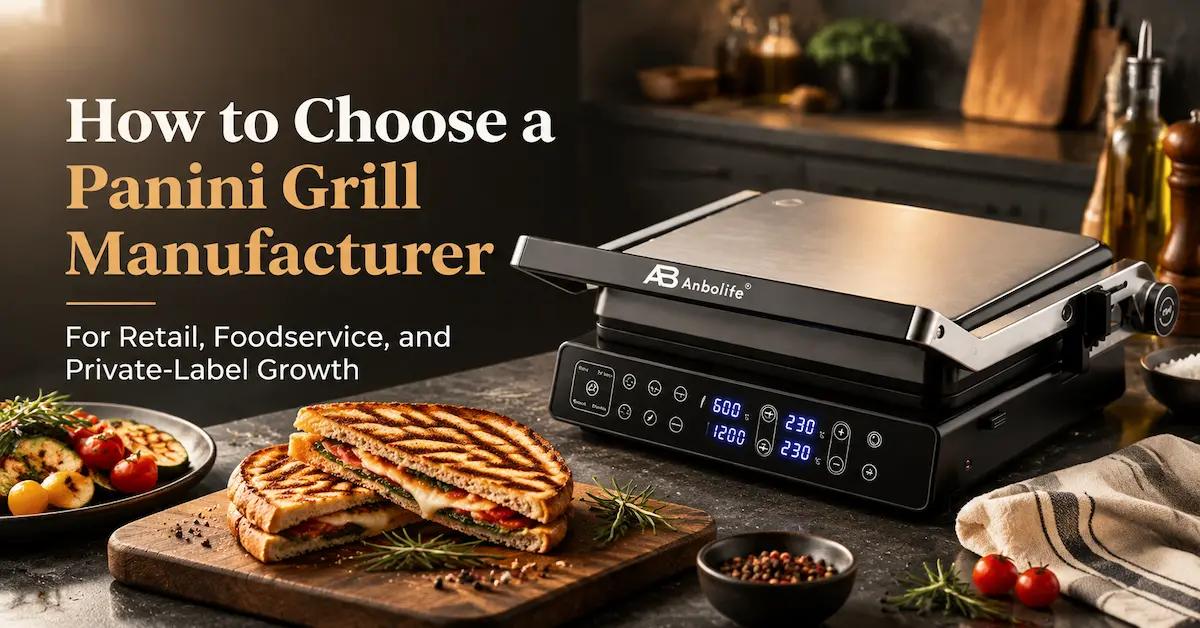
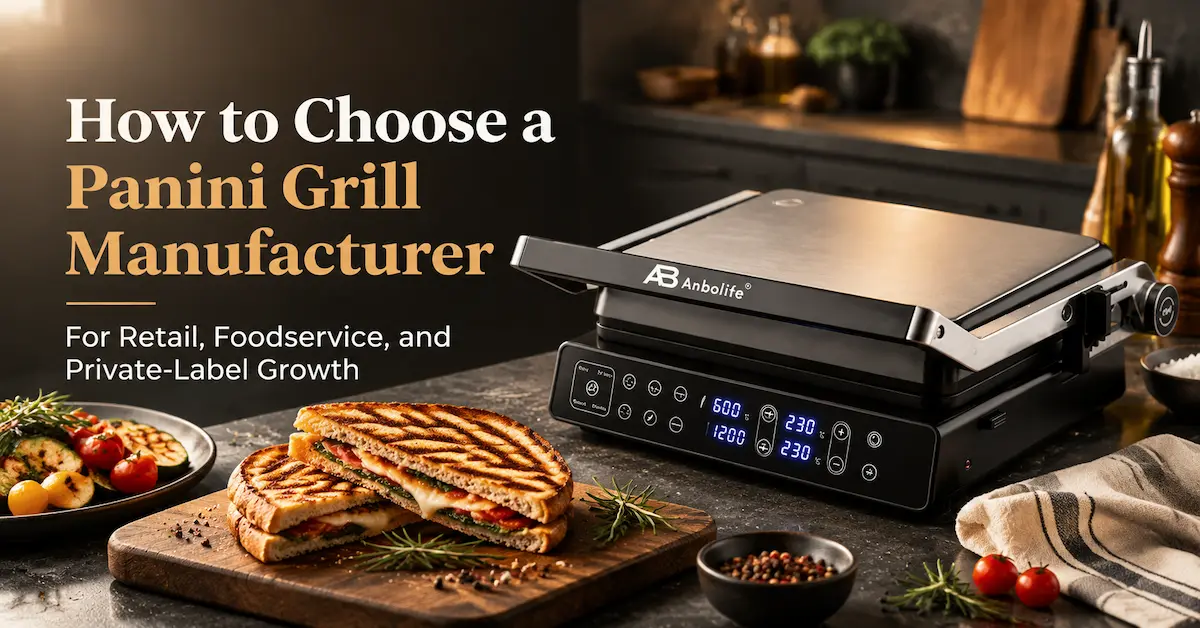
For buyers looking for a compact product platform, the Anbo 4-Slice Electric Panini Grill with 180° Opening and Adjustable Temperature is a useful product reference. The product page identifies it as an electric contact grill and panini press with four-slice capacity, electric heating, panini and sandwich applications, and potential temperature adjustment depending on the selected configuration.
The product page also clearly states that rated power, voltage, frequency, cooking-plate material, non-stick coating, removable-plate status, temperature range, dimensions, net weight, warranty, and customization options should be confirmed for the specific model. This model-specific confirmation is essential for professional B2B purchasing.
Why the Choice of Panini Grill Manufacturer Affects Profitability
A panini grill may appear to be a simple countertop appliance, but its commercial performance depends on multiple connected factors. Product design determines how easily users can prepare sandwiches. Manufacturing consistency determines whether every unit performs the same way. Packaging determines whether the appliance arrives without scratches or damage. Documentation determines whether the buyer can sell the product confidently in the target market.
The supplier also affects the speed of product development. A manufacturer with clear OEM and ODM communication can help a buyer move from an existing product platform to a branded product program. A supplier with weak project management may create delays between sample approval, packaging artwork, production, inspection, and shipment.
The Hidden Cost of a Low-Cost Supplier
The lowest quoted price does not always create the lowest total cost. A buyer may face additional expenses when:
- Product specifications are unclear
- Samples do not match mass production
- Packaging protection is insufficient
- Surface finishes are inconsistent
- The control system is difficult to use
- Cooking plates are difficult to clean
- Hinge alignment is unstable
- Cables or plugs are not suitable for the destination market
- Documentation is incomplete
- Defect handling is slow
- Replacement parts are unavailable
- Product claims cannot be verified
These issues can increase product returns, warranty cases, negative reviews, customer-support work, and inventory risk.
The Value of a Complete Supplier Process
A professional panini grill manufacturer should help coordinate:
- Product platform selection
- Technical specification confirmation
- Target-market evaluation
- Sample development
- Appearance and branding
- Packaging design
- Production planning
- Quality inspection
- Documentation
- Shipment coordination
The buyer should look for a supplier that can explain each step clearly and identify which requirements are standard, which are customizable, and which require additional engineering.
Anbo 4-Slice Electric Panini Grill as a Product Reference
The Anbo product page presents a four-slice electric panini grill and contact grill designed for sandwich, panini, breakfast, quick lunch, household cooking, and selected foodservice applications.
Four-Slice Cooking Capacity
The product is designed to accommodate up to four slices of bread or suitable sandwich portions at one time. This capacity may help users prepare multiple servings more efficiently than a single-serving appliance.
For retailers, the four-slice configuration provides a simple feature that is easy to communicate in product titles, comparison charts, packaging, and e-commerce listings. For distributors, it can serve customers who need a practical countertop appliance for family kitchens, offices, small cafés, rental properties, or hospitality environments.
Capacity should still be evaluated based on the actual food size and plate layout. Buyers should confirm:
- Maximum usable cooking area
- Plate dimensions
- Sandwich thickness
- Bread size
- Whether four slices refers to four individual bread slices or two assembled sandwiches
- Whether the plates support different food shapes
- Whether the product can maintain even contact across the cooking area
The final marketing claim should match the approved specification and sample test.
Panini and Sandwich Applications
The product is positioned for panini sandwiches, toasted sandwiches, and other compatible grilled foods. This gives buyers multiple ways to present the product to different customer segments.
A household retailer may emphasize:
- Breakfast preparation
- Quick family meals
- Toasted sandwiches
- Weekend cooking
- Indoor grilling
- Easy countertop use
A foodservice distributor may focus on:
- Panini preparation
- Café snacks
- Breakfast counters
- Small lunch menus
- Office kitchens
- Compact food preparation
A private-label brand may use the product as an entry-level or mid-range sandwich appliance, depending on its final specifications, appearance, packaging, and target price.
180° Opening Design
The product title identifies a 180° opening design. A flat-opening configuration can increase cooking flexibility by allowing the two plates to open into a wider grilling surface.
Potential benefits include:
- Easier food loading
- Improved access to the cooking plates
- Greater flexibility for grilled foods
- More convenient use with utensils
- Better visibility during cooking
- Broader positioning beyond sandwiches
The hinge and opening mechanism should be inspected carefully. Buyers should verify:
- Stability at the fully open position
- Hinge strength
- Plate alignment
- Opening and closing smoothness
- Handle balance
- Safety during loading
- Countertop stability
- Resistance to repeated movement
The 180° opening feature should be tested with the actual product configuration selected for mass production.
Adjustable Temperature
The product title also identifies adjustable temperature functionality. The product description states that temperature adjustment is available on compatible configurations and advises buyers to confirm the control type and temperature range for the specific model.
This is an important distinction. Buyers should not publish a specific temperature range unless it has been confirmed for the exact model and production version.
Temperature control can support different recipes and ingredients, including:
- Soft sandwiches
- Thick panini
- Toasted bread
- Cheese-based recipes
- Vegetables
- Grilled meat
- Sausages
- Fish portions
- Other compatible foods
During sample evaluation, buyers should check how easily the control can be adjusted, whether the settings are visible, whether the appliance recovers after opening, and whether the heating result remains consistent across the plate.
Product Specification Checklist for B2B Buyers
The following table can be used when requesting a quotation from a panini grill manufacturer.
| Specification Area | Buyer Requirement |
|---|---|
| Product type | Electric contact grill and panini press |
| Cooking capacity | Four-slice reference configuration |
| Main applications | Panini, toasted sandwiches, compatible grilled foods |
| Opening design | 180° opening listed on the product title |
| Temperature control | Adjustable temperature on compatible configurations |
| Heating method | Electric heating |
| Rated power | Confirm for the selected model |
| Voltage and frequency | Confirm for the destination market |
| Cooking plate material | Confirm for the selected configuration |
| Non-stick coating | Confirm for the selected configuration |
| Removable plates | Confirm before ordering |
| Product dimensions | Confirm after final model selection |
| Net and gross weight | Confirm for shipping calculations |
| Packaging | Confirm retail and export packaging |
| Warranty | Confirm with the supplier |
| Customization | Confirm logo, color, packaging, and manual options |
| MOQ | Confirm for standard and private-label versions |
| Lead time | Confirm after sample and artwork approval |
The purpose of this table is to prevent buyers from comparing incomplete quotations. Every supplier should quote the same specification baseline.
Target Customer Segments for a Panini Grill Manufacturer
Home Appliance Importers
Importers often want products that can be distributed through multiple channels. A four-slice electric panini grill can be suitable for kitchenware stores, appliance retailers, online marketplaces, home-goods distributors, and hospitality suppliers.
Importers should evaluate:
- Market demand
- Product price position
- Packaging quality
- Product dimensions
- Electrical compatibility
- Customer-service requirements
- Warranty exposure
- Container loading
- Repeat-order stability
- Available replacement parts
The product should be described accurately. If the supplier has not confirmed commercial-duty performance, the buyer should avoid positioning it as a heavy-duty commercial grill.
Kitchenware Wholesalers
Kitchenware wholesalers may need a product that is easy to explain and suitable for different retail customers. A panini grill with four-slice capacity, electric heating, and adjustable-temperature functionality can be positioned as a practical countertop cooking appliance.
Wholesalers may also need:
- Master-carton information
- Retail-box dimensions
- Product photography
- Instruction manuals
- Barcode support
- Display samples
- Product comparison content
- Spare-parts information
Private-Label Appliance Brands
Private-label brands require a controlled customer experience. The product, packaging, manual, logo, colors, and sales claims should all support the same brand position.
A private-label panini grill project may include:
- Custom logo
- Housing color
- Control-panel graphics
- Packaging artwork
- Product name
- Model number
- User manual language
- Barcode and label information
- Accessory configuration
- Retail-carton structure
The Anbolife OEM/ODM page can be used to start a discussion about product direction, customization, sampling, branding, packaging, production, and inspection.
Café and Snack Equipment Suppliers
Cafés, snack shops, bakeries, food kiosks, and small restaurants may require compact cooking equipment for panini, toasted sandwiches, breakfast items, or quick snacks.
Before recommending the appliance to these buyers, a distributor should confirm:
- Expected daily use
- Food size
- Cooking frequency
- Cleaning schedule
- Plate configuration
- Temperature control
- Service access
- Warranty expectations
- Spare-part availability
- Commercial-use suitability
A product may be useful in a selected foodservice environment without being suitable for every commercial kitchen. The final positioning should match the approved operating conditions.
Hospitality and Office Suppliers
Hotels, guesthouses, serviced apartments, offices, and rental properties often value compact appliances that are simple to operate and easy to clean.
Potential applications include:
- Hotel breakfast areas
- Guest kitchenettes
- Office break rooms
- Staff kitchens
- Student housing
- Serviced apartments
- Holiday rentals
- Small meeting-room catering
For hospitality projects, the buyer should pay close attention to user instructions, electrical safety, cleaning access, countertop stability, and replacement support.
E-Commerce Sellers
E-commerce sellers need a product with clear visual benefits. The following features may be useful in online content when they are confirmed for the selected configuration:
- Four-slice cooking capacity
- Panini and sandwich applications
- Electric indoor operation
- 180° opening
- Adjustable temperature
- Non-stick cooking surface
- Compact countertop format
- Multi-purpose grilling potential
Online listings should not include unconfirmed claims such as exact heating temperature, commercial-duty operation, dishwasher-safe plates, removable plates, or certified performance.
How to Evaluate a Panini Grill Manufacturer
Check Product Transparency
A reliable supplier should clearly distinguish between confirmed specifications and items that require model-specific confirmation.
The Anbolife product page provides confirmed product-category information while marking several technical items as requiring confirmation. These include rated power, voltage, frequency, cooking-plate material, non-stick coating, removable plates, temperature control, dimensions, weight, warranty, and customization options.
This approach is valuable for professional buyers because it reduces the risk of publishing inaccurate specifications.
Review the Supplier’s Product Category
Buyers can review the Anbolife electric grills and griddles category to compare related product platforms and determine whether the supplier has a broader electric-grill range.
A product-category review should consider:
- Number of related models
- Similar capacity options
- Different opening designs
- Temperature-control formats
- Plate configurations
- Household and foodservice positioning
- Customization possibilities
- Product documentation
A supplier with a broader category platform may be better positioned to support product-line expansion.
Confirm Engineering Boundaries
Ask the supplier which changes can be made through artwork and which require engineering.
Artwork-level changes may include:
- Logo
- Packaging graphics
- Manual language
- Barcode
- Product name
- Label design
Engineering-level changes may include:
- Plate structure
- Heating elements
- Housing dimensions
- Hinge design
- Electrical components
- Temperature-control system
- Product materials
- Accessory configuration
This distinction affects cost, lead time, tooling, and sample requirements.
OEM and ODM Opportunities
OEM Panini Grill Projects
An OEM project usually starts with the buyer’s product requirements, drawings, target specifications, or quality standards.
The buyer may provide:
- Product drawings
- Technical specifications
- Target power
- Voltage requirements
- Plate dimensions
- Housing design
- Branding instructions
- Packaging requirements
- Inspection standards
The supplier then reviews feasibility, confirms development scope, prepares samples, and supports production according to the approved specification.
ODM Panini Grill Projects
An ODM project begins with an existing product platform or supplier design. The buyer may request selected changes for a specific market.
Possible ODM changes include:
- Housing color
- Logo placement
- Packaging
- Manual
- Control-panel graphics
- Electrical version
- Selected accessories
- Product name
- Retail presentation
ODM can be useful for brands that need faster market entry but do not want to develop the entire appliance from zero.
Private-Label Packaging
Packaging should reflect the product’s customer segment. A retail product for home users may need lifestyle images and simple cooking messages. A distributor product for foodservice buyers may need more technical information and carton-level logistics details.
Packaging should confirm:
- Product name
- Model number
- Cooking capacity
- Electrical rating
- Safety warnings
- Importer information
- Barcode
- Manual language
- Country-of-origin requirements
- Carton markings
Sample Evaluation Before Mass Production
A sample should be assessed as the future production reference. It should not be judged only by whether it can toast one sandwich.
Appearance Inspection
Review:
- Housing color
- Surface finish
- Logo placement
- Plate alignment
- Handle position
- Hinge appearance
- Control markings
- Surface scratches
- Gaps and seams
- Foot stability
- Packaging protection
Take photographs from multiple angles and record any approved color or finish references.
Functional Inspection
Test:
- Power-on operation
- Opening and closing
- 180° flat opening
- Temperature adjustment
- Heating response
- Sandwich loading
- Four-slice capacity
- Handle operation
- Stability during use
- Cooking result
- Cooling and storage
The test should be repeated after several operating cycles to identify issues that do not appear during a short demonstration.
Cooking Test
Use representative foods rather than only empty heating. Test different types of bread and sandwich fillings that reflect the intended market.
Review:
- Browning consistency
- Cheese melting
- Food release
- Plate contact
- Cooking time
- Heat recovery
- Surface marks
- Filling leakage
- Smoke or residue
- Cleaning difficulty
The test should define which variables are controlled and which results are considered acceptable.
Cleaning Test
Check whether the user can remove food residue without damaging the cooking surface. Confirm the approved cleaning tools and instructions.
Inspect:
- Plate access
- Hinge area
- Handle area
- Edge gaps
- Drip or residue collection
- Non-stick surface care
- Removable components
- Storage position
A product that performs well but is difficult to clean may receive poor customer reviews.
Packaging Test
Review whether the carton protects:
- Cooking plates
- Handle
- Hinge
- Housing
- Control panel
- Accessories
- Manuals
- Labels
Simulated transport handling can help identify movement, surface scratches, compression, or carton weakness before mass production.
Quality Control Checklist
A professional panini grill manufacturer should define quality checks at several stages.
Incoming Material Review
Check:
- Housing parts
- Heating components
- Electrical parts
- Plate components
- Handles
- Hinges
- Feet
- Cables and plugs
- Packaging materials
Assembly Inspection
Check:
- Screw tightening
- Hinge alignment
- Plate positioning
- Handle stability
- Wiring protection
- Housing fit
- Foot installation
- Control-panel alignment
Functional Testing
Check:
- Power-on behavior
- Temperature adjustment
- Heating response
- Opening positions
- Stability
- Four-slice loading
- Control operation
- Cooking performance
Appearance Inspection
Check:
- Scratches
- Dents
- Uneven color
- Printing quality
- Logo position
- Surface finish
- Edge quality
- Plate coating appearance
Packing Inspection
Check:
- Product immobilization
- Inner protection
- Correct accessories
- Correct manual
- Correct labels
- Correct carton artwork
- Correct shipping marks
- Final carton dimensions
Electrical and Compliance Requirements
Electrical requirements should be confirmed for the destination market and exact model.
Buyers should verify:
- Rated voltage
- Frequency
- Plug type
- Power cord
- Label format
- User manual information
- Test requirements
- Importer marking
- Packaging information
- Applicable market standards
The product page marks voltage, frequency, and rated power as items to be confirmed. Buyers should therefore request a model-specific specification sheet before approving packaging or publishing product information.
Compliance documentation should also be connected to the exact model and version. Do not assume that documents for another electric grill automatically apply to the selected panini grill.
For a broader view of supplier quality and compliance information, buyers can review the Anbolife quality and certifications page.
Total Cost of Ownership
When comparing a panini grill manufacturer, calculate the full commercial cost rather than only the factory unit price.
Potential cost items include:
- Product price
- Sample cost
- Tooling
- Branding
- Packaging
- Manual printing
- Testing
- Inspection
- Freight
- Insurance
- Warehousing
- Spare parts
- Warranty handling
- Returns
- Customer service
- Local compliance
- Relabeling
- Product disposal
A supplier with better packaging and clearer documentation may create a lower total cost even when the initial unit price is not the lowest.
Buyers should also consider whether a four-slice product can serve several channels. A product with broader applications may reduce the need to develop multiple separate appliances, but only if the product’s actual capabilities match the marketing claims.
Common Procurement Mistakes
Mistake 1: Comparing Different Configurations
Two suppliers may quote a “panini grill” with different plate materials, temperature controls, dimensions, and power ratings.
Solution: Use a shared specification sheet for every quotation.
Mistake 2: Assuming Features From the Product Title
The product title may mention adjustable temperature and 180° opening, while other technical items still require confirmation.
Solution: Separate confirmed features from items requiring model-specific approval.
Mistake 3: Ignoring Cleaning
A panini grill can accumulate cheese, oil, bread crumbs, and fillings.
Solution: Evaluate plate access, cleaning instructions, coating care, and removable components.
Mistake 4: Approving Packaging Too Early
Packaging dimensions may change after final product and accessory confirmation.
Solution: Approve the final carton after the production configuration is fixed.
Mistake 5: Using Unsupported Commercial Claims
A household or light-use product should not automatically be advertised as heavy-duty commercial equipment.
Solution: Match the claim to the approved product specification and testing evidence.
Mistake 6: Forgetting Repeat Production
A sample may look acceptable, but future batches can vary if the approved reference is not documented.
Solution: Record photos, dimensions, materials, functions, packaging, and inspection criteria.
Questions to Ask a Panini Grill Manufacturer
Technical Questions
- What is the confirmed rated power?
- What voltage and frequency versions are available?
- What is the confirmed temperature range?
- Is temperature adjustment manual, digital, or preset?
- What is the plate material?
- Is the cooking surface non-stick?
- Are the plates removable?
- What is the usable cooking area?
- Can the plates open to 180°?
- What is the confirmed four-slice capacity?
- What are the product dimensions and weight?
- Is the handle heat-resistant?
- What cleaning method is recommended?
Commercial Questions
- What is the MOQ for the standard model?
- What is the MOQ for a private-label project?
- What is the sample lead time?
- What is the mass-production lead time?
- What packaging options are available?
- Can the logo be customized?
- Can the housing color be customized?
- Can the manual be translated?
- What is the warranty policy?
- Are spare parts available?
- What is the shipping carton size?
- What is the loading quantity?
Quality Questions
- What inspections are completed before shipment?
- Can the buyer approve a pre-production sample?
- Can third-party inspection be arranged?
- How are defects handled?
- How are engineering changes controlled?
- Can the supplier provide production photographs?
- Can the supplier provide model-specific documents?
- How are repeat orders matched to the approved sample?
How to Prepare a High-Conversion Inquiry
A clear inquiry helps the supplier provide a more accurate recommendation and quotation.
Include:
- Target country
- Sales channel
- Customer segment
- Product application
- Expected order quantity
- Annual demand estimate
- Required voltage and plug
- Preferred plate configuration
- Branding requirements
- Packaging requirements
- Manual language
- Required documents
- Sample approval requirements
- Target delivery date
A strong inquiry might state that the buyer needs a four-slice private-label panini grill for online retail in a specific voltage market, with a custom logo, branded carton, translated manual, sample approval, model-specific test documents, and a first order quantity.
A foodservice distributor might explain that the product will be supplied to cafés and small snack shops, requiring confirmation of temperature adjustment, opening design, cleaning access, operating frequency, and spare-parts support.
A hospitality supplier might focus on breakfast areas and guest kitchens, requiring compact packaging, simple controls, clear instructions, and stable daily operation.
The more precise the project brief, the easier it is for the panini grill manufacturer to confirm feasibility.
FAQ About Panini Grill Manufacturers
What is a panini grill manufacturer?
A panini grill manufacturer develops or produces electric contact grills and sandwich presses for importers, distributors, retailers, private-label brands, foodservice suppliers, and hospitality buyers. The supplier may also support product customization, packaging, sampling, inspection, and delivery.
What is the difference between a panini grill and a contact grill?
A panini grill is generally positioned for pressed sandwiches and toasted bread, while a contact grill can also support broader grilled-food applications. The actual use range depends on plate design, temperature control, opening angle, cooking area, and approved product specifications.
Is a four-slice panini grill suitable for commercial use?
A four-slice configuration may be useful in selected cafés, snack shops, hospitality areas, and small foodservice environments. Buyers should confirm the intended operating conditions and avoid making heavy-duty commercial claims without model-specific confirmation.
What does a 180° opening provide?
A 180° opening allows the plates to open flat, potentially creating a wider cooking surface and easier food access. Buyers should verify hinge stability, plate alignment, and safety during the open position.
Can the temperature be adjusted?
The Anbo product page identifies adjustable temperature on compatible configurations, but the control type and exact temperature range should be confirmed for the selected model.
Can the panini grill be customized?
Potential options may include logo, housing color, control graphics, packaging, product name, manual language, labels, and selected electrical configurations. The final scope depends on the product model, order quantity, and engineering requirements.
What specifications should be confirmed before ordering?
Confirm rated power, voltage, frequency, plate material, non-stick coating, removable-plate status, temperature range, product dimensions, weight, packaging, MOQ, lead time, warranty, spare parts, and documentation.
How should the sample be tested?
Test appearance, heating, temperature adjustment, opening positions, capacity, food release, cooking consistency, cleaning, handle stability, plate alignment, and packaging protection.
How can I compare different suppliers?
Compare the exact product configuration, documentation, sample process, customization scope, quality-control system, packaging, MOQ, lead time, after-sales support, and total cost of ownership.
Why Consider Anbolife for a Panini Grill Project?
Anbolife presents the Anbo four-slice electric panini grill as a product platform for importers, kitchenware wholesalers, retailers, and distributors seeking practical electric cooking appliances.
The Anbolife About Us page provides company background and explains the company’s focus on home-appliance development and manufacturing support for international brands.
The Anbolife OEM/ODM page provides a starting point for buyers who need product direction, branding, packaging, sampling, production, inspection, and delivery coordination.
The Anbolife manufacturing page can be reviewed when assessing the supplier’s production workflow and project-support structure.
The supplier’s product information also makes an important distinction between general product positioning and specifications that require model-specific confirmation. This is useful for B2B buyers who need accurate product pages, packaging, compliance files, and sales materials.
Conclusion
Choosing the right panini grill manufacturer requires a structured review of product capacity, heating method, temperature control, opening design, cooking plates, cleaning access, electrical configuration, packaging, customization, quality control, documentation, MOQ, lead time, and after-sales support.
The Anbo 4-Slice Electric Panini Grill provides a practical product reference for buyers who need an electric contact grill and panini press for sandwiches, panini, breakfast preparation, quick lunches, household kitchens, and selected foodservice environments. The product is presented with four-slice capacity, electric heating, 180° opening, adjustable-temperature positioning on compatible configurations, and potential OEM/ODM support.
For accurate purchasing decisions, buyers should confirm the exact rated power, voltage, frequency, cooking-plate material, non-stick coating, removable-plate status, temperature range, dimensions, weight, warranty, and customization scope before placing an order.
Importers, distributors, retailers, hospitality suppliers, and private-label brands can review the Anbo 4-Slice Electric Panini Grill product page, explore the electric grills and griddles category, or submit project requirements through the Anbolife contact page.
A high-quality inquiry should include the target market, intended application, order quantity, electrical requirements, branding needs, packaging expectations, documentation requirements, sample standards, and delivery schedule. This gives the panini grill manufacturer the information needed to recommend the right configuration and create a clearer path from sample evaluation to production and repeat orders.