
Why Choosing the Right Automatic Espresso Machine Supplier Matters
Selecting an automatic espresso machine supplier is a strategic decision for importers, private-label brands, retail groups, hospitality suppliers, café equipment distributors, and online appliance sellers. The supplier influences more than the initial quotation. Product design, beverage functions, electrical configuration, sample approval, documentation, packaging, quality control, delivery coordination, and after-sales support all affect the final commercial result.
A low unit price may appear attractive at the beginning, but it can become expensive if the product has inconsistent extraction, unreliable controls, poor packaging, unclear documentation, difficult cleaning procedures, or weak supplier communication. For a brand owner, these problems can lead to customer complaints, product returns, warranty costs, negative reviews, and reduced repeat-order potential.
A professional automatic espresso machine supplier should help buyers build a complete product plan. This plan should define the target market, beverage menu, expected daily use, machine configuration, private-label requirements, packaging, compliance documents, order quantity, sample standards, inspection criteria, and delivery expectations.
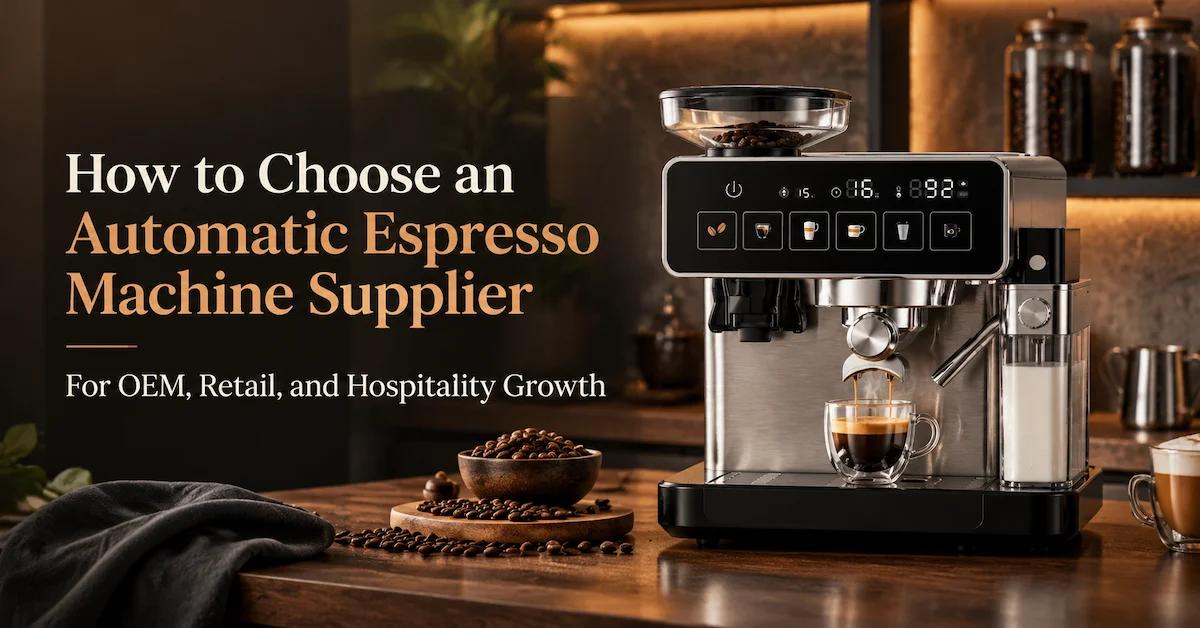
For buyers evaluating an all-in-one coffee platform, the Anbolife Automatic Espresso Coffee Machine with Built-in Grinder and Milk Frother provides a practical product reference. The listed model combines grinding, espresso preparation, milk frothing, digital touch control, and multiple beverage selections in one appliance. (anbolife.com)
What Buyers Expect From an Automatic Espresso Machine Supplier
An automatic espresso machine supplier should provide a structured process from product selection to shipment. A product catalog is only the starting point. B2B buyers need clear information about the product platform, technical configuration, customization limits, production process, inspection scope, and market documentation.
Product Selection Support
Different buyers need different coffee machine configurations. A product designed for household users may focus on compact dimensions, simple controls, visual appearance, and easy daily cleaning. A model positioned for hospitality or light commercial use may need a different evaluation of beverage workflow, repeated operation, service access, water management, and spare parts.
Before requesting a quotation, buyers should define:
- The destination market
- The target user
- The sales channel
- The required beverage menu
- Expected daily use
- Required voltage and plug
- Preferred grinder configuration
- Milk preparation requirements
- Target retail price
- Estimated order volume
- Private-label requirements
- Packaging and manual language
- Required testing documents
The Anbolife coffee machine category page recommends defining beverage needs, serving sizes, expected daily use, brewing method, grinder configuration, milk preparation, controls, dimensions, voltage, plug, and documentation before selecting a model. (anbolife.com)
Engineering and Manufacturing Coordination
Coffee machines combine mechanical, electrical, thermal, hydraulic, and user-interface elements. A supplier must coordinate these areas so that the final product functions as a complete appliance rather than as a collection of disconnected components.
Important engineering areas include:
- Bean hopper and grinder structure
- Grinding-time control
- Brewing assembly
- Water delivery
- Heating system
- Milk frothing path
- Drip tray design
- Control-panel operation
- Display information
- Cleaning access
- Electrical safety
- Housing and internal layout
A strong supplier should be able to explain how the selected model supports the required customer experience and what changes are possible without creating excessive development risk.
Documentation and Market Preparation
The coffee machine may be sold through several countries and sales channels. Documentation should therefore be aligned with the destination market and the exact production configuration.
Buyers may need:
- Product specification sheets
- User manuals
- Cleaning instructions
- Product labels
- Packaging artwork
- Electrical information
- Food-contact material information
- Test reports
- Certification references
- Spare-parts information
- Warranty terms
- Inspection records
The availability of a document should not be assumed from a general company statement. Buyers should verify that the model, configuration, destination market, document scope, issuing body, and validity period match the actual project.
Product Reference: Automatic Espresso Coffee Machine With Built-In Grinder
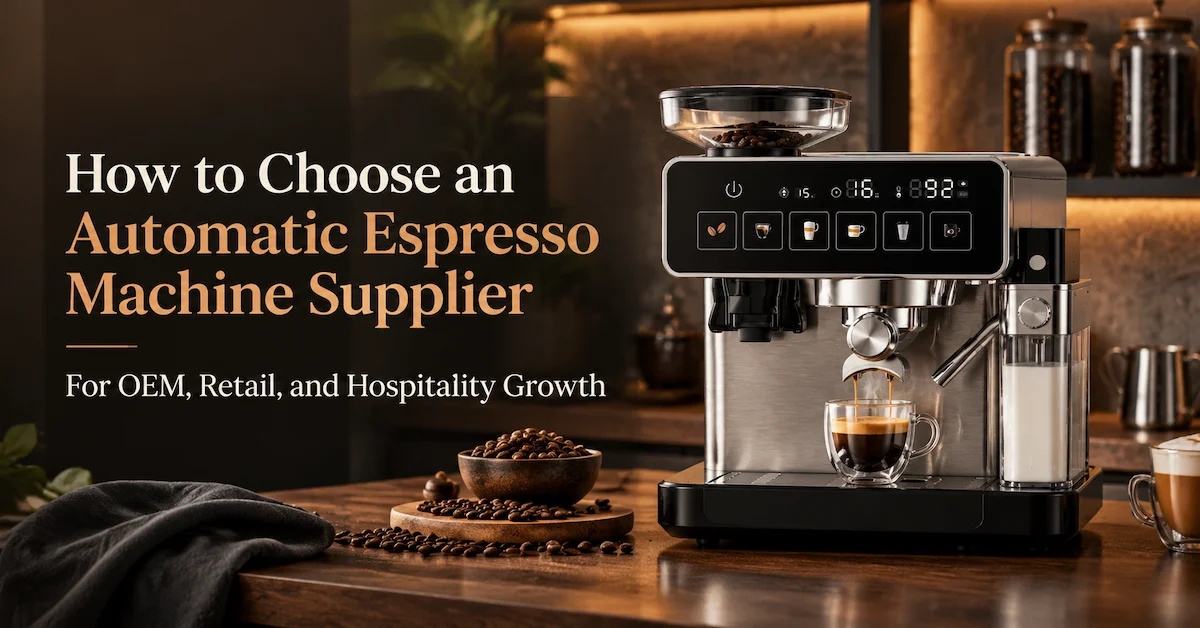
The Anbolife product page describes an automatic espresso coffee machine with a built-in grinder, digital touch control panel, external milk container, and integrated milk frothing system. The listed design uses a brushed stainless steel body and a black digital control panel, creating a premium appearance for modern kitchen and coffee-station applications. (anbolife.com)
Built-In Coffee Grinder
The integrated grinder allows users to grind coffee beans as part of the preparation process. A transparent bean hopper is positioned at the top of the machine for bean storage and visibility.
For buyers, a built-in grinder can create several commercial advantages:
- Fresh bean preparation can be used as a key product message
- The appliance does not require a separate grinder
- The product can be positioned as an all-in-one coffee station
- The machine can support a more complete coffee preparation routine
- Retailers can demonstrate more functions in one product
The grinder is also an important evaluation area. Buyers should confirm the grinding-time range, adjustment method, burr or blade configuration, hopper capacity, noise behavior, cleaning access, and replacement-part plan. These specifications should be confirmed for the selected model rather than assumed from general category expectations.
Digital Touch Control Panel
The listed model includes a large black digital control panel with illuminated indicators and beverage selection icons. The interface displays grinding time, brewing time, and brewing temperature information according to the product description. (anbolife.com)
A digital control system can help simplify product operation and create a more premium retail presentation. However, the interface should be reviewed carefully before mass production.
Buyers should check:
- Display readability
- Button or touch sensitivity
- Menu logic
- Language requirements
- Icon clarity
- Error messages
- Brewing-time display
- Temperature display
- Grinding-time adjustment
- Cleaning reminders
- User feedback during operation
The user interface has a direct effect on customer satisfaction. A machine can have good internal components but still receive poor reviews if the controls are confusing or if the user cannot understand the selected function.
Integrated Milk Frothing System
The product uses an external milk container and milk frothing assembly. The listed functions include cappuccino, latte, and hot milk preparation. (anbolife.com)
Milk preparation is an important selling point for buyers targeting consumers who want café-style beverages at home or in small hospitality settings. It also creates additional cleaning and maintenance requirements.
Before placing an order, buyers should evaluate:
- Milk container capacity
- Connection method
- Frothing consistency
- Milk tube cleaning
- Removable components
- Residue management
- Storage after use
- User instructions
- Replacement components
- Compatibility with local milk-use habits
A product page should explain the milk system clearly. Buyers should avoid vague claims such as “professional foam” or “barista-quality milk” unless those claims are supported by approved testing and the intended product positioning.
Beverage Selection
The visible control interface lists the following options:
- Grind
- Espresso
- Cappuccino
- Latte
- Hot Milk
- Espresso Cool
This menu provides multiple ways to position the machine across retail, private-label, and hospitality channels. A buyer can emphasize espresso preparation, milk-based drinks, fresh grinding, or beverage variety depending on the target customer.
The menu should be checked during sample approval to verify:
- The function names
- The operating sequence
- The displayed icons
- The default settings
- The user-adjustable parameters
- The brewing volume
- The milk preparation behavior
- The cleaning requirements
- The manual instructions
Stainless Steel Appearance
The brushed stainless steel body and black digital panel create a modern appearance suitable for premium kitchen appliances. Product appearance can be particularly important for private-label brands because the appliance may be displayed on a countertop rather than stored inside a cabinet.
During sample evaluation, buyers should inspect:
- Brushed surface consistency
- Color matching
- Fingerprint visibility
- Panel alignment
- Logo placement
- Housing gaps
- Edge finishing
- Door or cover alignment
- Surface scratches
- Protection during packaging
The appearance standard should be documented with approved photographs or a signed sample reference.
How to Evaluate an Automatic Espresso Machine Supplier Before Ordering
Confirm the Product Positioning
The first step is to confirm where the machine will be sold and who will use it. A product may be suitable for several channels, but the marketing message, packaging, manual, and compliance requirements should match the final positioning.
Possible positioning options include:
- Automatic espresso machine for home kitchens
- Built-in grinder coffee machine
- Private-label coffee appliance
- Premium countertop espresso machine
- Coffee machine for office kitchens
- Hospitality coffee preparation appliance
- Retail coffee machine with milk frother
- Bean-to-cup style appliance platform
- Compact espresso machine for apartment living
A buyer should not use every possible claim at the same time. Clear positioning improves search relevance, product-page conversion, and customer understanding.
Review the Brewing Workflow
A coffee machine should be evaluated as a workflow rather than as a list of features. The buyer should observe how a user moves from coffee beans to the final drink.
The workflow may include:
- Filling the bean hopper
- Selecting a grinding function
- Adjusting grinding time
- Preparing the brewing system
- Selecting espresso or a milk-based beverage
- Placing the cup
- Starting the preparation cycle
- Adding or preparing milk
- Removing the drink
- Cleaning the relevant components
A supplier should be able to explain each step and identify the parts that need regular maintenance.
Check Cleaning and Consumables
Coffee machines require a clearer maintenance plan than many simple kitchen appliances. Coffee oils, ground coffee residue, milk residue, and water deposits can affect hygiene, taste, and machine performance.
Buyers should ask about:
- Water-tank access
- Drip-tray removal
- Coffee-ground residue
- Milk-system cleaning
- Descaling procedure
- Filter requirements
- Cleaning tablets or consumables
- Removable components
- Cleaning frequency
- Replacement parts
- Storage instructions
The Anbolife coffee sourcing guide specifically recommends reviewing water-tank access, cleaning cycles, removable components, descaling instructions, filters, cleaning consumables, and spare parts for the destination market. (anbolife.com)
Buyer Segments and Their Procurement Requirements
Importers
Importers typically need a product that is commercially attractive, technically documented, and suitable for local distribution. Their priorities may include:
- Stable supply
- Competitive landed cost
- Market-specific electrical configuration
- Retail packaging
- Product documentation
- Container efficiency
- Warranty support
- Repeat-order consistency
An importer should provide the supplier with the target country, estimated quantity, preferred model, retail channel, and required documentation. This gives the supplier enough information to recommend an appropriate configuration.
Private-Label Brands
Private-label brands need control over the visible customer experience. The logo, color, display language, packaging, product name, manual, and accessory configuration may all need to match the brand identity.
A private-label project should define:
- Brand positioning
- Target price range
- Target consumer
- Product color
- Surface finish
- Logo application
- Packaging style
- Manual language
- Barcode requirements
- Retail channel
- Expected annual volume
The Anbolife OEM/ODM service describes two project routes: OEM based on the buyer’s drawings and technical requirements, and ODM based on an existing product direction with selected changes for the target market. (anbolife.com)
Coffee Equipment Distributors
Distributors may need several coffee appliances for different customer levels. One customer may require a compact household model, while another may need a higher-capacity or more commercial configuration.
A distributor should examine:
- Product range compatibility
- Channel conflict
- Regional exclusivity requirements
- Packaging differentiation
- Model naming
- Spare-parts availability
- Training materials
- Sales support
- Sample availability
- Order continuity
The supplier should clarify which specifications are standard and which are project-specific.
Hospitality Suppliers
Hotels, serviced apartments, offices, and guest facilities often value simple operation, attractive design, easy cleaning, and consistent beverage preparation.
Hospitality buyers should evaluate:
- Daily use expectations
- Beverage menu
- User skill level
- Water and milk handling
- Cleaning access
- Noise
- Countertop footprint
- Service requirements
- Replacement parts
- User instructions
A machine intended for hospitality environments should be positioned carefully. Buyers should confirm whether the selected model is intended for household, office, hospitality, light commercial, or other approved use.
E-Commerce Sellers
E-commerce sellers need product features that can be demonstrated clearly through images, videos, comparison tables, and customer reviews. Built-in grinding, touch controls, milk frothing, stainless steel appearance, and multiple beverage selections can provide strong content opportunities.
However, product information must remain accurate. Online sellers should not publish unconfirmed claims about:
- Exact brewing pressure
- Guaranteed temperature stability
- Commercial capacity
- Daily cup volume
- Certification status
- Warranty duration
- Noise level
- Automatic cleaning
- Professional barista performance
Every claim should be matched to the approved product specification.
OEM and ODM Customization Opportunities
Logo and Branding
Logo placement may include the front housing, control panel, drip tray area, packaging, manual, and product label. The buyer should confirm the printing method, logo size, color limitations, durability, and approval process.
A premium coffee appliance often benefits from restrained branding. The logo should be visible but should not interfere with the display or create an unbalanced appearance.
Housing Color and Surface Finish
The brushed stainless steel appearance can be adapted depending on the model and project scope. Buyers may request:
- Stainless steel finish
- Matte black
- White housing
- Custom color
- Two-tone appearance
- Gloss or matte surface
- Decorative trim
Color customization should be evaluated against material, coating, production quantity, and consistency requirements.
Packaging
Packaging is especially important for coffee machines because the appliance contains visible surfaces, removable parts, accessories, containers, tubes, and electrical components.
A packaging review should cover:
- Product immobilization
- Protection for the control panel
- Protection for the stainless steel housing
- Milk-container placement
- Accessory organization
- Manual placement
- Retail box artwork
- Barcode location
- Shipping marks
- Carton strength
- Drop and transport risk
The OEM/ODM process should include artwork approval before mass production. Changes made after printing may create unnecessary costs and delays.
Electrical Configuration
Electrical customization may include:
- Voltage
- Frequency
- Plug type
- Power cord
- Labeling
- Manual information
- Packaging markings
- Destination-market requirements
The exact electrical configuration should be confirmed for the selected model and market. The buyer should not rely only on a general product description.
Selected Specifications
Depending on the model, buyers may discuss selected functions, display language, milk-system configuration, appearance, packaging, and other project requirements.
The final scope should be written into the approved product specification. A verbal agreement is not sufficient for a long-term private-label program.
Sample Development and Approval
A sample should be treated as the production reference, not as a demonstration product only.
Appearance Review
Check:
- Housing color
- Brushed finish
- Logo position
- Display alignment
- Bean hopper fit
- Milk-container fit
- Drip-tray alignment
- Surface scratches
- Housing gaps
- Component edges
Photographs and measurements should be recorded.
Functional Review
Test:
- Grinding function
- Espresso function
- Cappuccino function
- Latte function
- Hot milk function
- Espresso Cool function
- Touch-panel response
- Grinding-time display
- Brewing-time display
- Temperature display
- Selector operation
The test result should be compared with the approved product description and user manual.
Beverage Review
The buyer should define the evaluation method before testing. Important variables may include:
- Coffee bean type
- Roast level
- Grind setting
- Dose
- Cup size
- Water temperature
- Milk type
- Milk temperature
- Frothing method
- Cleaning condition
The purpose is not to claim that one sample represents every use situation. The purpose is to verify whether the appliance meets the agreed product requirements and target customer expectations.
Maintenance Review
The reviewer should inspect:
- Bean hopper cleaning
- Brewing-area access
- Drip-tray removal
- Milk-tube cleaning
- Milk-container cleaning
- Residue management
- Descaling instructions
- Storage procedure
- Consumable availability
A machine that is difficult to maintain may create high customer-support costs after launch.
Quality Control and Compliance Review
An automatic espresso machine supplier should operate a defined quality path. According to Anbolife’s quality information, the project workflow includes incoming review, process inspection, safety checkpoints, and document verification. The exact inspection plan depends on the product category, specification, and destination market. (anbolife.com)
Incoming Review
Incoming materials and components should be checked against the requirements defined for the selected product project. Relevant items may include:
- Housing parts
- Electrical components
- Heating components
- Grinder components
- Brewing parts
- Milk-system components
- Display panels
- Cables and plugs
- Packaging materials
Process Inspection
Process inspection should cover assembly quality, appearance, functional checks, and any specific checkpoints agreed for the order.
The buyer may define inspection items such as:
- Housing alignment
- Display operation
- Grinder assembly
- Water-system connections
- Milk-system connections
- Drip-tray fit
- Electrical wiring
- Fastener condition
- Label placement
- Packaging assembly
Safety Checkpoints
AC-powered coffee appliances require appropriate electrical safety checks. The selected tests should match the model and destination market.
Buyers should request confirmation of:
- Electrical safety testing
- Grounding or insulation checks where applicable
- High-voltage testing where applicable
- Component ratings
- Thermal protection
- Applicable test standards
- Product-specific reports
Document Verification
Certificates and test reports should be connected to the correct product model, configuration, scope, issuing body, and validity period. Anbolife’s quality page emphasizes that documentation should be reviewed with context rather than treated as a blanket promise for every product category. (anbolife.com)
Manufacturing Capability and Supplier Due Diligence
Supplier due diligence should consider both company-level capabilities and project-specific execution.
Anbolife’s company overview states that the company was founded in 2014 and has expanded from air fryers and small kitchen appliances into cooking, coffee, home-care, and selected personal-care categories. The page also describes more than 30,000 square meters of production space, more than 2,500 employees, more than 2,000 product models, and OEM/ODM support covering development, engineering review, branding, packaging, sampling, mass production, inspection, and delivery. (anbolife.com)
The company overview also presents overall figures such as production capacity, international market reach, and pre-shipment inspection. These should be treated as company-level references rather than automatic guarantees for every coffee machine model. Model-specific MOQ, lead time, certification scope, and production capacity should be confirmed during quotation.
A buyer should evaluate:
- Whether the supplier understands the product category
- Whether the product page contains useful technical information
- Whether the supplier can support samples
- Whether inspection criteria can be written clearly
- Whether documentation matches the model
- Whether packaging can be customized
- Whether the supplier can handle repeat production
- Whether communication remains consistent after the first quotation
Total Cost of Ownership
The purchase price is only one part of the commercial calculation. Buyers should calculate the total cost of ownership, including:
- Product price
- Sample cost
- Tooling
- Packaging
- Printed manuals
- Testing
- Certification
- Inspection
- Freight
- Insurance
- Warehousing
- Spare parts
- Warranty replacements
- Customer service
- Product returns
- Local compliance
- Relabeling
- Product disposal
A coffee machine can create hidden costs if the milk system is difficult to clean, the grinder is sensitive to misuse, the drip tray is fragile, the manual is unclear, or replacement parts are not available.
The buyer should therefore compare suppliers based on total commercial value rather than unit price alone.
Common Supplier Risks and How to Reduce Them
Risk 1: Unclear Product Configuration
A product name may refer to several versions with different voltage, plug, display language, grinder setup, or packaging.
Solution: Create a written specification sheet that identifies the exact model and configuration.
Risk 2: Unsupported Performance Claims
A supplier or seller may describe the product as professional, commercial, barista-grade, or high-capacity without defining the test basis.
Solution: Request model-specific evidence and use only approved claims.
Risk 3: Certification Mismatch
A certificate may belong to another model, another voltage version, or another product category.
Solution: Verify model, scope, issuer, validity, and destination-market applicability.
Risk 4: Sample and Mass Production Differences
The approved sample may not be documented as the production reference.
Solution: Record photographs, measurements, materials, functions, packaging, and inspection standards before production.
Risk 5: Weak Cleaning Instructions
Users may not understand how to clean the grinder, brewing area, milk system, or drip tray.
Solution: Require clear manuals, cleaning diagrams, maintenance instructions, and customer-support materials.
Risk 6: Packaging Damage
Stainless steel surfaces and digital panels can be damaged by movement or insufficient protection during shipping.
Solution: Test the final packaging and confirm the packing method before mass production.
Risk 7: Unclear Lead Time
A general lead-time statement may not apply to a customized model.
Solution: Confirm the schedule in writing after specification, packaging, sample, and order details are approved.
How to Prepare a High-Quality Inquiry
A clear inquiry helps the automatic espresso machine supplier respond with relevant technical and commercial information.
Include the following:
- Company name
- Target country
- Sales channel
- Product category
- Reference model
- Required beverage functions
- Voltage and plug
- Estimated quantity
- Target launch date
- Branding requirements
- Packaging requirements
- Manual language
- Required documents
- Sample expectations
- Inspection requirements
- Shipping destination
For example, a private-label brand can state that it needs a built-in grinder espresso machine for online retail in a 220-240V market, with a custom logo, black housing, branded retail packaging, English and local-language manuals, sample approval, and model-specific compliance documentation.
A distributor can provide estimated annual volume and explain whether the product will be sold to home users, offices, cafés, or hotels.
A hospitality supplier can describe the number of beverage types required, the expected usage environment, cleaning expectations, and service requirements.
The Anbolife contact page asks project partners to provide the product category or reference model, target market, required timeline, estimated order quantity, and current project stage. (anbolife.com)
FAQ About Automatic Espresso Machine Suppliers
What is an automatic espresso machine supplier?
An automatic espresso machine supplier provides coffee appliances and related procurement support for importers, distributors, private-label brands, retailers, hospitality companies, and other buyers. The supplier may support product selection, customization, sampling, production, inspection, packaging, and delivery.
What is the difference between an OEM and ODM coffee machine project?
An OEM project normally starts with the buyer’s drawings, technical specifications, or quality requirements. An ODM project starts with an existing product direction and discusses approved changes for the buyer’s market. The final scope depends on the selected model and project requirements.
What should I check in a built-in grinder coffee machine?
Check the grinder configuration, grinding-time control, hopper access, noise, cleaning, brewing workflow, user interface, milk preparation, water management, drip tray, electrical configuration, spare parts, and product documentation.
Is a milk frother important for private-label coffee machines?
A milk frother can increase the beverage range and support cappuccino, latte, and hot milk positioning. It also creates additional cleaning and maintenance requirements, so the buyer should evaluate milk-tube cleaning, container access, residue management, and user instructions.
Can I customize the logo and packaging?
Logo and packaging customization may be available depending on the selected model and order scope. Buyers should confirm logo placement, printing method, housing color, packaging artwork, manuals, barcode information, and minimum order requirements.
How can I verify coffee machine quality before mass production?
Use a written sample approval process. Review appearance, controls, grinding, espresso preparation, milk frothing, cleaning access, safety functions, packaging, labels, and documentation. Record the approved sample as the production reference.
Can the supplier provide certification documents?
Certification and test-report availability depends on the selected model, configuration, destination market, document scope, issuing body, and validity. Request model-specific information before placing an order.
How should I compare two automatic espresso machine suppliers?
Compare product configuration, technical transparency, sample process, customization scope, inspection system, documentation, packaging, MOQ, lead time, communication quality, spare parts, and total cost of ownership.
What information should I send for a quotation?
Send the target market, sales channel, required functions, voltage, plug, estimated quantity, private-label needs, packaging requirements, manual language, required documents, sample plan, and desired delivery schedule.
Why Work With a Supplier That Supports the Full Project
A coffee machine project involves many decisions that must remain connected. If product design is handled by one team, packaging by another, and inspection by a third without a clear coordination process, errors can occur between the approved specification and the shipped product.
A full-project supplier can help align:
- Product direction
- Engineering review
- Sample development
- Branding
- Packaging
- Production
- Inspection
- Documentation
- Shipment coordination
Anbolife’s OEM/ODM workflow describes a route from project brief to product or design review, sample confirmation, branding and packaging, production, inspection, and shipment coordination. (anbolife.com)
This structure is valuable for buyers who want to reduce communication gaps and move from product concept to market-ready appliance with fewer disconnected steps.
Conclusion
Choosing an automatic espresso machine supplier requires a complete assessment of product capability, engineering coordination, beverage functions, grinder design, milk preparation, user interface, maintenance, quality verification, documentation, customization, packaging, and delivery planning.
The Anbolife automatic espresso coffee machine reference combines a built-in coffee grinder, digital touch control panel, external milk container, integrated milk frothing system, brushed stainless steel body, and multiple beverage selections including grind, espresso, cappuccino, latte, hot milk, and espresso cool. These features can support private-label, retail, hospitality, office, and distribution projects when the selected configuration matches the target market and customer requirements. (anbolife.com)
For buyers, the most important next step is to prepare a specific project brief. Include your target country, sales channel, required voltage, expected order volume, beverage menu, branding requirements, packaging expectations, documentation needs, sample criteria, and target delivery schedule.
A detailed inquiry allows the supplier to recommend a more suitable model, confirm customization scope, clarify quality and compliance requirements, and provide a realistic quotation. Brands, importers, distributors, and hospitality suppliers can start their project through the Anbolife OEM/ODM service or submit requirements through the Anbolife contact page.